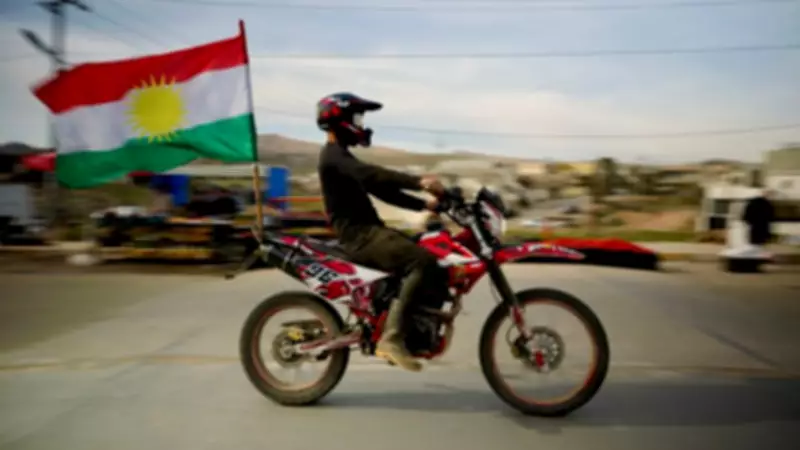
Kurdish Forces Mobilize Amid US-Israeli Air Strikes on Iran
In the wake of devastating air strikes by the United States and Israel, Kurdish fighters in Iran are reportedly preparing for a potential cross-border operation that could spark a broader uprising. The attacks, which began on Saturday, have severely impacted Iranian security forces, particularly in Kurdish regions bordering Iraq. According to sources within Iran, even minor outposts of Iranian security have been completely destroyed, raising questions about the feasibility of a coordinated offensive by Iranian Kurdish groups.
Potential for Cross-Border Incursion and Uprising
Security analysts estimate that Iranian Kurdish groups collectively possess between 5,000 and 10,000 active fighters, excluding Iraqi-Kurdish forces who may not participate. These groups maintain extensive covert networks within Iran's Kurdish areas and even in Tehran, facilitating secret coordination. If Peshmerga fighters from northern Iraq cross into Iran, these networks could join them in securing Kurdish territories. Some observers believe this move might inspire non-Kurdish Iranians to rise up against the regime, with one Tehran resident stating, "If the Peshmerga secure the Kurdish region, thousands of non-Kurdish Iranians will join them to finally free Iran."
Iraqi Kurds in a Diplomatic Dilemma
The situation places Iraqi Kurds in a precarious position. While the US provides critical political and military support to Iraqi Kurdish peshmerga forces, including training and funding, the Kurdish authorities also maintain friendly diplomatic and trade relations with Iran. Kurdish officials, such as President Nechirvan Barzani, have asserted they will not allow their territory to be used for attacks on Iran. Tehran has warned that any incursion from Iraqi Kurdistan will be met with retaliation against the Kurdistan Regional Government (KRG).

Key Iranian Kurdish Groups
Several Iranian Kurdish groups could serve as boots on the ground in any operation:
- Kurdistan Democratic Party of Iran (KDPI): Established in 1945, this party advocates for Kurdish autonomy and democracy in Iran. After failed negotiations with Tehran post-1979, it launched an insurgency until 1988, when it was forced into Iraqi Kurdistan. The group has faced attacks from Iran's Islamic Revolutionary Guard Corps (IRGC), including missile strikes on its camps.
- Kurdistan Freedom Party (PAK): A radical group founded in the early 1990s, PAK is allied with Iraq's Kurdistan Democratic Party (KDP). Its fighters have a reputation as fierce warriors and received training from the US-led coalition against Islamic State.
- Komala Party: A leftist-nationalist party formed in 1979, Komala pioneered the recruitment of Kurdish women and has engaged in conflicts with the IRGC.
- Kurdistan Free Life Party (PJAK): Created in 2004 by Iranian Kurdish members of the PKK, PJAK operates in mountainous border areas and has clashed with IRGC forces. An official noted that taking cities like Marivan would require US air cover to ensure civilian safety.
Veteran Fighters and Logistical Challenges
Hundreds of Iranian-Kurdish veterans from the war against Islamic State in Iraq and Syria are reportedly ready to cross the border, having fought alongside US, British, and French special forces. Additionally, former Peshmerga fighters have returned from Europe, the UK, and North America to participate. Kurdish intelligence officials report that thousands of light arms have been smuggled into Iranian Kurdish areas in recent years. However, without US air support, any mission risks being suicidal due to Iran's remaining short-range ballistic missiles, which could target Kurdish regions.
As tensions escalate, the Kurdish groups emphasize they are not proxies of any country but are fighting for equal rights in Iran. The outcome hinges on whether the US will provide the necessary air cover to enable a successful cross-border operation and potential uprising.