

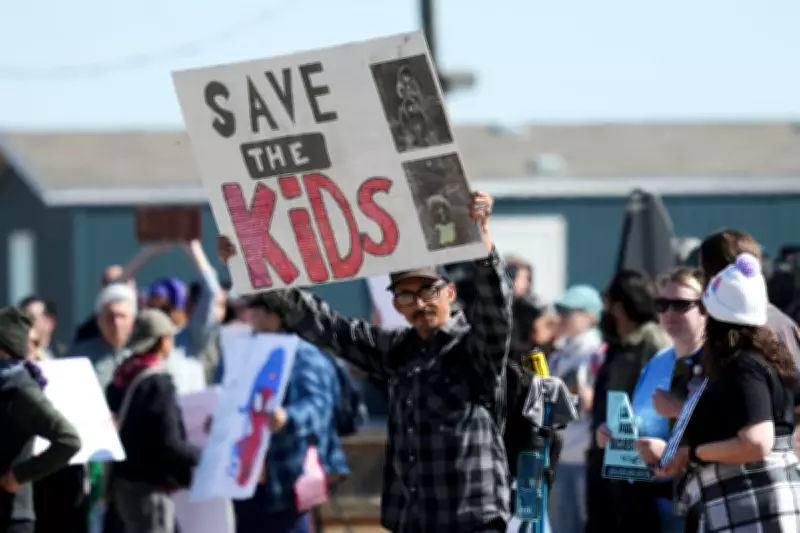
Protesters gathered outside a detention facility in Dilley, Texas, on 28 January, where Liam Ramos and his father are being held, highlighting growing tensions over immigration policies and health risks.
Measles Cases Confirmed at Texas Detention Centre
At least two cases of measles have been confirmed at a major immigration detention centre in Dilley, Texas, which houses children and their parents. This development comes as measles outbreaks continue to spread alarmingly across multiple US states, including South Carolina, Arizona, and Utah, with experts warning of a dangerous escalation.
In January alone, the United States recorded 25% of the total measles cases confirmed throughout the entire previous year, and the outbreak shows no signs of abating. Federal officials have remained notably silent on vaccination efforts, exacerbating concerns among health professionals.

Vaccination Gaps and Political Silence
The vast majority of measles patients are unvaccinated, yet no national campaigns have been announced to address this crisis. Key leaders, such as Robert F Kennedy Jr, the Secretary of the US Department of Health and Human Services, have not issued recent public statements on the matter. Last year, Kennedy controversially framed measles vaccines as a personal choice and promoted unproven treatments for the highly contagious illness.
Health experts have expressed grave concerns about the situation. Jason Bowling, a professor of infectious diseases at UT Health San Antonio, described the measles outbreak as "frightening" and "very worrisome." Similarly, Anna-Kathryn Burch, division director of pediatric infectious diseases at Prisma Health Children’s Hospital in South Carolina, warned that the spread could occur anywhere vaccination rates drop too low, stating, "It’s not a matter of if, but more likely when."
Detention Centre Conditions and Protests
The Dilley family detention centre, one of only two immigration facilities in the US dedicated to children, reported the two measles cases on Friday. Chris Van Deusen, director of media relations at the Texas Department of State Health Services, confirmed awareness of the cases and noted that assistance is being provided by supplying measles vaccine doses as requested by US Immigration and Customs Enforcement.
This facility has been at the centre of recent protests, with demonstrators gathering on 24 January and children heard yelling, "Let us go!" Currently, children and parents are locked down within the centre due to the outbreak. Among those affected, Elizabeth Zuna Caisaguano and her mother were released on Tuesday night after reporting flu-like symptoms and hives, though neither have been tested for measles.
Calls for Immediate Closure
Joaquin Castro, a Democratic congressman from San Antonio, has called for the detention centre to be "shut down immediately." In a post on social media, Castro argued that Dilley is ill-equipped to handle the spread of measles and emphasised that children and families, who have committed no crime, should not endure such suffering in prison-like conditions.
Eric Reinhart, a political anthropologist and psychiatrist who researched the spread of Covid-19 in jails and prisons, described detention centres as "epidemic engines" that can become "factories for manufacturing virus at incredible scale and pace." He warned that such environments inevitably allow viruses to escape into the wider community, posing a significant public health threat.
Nationwide Outbreak and Public Health Impact
The measles outbreak is rapidly escalating across the United States. South Carolina has reported a total of 876 measles cases and at least 18 hospitalisations, already surpassing last year's official tally for the west Texas outbreak. Other states, including Arizona with 239 cases and 14 hospitalisations, and Utah with 251 cases and 23 hospitalisations, are also experiencing continued spread.

According to data from the US Centers for Disease Control and Prevention, there have been 588 confirmed measles cases in the US this year, with all but three resulting from local transmission. When measles spreads in communities, it can easily enter detention centres, where conditions—such as close quarters, poor water, food, and medical care—allow it to multiply exponentially. Individuals from countries with unstable healthcare systems may also have lower vaccination rates, increasing vulnerability.
Risks and Mitigation Efforts
One in five measles patients typically requires hospitalisation, underscoring the severity of the outbreak. Reinhart highlighted that detention centres provide "an ideal environment for the spread of measles," and while officials claim to be "ceasing all movement within the facility," complete isolation is impossible unless staff are also confined. He advocated for decarceration and an end to immigration raids as essential measures to protect public health.
In the absence of federal vaccination campaigns, state and local officials and healthcare providers are bearing the brunt of vaccination efforts. Burch expressed frustration, noting, "It breaks my heart that we are seeing this in my state, when we have a vaccine that is very effective and safe." She emphasised that the MMR vaccine is the most effective way to curb the outbreak, despite increasing vaccine hesitancy among the public.
Bowling agreed, stressing the importance of vaccination rates, particularly for vulnerable groups like infants under six months and pregnant individuals, who cannot receive the vaccine and are at high risk in confined settings like Dilley. Health systems in affected areas are implementing adaptive measures, such as incident command systems, mask mandates, and telehealth services, drawing on lessons learned during the Covid-19 pandemic.
As the crisis unfolds, the lack of response from ICE and federal agencies continues to draw criticism, with calls growing louder for urgent action to address both the immigration detention system and the public health emergency it exacerbates.





