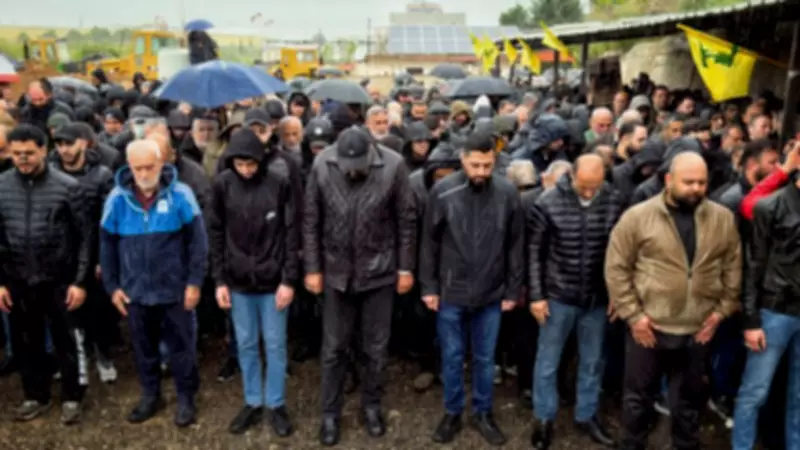
Mourners Brave Downpour for Funeral of Journalists Killed in Israeli Strikes
Hundreds of mourners gathered in pouring rain in Beirut on Sunday, March 29, 2026, to pay their respects at the funerals of three Lebanese journalists killed by Israeli military strikes in southern Lebanon. The somber event saw attendees holding posters of the deceased, with many women openly sobbing as they mourned the loss of the media professionals.
Accusations of War Crimes and Unsubstantiated Claims
Elsy Moufarrej of the Union of Journalists in Lebanon has described the killings as a war crime, drawing parallels to tactics used in Gaza. "We've seen this in Gaza where they tried to undermine Palestinian journalists by linking them to Hamas," Moufarrej stated. "Now they're trying to do the same to Lebanese journalists by linking them to Hezbollah. Let's be in no doubt. This is a war crime."
The journalists—Ali Shoaib, who worked for the Hezbollah-owned TV channel Al-Manar; Fatima Fatouni, employed by Al Mayadeen; and her brother Muhammad Fatouni, a freelance cameraman—were covering the ongoing invasion of Israeli troops in south Lebanon. They were traveling together in a vehicle near Jezzine on the highway between Nabatieh and Sidon when an Israeli bomb struck them. Witnesses reported that as colleagues rushed to help, a second strike hit, and the Lebanese health ministry confirmed that an ambulance filled with first responders was also targeted.

Israeli Justification and International Condemnation
An Israeli military spokesman admitted targeting the journalists but attempted to justify the killings by claiming Ali Shoaib was a member of Hezbollah's elite Radwan force, alleging he was passing information on Israeli troop movements. No evidence was provided to support this claim. Sara Qudah, Regional Director of the Committee for the Protection of Journalists, responded, "We have seen a disturbing pattern in this war and in the decades prior of Israel accusing journalists of being active combatants and terrorists without providing credible evidence. Journalists are not legitimate targets, regardless of the outlet they work for."
Escalating Attacks on Health Facilities and Humanitarian Crisis
The journalist killings occurred amid intensified Israeli attacks on Lebanon, many directed at health facilities and workers. A health care center in Deir Kifa was struck early on Sunday, rendering it inoperable, followed by an attack on an ambulance that killed a paramedic and a patient. Over fifty medics have been killed in less than a month. The Israeli military insists Hezbollah is using ambulances for military purposes, but the Lebanese health ministry denies this, compiling a list of attacks to present to the UN. Health Minister Dr. Rakan Nassereddine told Sky News, "These are war crimes."
Lebanon is facing a severe humanitarian crisis, with over a million displaced and daily casualties exceeding fifty in the last 24 hours, though the ministry does not differentiate between civilians and combatants. Hezbollah continues to fire rockets into northern Israel, with hand-to-hand fighting reported in border villages. Israeli troops have been sighted several kilometers inside Lebanese territory, and ministers have outlined plans to seize a security buffer zone up to the Litani River, occupying about 10% of Lebanese land.