

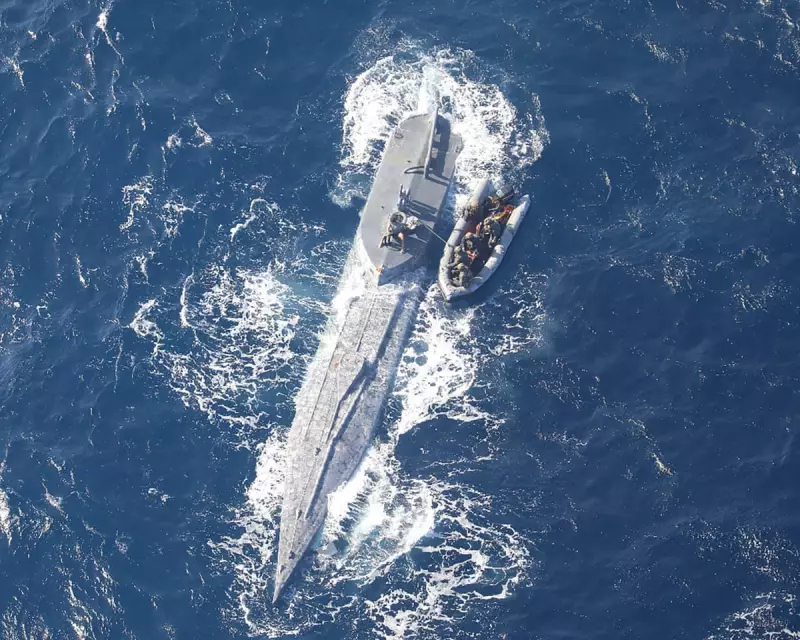
Portuguese law enforcement agencies have achieved a historic breakthrough in combating international drug trafficking, confiscating an unprecedented haul of nearly nine tonnes of cocaine from a semi-submersible vessel intercepted in the Atlantic Ocean. This operation represents the largest single seizure of cocaine ever recorded in Portugal, marking a significant victory against organised crime networks targeting European markets.
Record-Breaking Atlantic Interception
The Portuguese Judicial Police, working in close collaboration with the nation's navy and air force, successfully intercepted what authorities describe as a "narco-sub" approximately 230 nautical miles from the Azores archipelago. This sophisticated joint operation was coordinated with international partners including the United States Drug Enforcement Administration and the United Kingdom's National Crime Agency, demonstrating the global nature of the fight against narcotics smuggling.
During the challenging maritime operation, conducted under what police described as "extremely difficult and dangerous conditions due to adverse weather," the intercepted vessel eventually sank, taking 35 bales of cocaine to the ocean floor. Despite this partial loss, authorities managed to secure the majority of the illicit cargo, which consisted of 300 bales in total.

International Crew Arrested
Four individuals aboard the narco-submarine were apprehended during the operation, comprising three Colombian nationals and one Venezuelan citizen. The vessel had embarked from Latin America, following established trafficking routes that have increasingly targeted European destinations in recent years.
A police spokesperson confirmed to international media that this seizure represents "the biggest seizure of cocaine ever in Portugal," with Portuguese media reports estimating the street value of the confiscated drugs at approximately €600 million (£521 million). This staggering valuation underscores the enormous financial scale of the international cocaine trade.
Evolving Narco-Submarine Tactics
The interception highlights the sophisticated methods employed by drug trafficking organisations, who have increasingly turned to semi-submersible vessels to transport narcotics across vast ocean distances. While such vessels have been utilised in South and Central American waters since the 1980s, their appearance in European maritime zones represents a more recent development in transnational crime.
Portuguese authorities have demonstrated growing expertise in countering this threat, having intercepted another narco-submarine carrying 6.5 tonnes of cocaine in March of the previous year. The increasing frequency of such interceptions suggests both the expanding scale of the problem and improved detection capabilities among European law enforcement agencies.
Changing Criminal Economics
Recent intelligence from European narcotics investigators reveals shifting economic patterns within the cocaine trade that are influencing traffickers' operational methods. According to Spanish police officials interviewed last month, plummeting wholesale cocaine prices have prompted criminal organisations to reconsider their traditional approach of abandoning narco-subs after single journeys.
"Rather than sink them, what they do now is unload the merchandise and set up a refuelling platform at sea so that the semi-submersibles can head back to the countries they came from and make as many journeys as possible," explained Alberto Morales, head of the central narcotics brigade of the Spanish Policía Nacional. This adaptation represents a significant evolution in trafficking methodology, aimed at maximising profitability through vessel reuse.
Broader European Context
The Portuguese seizure occurs against a backdrop of intensified European efforts to combat cocaine smuggling through maritime routes. Spanish authorities recently announced the dismantling of a sophisticated trafficking network that utilised high-speed boats and offshore Atlantic bases to import over 57 tonnes of cocaine into Europe during the past year.

That year-long investigation resulted in 105 arrests and the confiscation of 10.4 tonnes of cocaine, alongside the seizure of 30 vessels. Investigators discovered that criminal organisations had established elaborate offshore logistical systems, including fuel storage facilities capable of holding over 100,000 litres, to support extended maritime operations.
The lengths to which trafficking networks will go to protect their operations were starkly illustrated by investigators' discovery that one organisation paid €12 million (£10.4 million) to the family of a deceased member to ensure their silence and prevent suspicion about criminal activities.
These developments underscore the increasingly sophisticated and well-resourced nature of international drug trafficking organisations targeting European markets, while simultaneously highlighting the determined multinational law enforcement response mobilising against them.





