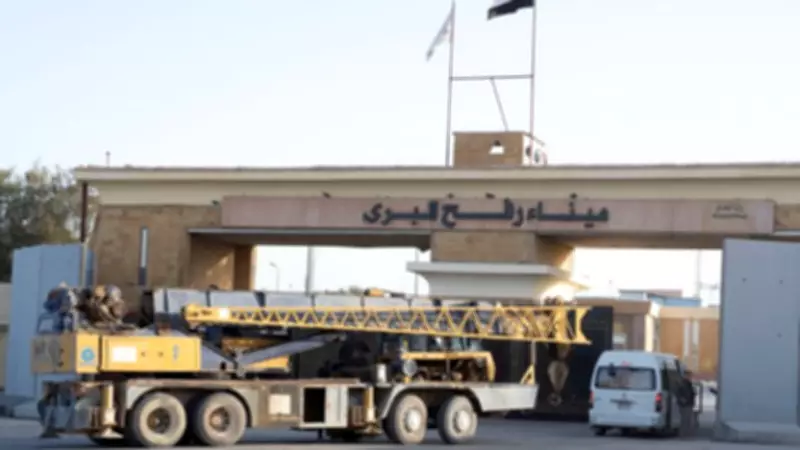
The Rafah border crossing between Gaza and Egypt has officially reopened after nearly two years of near-total closure, marking a significant but limited development in the region's fragile peace process. Officials have confirmed that the crucial crossing will initially permit around 50 people to travel in each direction daily, with movements subject to stringent rules and supervision by a European Union mission.
A Symbolic Yet Restricted Reopening
This resumption of travel forms a key component of the US-brokered Israel-Hamas ceasefire agreement, which aims to de-escalate tensions and facilitate humanitarian movements. On Sunday, Israel announced the opening as part of an operational test, with plans to allow resident movement in both directions starting Monday. However, the immediate impact remains constrained, as only a limited number of individuals—and no goods—will be permitted to cross initially.
Humanitarian Challenges and Delays
Palestinian authorities estimate that approximately 6,000 people require urgent medical treatment in Gaza, where the health system has been largely devastated by conflict. At the current rate of 50 medical evacuations per day, it would take about four months for all these patients to cross into Egypt for care. Medical sources warn that some individuals may succumb to their conditions before they can access treatment abroad.

Conversely, Israel reports that around 42,000 people left Gaza during the war and are now eligible to return. With only 50 allowed to re-enter daily, it would require more than two years for all of them to come back home. This slow pace highlights the logistical and security challenges involved, as Israel conducts thorough vetting of all applicants, a process that is not expedient.
EU Supervision and Security Measures
A European Union mission is overseeing exit and entry procedures at the crossing, ensuring compliance with agreed protocols. An Egyptian official disclosed to the Associated Press that Palestinian security officers and ambulances have already passed through the Egyptian gate into Gaza. However, Zaher al-Wahidi, head of the Gaza health ministry's documentation department, noted that they have not received formal notification regarding the commencement of medical evacuations.
Future Prospects and Ceasefire Context
The numbers permitted through Rafah are expected to gradually increase if the system proves successful and secure. This reopening follows a recent Israeli airstrike that killed at least 30 Palestinians in Gaza, including two women and six children, underscoring the ongoing volatility in the region.
Rafah has long been regarded by Gazans as their primary gateway to the outside world, but since 2024, Israel has imposed severe restrictions, citing concerns that Hamas used the crossing for weapon smuggling. The crossing was briefly reopened last year to evacuate medical patients, and earlier this month, Hollywood actor Angelina Jolie visited Rafah on a humanitarian mission.
The indefinite reopening comes after the remains of the final Israeli hostage were evacuated from Gaza, representing a pivotal step in the ceasefire agreement brokered by Donald Trump's US administration as it progresses into its second phase. While Gaza has four other border crossings, all are shared with Israel, making Rafah uniquely significant for direct access to Egypt and beyond.