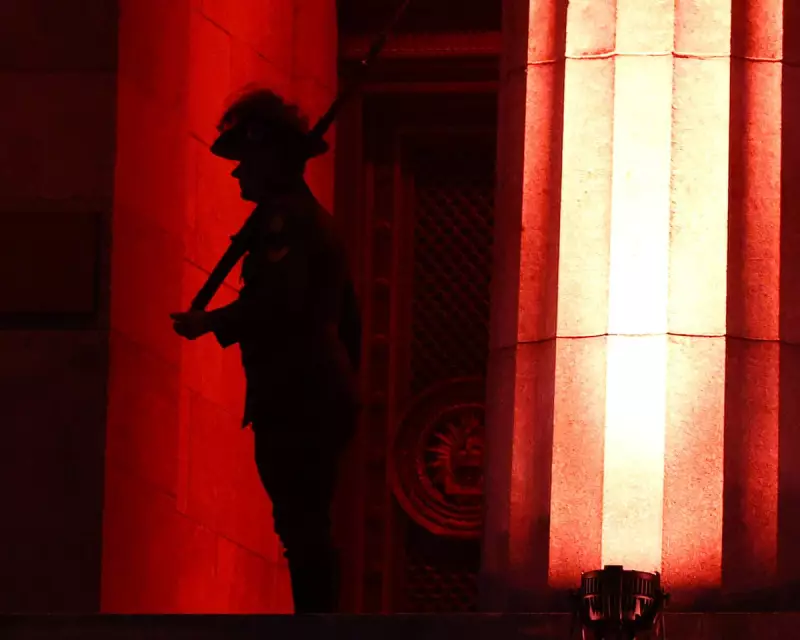
On this Remembrance Day, as political leaders across Australia and beyond prepare to deliver their annual solemn speeches honouring war dead, a troubling reality persists: the political-military establishment has failed to learn from the millions of lives lost in conflicts since the First World War ended on this day in 1918.
The Commemorative Disconnect
There exists a profound disconnect between how leaders mournfully recall the "fallen" of past wars and their passive responses to contemporary mass slaughter of civilians in conflicts across the Middle East, Africa and eastern Europe. This commemorative dissonance reveals much about selective remembrance and political priorities.
Australia's military history follows a consistent pattern of trailing powerful empires into distant conflicts. This tradition continues with the $368 billion Aukus submarine deal that binds Australia to what many consider the most unpredictable United States administration in history.

At precisely the moment when American democracy shows alarming signs of erosion under the Trump administration, Australia is committing to a blank-cheque military and diplomatic future that could easily entangle the nation in America's next major conflict. As always, military personnel and innocent civilians would pay the highest price.
The Human Cost Beyond Statistics
Approximately 103,000 Australians have died in various wars and peacekeeping operations, yet this number barely scratches the surface of the true human cost. The First World War remains Australia's most storied conflict, with staggering numbers that reveal the depth of sacrifice.
From a population of barely five million, 416,000 Australian men enlisted—half of those eligible. Of these, over 331,000 deployed overseas, with more than 60,000 killed and 155,000 physically wounded. Countless others returned with psychological and emotional damage that would haunt families for generations.
Veterans faced rampant drug and alcohol addiction, and families often endured terrible domestic violence. Despite this legacy, 107 years after the Great War's armistice, Australia continues to treat many veterans and serving personnel with what can only be described as shabby contempt.
The recent royal commission into defence and veteran suicide, along with the appalling treatment of its key witness, demonstrates how little has changed in how the nation supports those who serve.
Selective Remembrance and Omitted Truths
Remembrance constitutes a conscious act—political, cultural and personal—involving deliberate choices about who and what to commemorate, and equally importantly, what to omit.
Since former prime minister Billy Hughes, Australia has tightly bound its national identity to military adventurism, often at the exclusion of other crucial narratives. The contributions of women and migrants, along with groundbreaking democratic advancements like women's suffrage and workers' rights, frequently get overlooked.
Most significantly, Australia continues to deliberately forget the foundational racial discrimination and Indigenous dispossession that formed federation's bedrock, whose generational consequences still reverberate today.
The continental-wide frontier conflicts between British and Australian military forces and Aboriginal resistance fighters remain semi-officially excluded from national genesis acknowledgment. Political recognition of these frontier wars pitifully lags behind historical and cultural understanding of their importance to establishing the white federation on stolen lands.
The Australian War Memorial, where much of today's political remembrance will unfold, has been glacially slow to acknowledge the seminal importance of frontier conflict to national and military experience. The institution consistently makes retrograde choices about which Australian military operations to highlight.

A telling example emerged recently when the memorial's prestigious military history writing prize originally destined for journalist Chris Masters—for his book on alleged war crimes by Ben Roberts-Smith—was ultimately denied. Masters' work chronicles deeply unpalatable truths about Australian military personnel that starkly contradicts the memorial's cherished Anzac mythology.
War and politics, truth-telling and commemorative dissonance all demand serious private contemplation on this Remembrance Day. Such reflection requires far more than the traditional minute's silence—it demands honest reckoning with uncomfortable truths that continue to shape Australia's military engagements and national identity.