

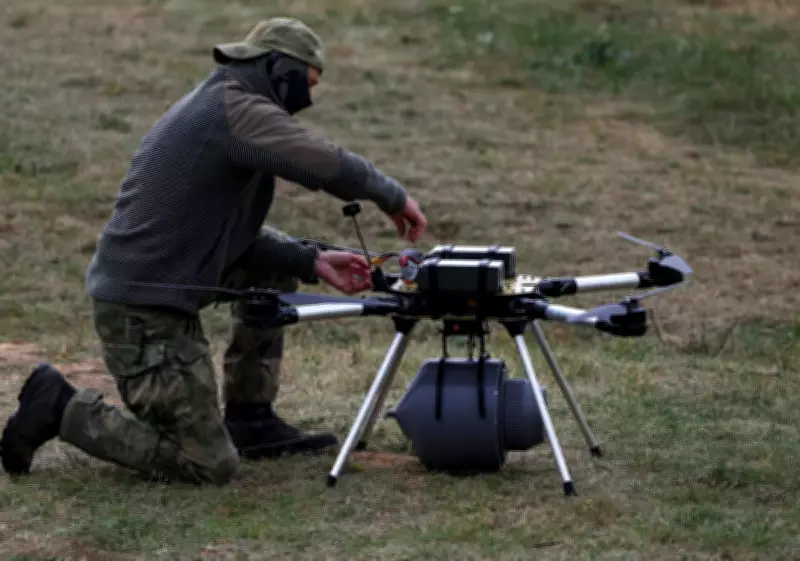
Russia's Strategic Move: Long-Range Drone Bases in Belarus
Ukrainian President Volodymyr Zelenskyy announced on Monday that Russia intends to establish four control stations for long-range attack drones within Belarusian territory. This development marks a significant escalation, drawing Belarus more directly into the ongoing conflict. Zelenskyy emphasized, "There will be responses to this. And they will be felt," underscoring Ukraine's determination to counteract this strategic maneuver.
Intelligence Reports and Historical Context
According to Ukrainian intelligence, Russia plans to utilize both Belarus and temporarily occupied Ukrainian territories to construct ground control stations for these drones. Zelenskyy recalled that earlier in the war, Belarusian assistance had temporarily intensified the damage from Russian attacks until Ukraine implemented countermeasures. The president has instructed Ukraine's security services to inform international partners about these plans, highlighting the growing threat.
Belarus's foreign ministry has not responded to requests for comment outside business hours, leaving the situation tense and unresolved.

Recent Attacks and Civilian Casualties
On Tuesday, Russian missile and drone strikes triggered air raid alerts across most of Ukraine, resulting in tragic civilian losses. In the Poltava region, two individuals lost their lives, and eleven others were wounded after residential buildings and a hotel sustained damage, causing fires. Vitali Dyakivnych, head of the Poltava regional military administration, confirmed the casualties on Telegram.
Similarly, in Zaporizhzhia, a "massive combined missile-drone strike" claimed one life and injured five people. The attack damaged six apartment buildings, two private houses, a shop, non-residential structures, and an industrial facility, as reported by Ivan Fedorov, the regional military administration head.
EU-Hungary Tensions Over Information Sharing
The European Union is facing internal strife following allegations that Hungarian Foreign Minister Péter Szijjártó shared sensitive EU negotiation details with Russia. Reports from the Washington Post suggest that Szijjártó regularly updated Russian counterpart Sergei Lavrov during EU meeting breaks, offering insights and suggesting potential actions.
European Commission spokesperson Anitta Hipper stated, "A relationship of trust between member states, and between them and the institution, is fundamental for the work of the EU. We expect the Hungarian government to provide the clarifications." This demand comes amid ongoing frustration in Brussels over Hungary's blockage of a €90 billion loan to Ukraine at a recent EU leaders' gathering.
Szijjártó has dismissed the allegations as "fake news" and "senseless conspiracy theories," while Hungary's Minister for European Affairs, János Bóka, defended the communications as normal diplomatic practice. Germany has labeled the claims "very serious," emphasizing that EU discussions are confidential and violations will not be tolerated.
Broader Implications and International Reactions
Zelenskyy also revealed on Monday that Ukraine possesses "irrefutable" evidence of Russia continuing to provide intelligence to Iran, a move that could prolong conflicts in the Middle East. He warned that such activities destabilize global security and negatively impact fuel markets worldwide. The Kremlin has previously denied similar reports as "fake news."
In diplomatic efforts, senior US officials visited Kyiv for discussions on the US-Ukraine Reconstruction Investment Fund, aiming to advance initial investment projects in critical minerals and strategic sectors. Meanwhile, UN undersecretary-general Rosemary DiCarlo reported that an estimated 15,364 civilians, including 775 children, have been killed since Russia's full-scale invasion in February 2022.
US undersecretary of state Christopher Landau reiterated calls for negotiations to end the war, emphasizing flexibility and compromise to protect civilian lives. Despite bilateral talks between US and Ukrainian delegations, the ongoing conflict in Iran has overshadowed these peace efforts.






