

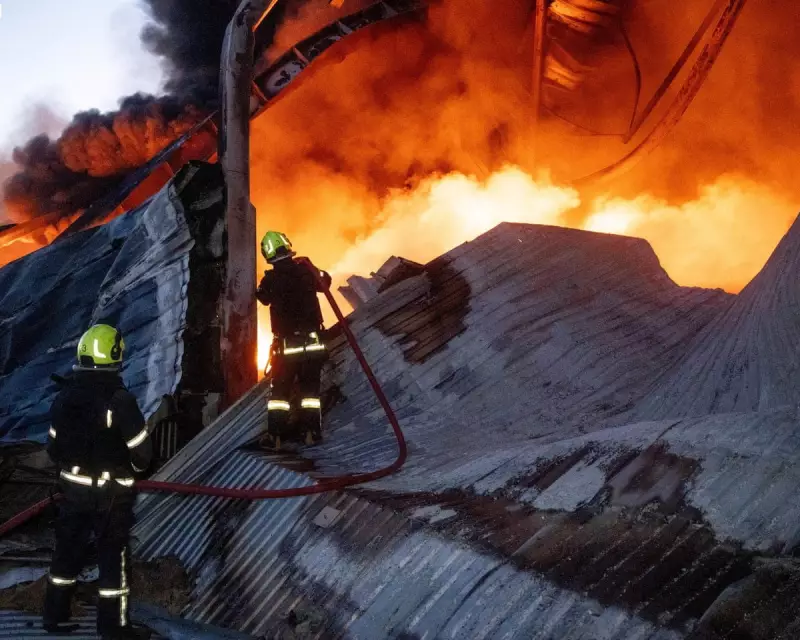
A Russian missile attack on infrastructure around a key Ukrainian Black Sea port has resulted in multiple casualties, officials confirmed, marking another escalation in the long-running conflict. The strike targeted the port of Pivdennyi in the Odesa region late on Friday, 16 December.
Details of the Deadly Attack
Ukrainian officials reported that seven people were killed and a further 15 injured in the assault. The attack focused on one of three ports in the area that are critically important for the export of Ukrainian grain and other goods to international markets. The Odesa region has been a frequent and focal target for Russian forces throughout the invasion, now in its 1,396th day, due to its strategic economic significance.
This latest aggression followed an earlier Ukrainian operation. On the same Friday, Ukraine stated it had used aerial drones to attack a Russian "shadow fleet" tanker off the coast of Libya. This was noted as the first such Ukrainian strike in the Mediterranean Sea since the full-scale invasion began.

Humanitarian and Diplomatic Fallout
In response to the disruption caused by the ongoing attacks, Ukraine's deputy prime minister, Oleksiy Kuleba, said discussions were underway with Moldovan authorities. The aim is to establish alternative routes for trucks and passengers needing to cross the border, away from the affected combat zone. Authorities in Moldova have already set up temporary camps at border crossings to provide shelter and food for travellers heading to Ukraine.
On the financial front, President Volodymyr Zelenskyy welcomed a significant €90 billion loan from the European Union, secured on Friday. He described it as "significant support that truly strengthens our resilience." The loan is structured to last for two years, with a unique condition: Kyiv would only be required to repay it if and when Russia pays war reparations. Zelenskyy stressed the importance of keeping Russian assets immobilised.
Intelligence Reports and High-Stakes Peace Talks
The battlefield violence contrasts sharply with diplomatic manoeuvres. According to six sources familiar with US intelligence, President Vladimir Putin intends to capture all of Ukraine and reclaim parts of Europe that belonged to the former Soviet empire. This assessment, the most recent of which dates from late September, presents a starkly different picture from claims by Donald Trump and his negotiators that Putin seeks to end the war.
As Putin vowed in an annual news conference to press ahead with his military offensive, saying "the ball is now fully and completely" in Kyiv's court, parallel peace talks convened in Miami. The US Secretary of State, Marco Rubio, promised not to force Ukraine into any agreement to end Russia's invasion, a stance echoed by European allies joining the fresh discussions.
"We can’t force Ukraine to make a deal. We can’t force Russia to make a deal. They have to want to make a deal," Rubio stated. The talks are being led by Trump envoy Steve Witkoff and the president’s son-in-law, Jared Kushner, and include top Ukrainian negotiator Rustem Umerov, alongside officials from Britain, France, and Germany. Umerov committed to acting "clearly in line with the priorities defined by the [Ukrainian] president: security must be guaranteed reliably and in the long term."
In a significant development, Putin's special envoy, Kirill Dmitriev, is also heading to Miami to meet with Witkoff and Kushner, a Russian source told Reuters. However, the same source ruled out any direct meeting between Dmitriev and the Ukrainian negotiators. Witkoff and Kushner have been working on an amended version of a peace plan, earlier drafts of which were criticised by the EU and Ukraine as being slanted toward Russia.






