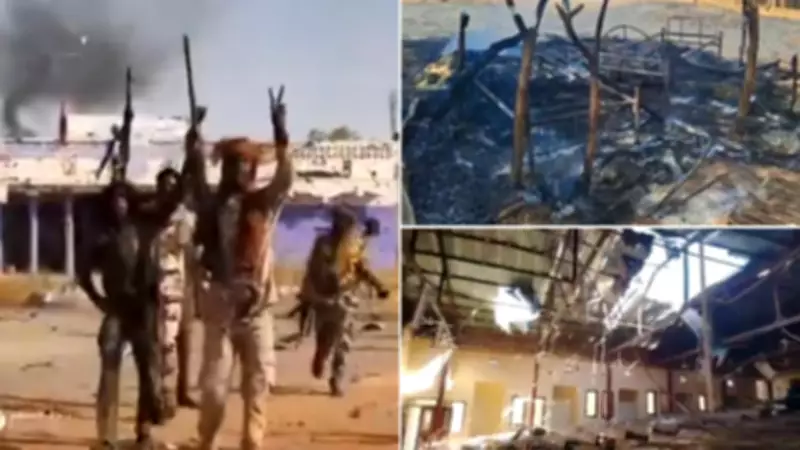
Sudan's Evolving War: Drones Create a Lethal Trap for Civilians
The nature of warfare in Sudan has undergone a profound transformation, with drone technology introducing a perilous new dimension that has turned the conflict into a death trap for civilians. As humanitarian efforts collapse under the threat of aerial strikes, the crisis deepens for over 46 million people caught in the crossfire between the Rapid Support Forces (RSF) and Sudanese Armed Forces (SAF).
Drone Warfare Escalates Humanitarian Catastrophe
In Sudan's southeastern Blue Nile state, humanitarian worker Zaki Ramadan describes a dire situation where aid operations have ground to a halt. "We stopped all humanitarian activity. We cannot work. All the offices are closing because of the drones," he reports, noting that staff from organizations like the World Food Programme have evacuated in anticipation of strikes. This shift marks a stark departure from past conflicts, where traditional clashes dominated, now replaced by relentless drone attacks that render safe aid delivery and emergency response virtually impossible in hard-hit areas.
According to the Armed Conflict Location & Event Data, an independent global monitor, at least 198 drone strikes were launched by both sides in the first two months of 2026 alone. These attacks have resulted in significant civilian casualties, with 52 strikes killing 478 people. Zaki recounts the terror: "For us, when we hear the sound - we just rush and hide ourselves. We run to the river, and sometimes we can go into our foxhole." The absence of basic necessities like food, medical care, and sanitation exacerbates the suffering, leaving populations with few options for sanctuary.

Civilian Casualties Mount Across Sudan
Sky News analysis of ACLED data reveals that deadly drone attacks are widespread across Sudan, with civilian casualties rising rapidly. In a recent incident, an RSF drone struck a secondary school and shelter in White Nile state, killing at least 17 people, mostly schoolgirls, and injuring 10 others. Over a two-day period in mid-February, more than 60 people were reported killed by drones from both sides, including 15 children in a single SAF strike on a shelter.
Earlier attacks have been equally devastating. In January, a drone strike on N'djamena market in South Kordofan's Dilling county killed 13 people, while a triple drone strike by the RSF on a kindergarten and hospital in the same state in December claimed 114 lives, including 43 children. These events underscore the indiscriminate nature of the warfare, with educational and medical facilities becoming targets, further crippling community resilience.
Borders Close as Refugees Face Deportation and Detention
The crisis extends beyond Sudan's borders, as neighboring countries grapple with the fallout. Chad has closed its border with Sudan following multiple cross-border attacks by the RSF, while other nations like South Sudan, Ethiopia, and Libya face their own civil conflicts, making them unsafe for refugees. Egypt, once a key haven, is now deporting Sudanese refugees en masse, with 578 citizens deported back to Sudan in December and January alone.
Affected families report that their asylum seeker status with the UN Refugee Agency is often ignored, leading to detentions and deportations. A Sudanese refugee detained in Egypt described horrific conditions: "They split us up into four groups, and we were around 110 to a single cell. There was violence from the police and then violence within the cell from embedded guards." Tragically, an 18-year-old named Al-Nazeer Al Sadiq died in detention, his health deteriorating rapidly after arrest, highlighting the brutal crackdown faced by those fleeing violence.
UK's Asylum Policies Impact Sudanese Students
In the UK, Home Secretary Shabana Mahmood's emergency ban on study visas for students from Sudan, among other countries, has blocked at least 210 Sudanese students from pursuing scholarships at top universities. This includes 22 accepted to the University of Oxford and 39 on UK government-funded Chevening scholarships. Mahmood defended the move, stating, "Britain will always provide refuge to people fleeing war and persecution, but our visa system must not be abused."

However, impacted students like Rawan, who was accepted into a master's program in international health at Oxford, argue that the policy is unjust. "It's heartbreaking to see how we're also villainising the students who sought asylum," she says, noting that asylum claims from Sudanese students represent only about 0.1% of total UK claims. She emphasizes that these individuals are fleeing one of the world's worst humanitarian crises, with over 14 million Sudanese displaced by the war.
A War with No Escape
As drones stalk the skies and borders shut, the conflict in Sudan has become a dead end for civilians and aid workers alike. Zaki expresses the confusion and helplessness felt by many: "They get confused about where they can go to feel peace - they go to South Sudan, there is a problem. They go to Ethiopia, there is a problem." With safe havens disappearing and violence escalating, the war's evolution into a drone-dominated battlefield signals a grim new chapter in global conflict, where civilians bear the brunt of technological warfare.