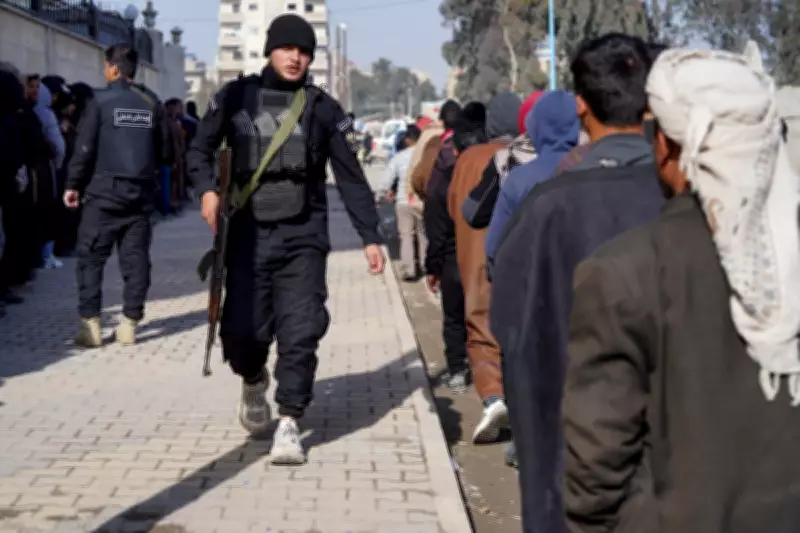
Historic Truce Forged Between Syrian Government and Kurdish Forces
In a significant diplomatic breakthrough, the Syrian government and Kurdish-led forces have finalised a comprehensive truce agreement, transforming a fragile ceasefire into a permanent settlement. This milestone accord, reached on Friday, effectively resolves escalating tensions over Kurdish autonomy in north-east Syria and establishes a clear pathway for the integration of Kurdish fighters into the state's military apparatus.
Framework for Integration and Territorial Control
The agreement lays out a detailed framework whereby the Kurdish-led Syrian Democratic Forces (SDF) will join Syria's national army through negotiated processes rather than armed conflict. This represents a pivotal moment for the Damascus government, which has long sought to reassert its authority over the entirety of Syrian territory after fourteen years of fragmentation among competing militias and external powers.
Previously, the SDF controlled approximately a quarter of the country, including all of its major oilfields, presenting a substantial challenge to the central government's rule. The recent military advances by Syrian government forces, bolstered by Arab and tribal allies, had already reduced SDF-controlled territory by around eighty percent prior to the agreement.

Key Provisions of the Landmark Deal
Under the terms of the truce, both parties have committed to withdrawing their combatants from frontlines across north-east Syria. Government security forces will gain entry to the key cities of Hasakah and Qamishli, which have served as strongholds for Kurdish authority throughout the conflict.
The agreement specifies that the SDF will be integrated into the Syrian army, with a new military brigade being established to incorporate three existing SDF brigades. Additionally, SDF fighters in Aleppo will be placed under direct government command. The civilian institutions that have operated under Kurdish authority will be absorbed into the Syrian state structure.
End of Kurdish Autonomous Project
This development effectively concludes the decade-long experiment in Kurdish autonomy in north-east Syria, where the Kurdish authority has functioned as a de-facto independent zone with its own governing bodies and armed forces. The agreement significantly reduces the scope of this autonomy, replacing it with unitary rule administered from Damascus.
In an effort to address Kurdish concerns, the deal includes specific provisions guaranteeing civil and educational rights for the Kurdish population, alongside commitments to facilitate the return of displaced persons to their original areas. The official agreement text emphasises the goal of "unifying the Syrian territories and achieving the full integration process in the region by enhancing cooperation between the concerned parties and unifying efforts to rebuild the country."
International Diplomacy and Reactions
The agreement has been praised by international mediators, particularly Tom Barrack, the United States special envoy to Syria, who described it as a "profound and historic milestone." Barrack had been intensively mediating between the two sides over the preceding fortnight to prevent the outbreak of full-scale warfare.
In a social media statement on Friday, Barrack noted: "This carefully negotiated step, building on earlier frameworks and recent efforts to de-escalate tensions, reflects a shared commitment to inclusion, mutual respect and the collective dignity of all Syrian communities."
Observers have noted that Friday's agreement represents more favourable terms for the Kurdish authority than previous ceasefire arrangements, with the outcome attributed to intensive diplomatic efforts from both the United States and France, nations that maintain constructive relations with all parties involved. The settlement effectively concludes the Kurdish autonomous project in north-east Syria while achieving this outcome with relatively minimal bloodshed compared to alternative scenarios.