Taliban's Escalating War on Women Exposes International Appeasement Failure
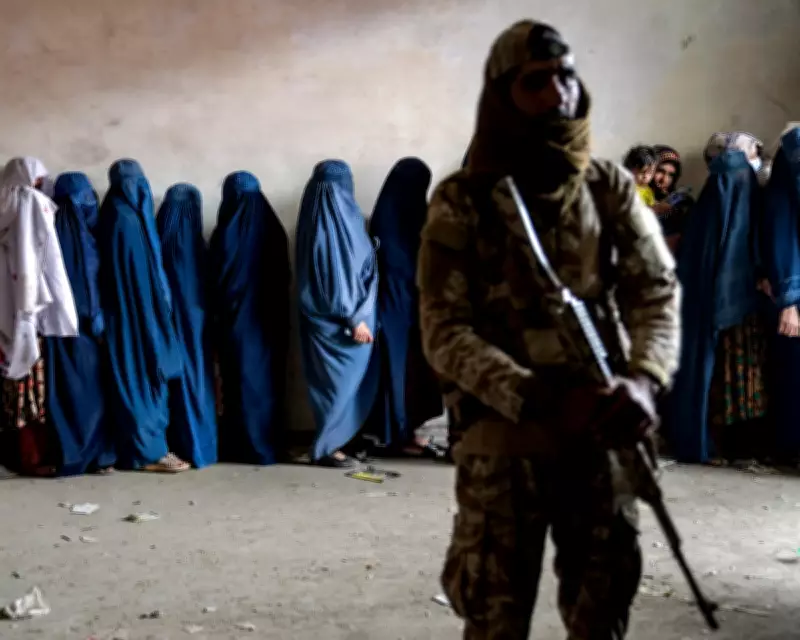
A Taliban fighter stands guard as women wait to receive food rations in Kabul, 23 May 2023. Photograph: Ebrahim Noroozi/AP. As the Taliban step up their systematic war against women and girls across Afghanistan, it has become painfully clear that international appeasement strategies have utterly failed to protect basic human rights.
Extreme Edicts and Systematic Repression
Afghanistan's Taliban government has now issued its most extreme edict yet, building upon what was already the world's only regime where girls are completely excluded from secondary education. The latest measures debar all Afghan women from any contact with schools or educational institutions, doubling down on what human rights organisations have rightly condemned as "gender apartheid."
This latest wave of repression, which United Nations legal authorities are likely to classify as crimes against humanity, marks the definitive victory of the extreme Kandahar clerical faction over more pragmatic Kabul-based government ministers. It represents the latest step in supreme leader Hibatullah Akhundzada's comprehensive plan to systematically erase girls and women from all aspects of public life in Afghanistan.

Failed International Engagement
This new ruling exposes the profound miscalculations and errors being made by foreign governments that, even as the regime has dramatically escalated its suppression of women, have recently sought to rebuild diplomatic relations with the Taliban regime. Four-and-a-half years into the Taliban's ascent to power, more children than ever are being denied education, with 2.2 million girls excluded from secondary education and up to 2.3 million primary school-age children no longer attending lessons.
In successive edicts since 2021, women have been banned from universities and most employment, including government positions and NGO work. They face requirements to cover their faces, must be accompanied by male relatives for any long-distance travel, and risk arrest if seen in public spaces such as parks, gyms, and beauty salons.
International Complicity and Consequences
The appeasement of the Taliban, led by Russia, China, and India and followed by some European governments, has emboldened Afghanistan's religious rulers to believe they can act with complete impunity. December witnessed the arrest of female journalist Nazira Rashidi in Kunduz, while another young woman, Khadija Ahmadzada, was imprisoned in Herat for running a women's sports gym, spending thirteen days in jail before UN intervention secured her release.
Richard Bennett, the United Nations special rapporteur on human rights in Afghanistan, warns that conditions for girls and women are deteriorating rapidly and that the Taliban's newly issued criminal procedure code foreshadows even more severe violations of fundamental rights.
Internal Power Struggles and Ideological Rigidity
The latest repression marks the definitive triumph of supreme ruler Akhundzada, with key government departments and functions, including weapons control, redirected from Kabul to Kandahar. While the Kabul faction acknowledges that the economy requires women's participation and access to technology, Akhundzada has become increasingly determined to impose a strict Islamic emirate, isolated from the modern world, where religious figures loyal to him control every aspect of society.
His ideology is so rigid that he approved of his own son's choice to become a suicide bomber. He suffered only momentary defeat when, within days of ordering a complete internet shutdown that would have severed Afghanistan's links with the world and prevented girls from accessing online education, he was defied by the Kabul-based telecommunications ministry, which restored service. However, by December, as a UN monitoring team noted, Akhundzada's consolidation of power had involved "a continued buildup of security forces under the direct control of Kandahar."

International Recognition Without Conditions
Russia became the first country to recognise the Taliban government and restore full diplomatic relations without securing any concessions on girls' and women's rights. China accepted the credentials of an ambassador from the Taliban regime in January 2024, while India upgraded its ties with the regime, formally reopening its embassy in Kabul and proclaiming that "the future of India-Afghanistan relations seems very bright."
European countries have increased engagement with the Taliban as part of efforts to deport failed Afghan asylum seekers, lending credibility to the regime despite its systematic persecution of girls and women. The 59th session of the UN human rights council debated this matter extensively, with special rapporteur Bennett persistently advocating making girls' rights a condition for engagement and devising mechanisms to hold the regime accountable, including referring the denial of education to the International Criminal Court.
Resistance and Future Prospects
Underground schooling persists in areas such as the Panjshir valley, where radio broadcasts cover everything from breastfeeding to basic science lessons for women and girls. Girls continue to study in "home schools" or leave for Pakistan or Iran to pursue education abroad, despite those countries' repatriation of 2.6 million Afghan refugees in 2025. Some young women have recently come to Scotland on scholarships to study medicine.
The failure to educate girls will eventually undermine the regime, as Afghanistan's population has swelled to more than 43 million and continues growing, with 17.4 million people predicted to be food-insecure by March and 4.9 million mothers and children suffering from malnutrition. Building an economy that can lift millions from poverty to prosperity will remain impossible so long as the Taliban deny half their population education and workforce participation. That is their fundamental failure. If the international community remains sanguine about this medieval repression, that failure will become ours as well.