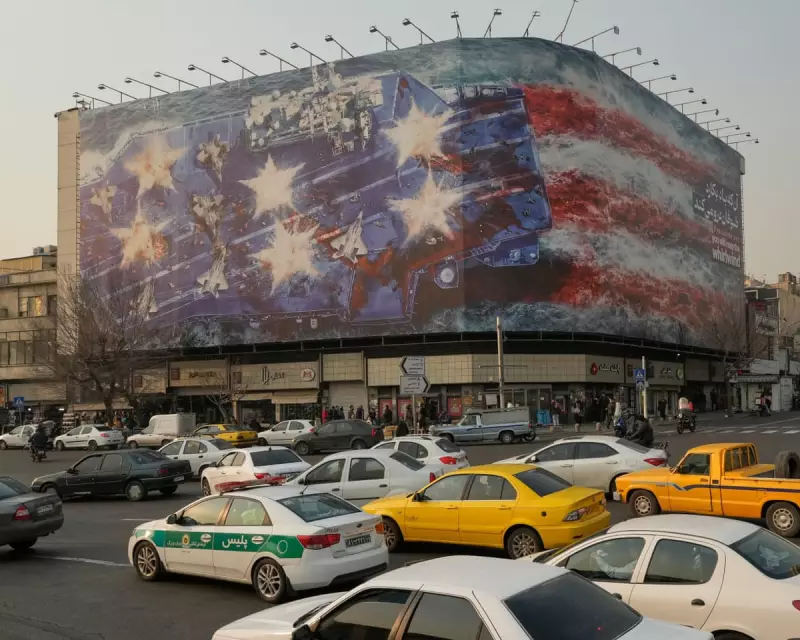
In a stark visual warning to the United States, Iranian authorities have unveiled a new and imposing mural on a giant billboard in central Tehran's Enghelab Square. The dramatic image serves as a direct caution against any potential US military strike on Iran, coinciding with the movement of American warships toward the region.
A Graphic Warning in the Heart of Tehran
The newly revealed mural presents a bird's-eye view of an aircraft carrier in a state of devastation. The flight deck is shown littered with damaged and exploding fighter planes, with bodies scattered across the scene. Streaks of blood trail into the water behind the vessel, forming a pattern that chillingly resembles the stripes of the American flag. Emblazoned across one corner of the image is a powerful slogan: "If you sow the wind, you will reap the whirlwind."
Timing Amid Military Movements
The unveiling of this provocative artwork comes at a moment of heightened military activity. The USS Abraham Lincoln aircraft carrier, accompanied by supporting warships, is currently en route to the Middle East. US President Donald Trump has stated that these vessels are being deployed "just in case" he decides to take action against Iran. "We have a massive fleet heading in that direction and maybe we won't have to use it," Trump remarked last Thursday.

Enghelab Square, the location of the new billboard, is a site traditionally used for state-organised gatherings. Iranian authorities routinely alter the square's prominent mural to reflect national occasions and current events. The installation of this latest image follows a warning issued on Saturday by the commander of Iran's paramilitary Revolutionary Guard, who declared that his force is "more ready than ever, finger on the trigger."
Escalating Tensions and Protests
Relations between the United States and Iran have deteriorated sharply following a severe crackdown on nationwide protests within Iran. These demonstrations, which began on 28 December, were initially sparked by the collapse of the Iranian rial and rapidly spread across the country. The subsequent government response resulted in thousands of fatalities and tens of thousands of arrests, according to activist reports.
President Trump had previously threatened military retaliation if Iran continued to kill peaceful protesters or carried out mass executions of detained individuals. While there have been no significant protests for several days, Trump recently claimed that Tehran had halted plans to execute approximately 800 arrested protesters—an assertion that Iran's top prosecutor has labelled "completely false."
Military Posturing and Regional Security
Despite these developments, Trump has indicated that all options remain on the table. He suggested last Thursday that any future US military action would make last June's strikes on Iranian nuclear sites "look like peanuts." In a parallel show of force, the US military announced on social media that its air force F-15E Strike Eagle fighter jets now have a presence in the Middle East, stating that this deployment "enhances combat readiness and promotes regional security and stability."
Similarly, the UK Ministry of Defence confirmed last Thursday that it has deployed its Typhoon fighter jets to Qatar "in a defensive capacity." These military movements underscore the volatile atmosphere in the region.
Information Blackout and Rising Toll
The death toll from the recent protests, as reported by activists, has continued to climb even after the demonstrations subsided. Information has been slow to emerge due to a comprehensive internet blackout imposed by Iranian authorities—a shutdown lasting more than two weeks that represents the most extensive in the nation's history. This communication blockade has severely hampered the flow of accurate information from within the country.
The new mural in Enghelab Square stands as a potent symbol of Iran's defiant stance amid these complex geopolitical tensions, serving as both a domestic message of resilience and an international warning of potential consequences.