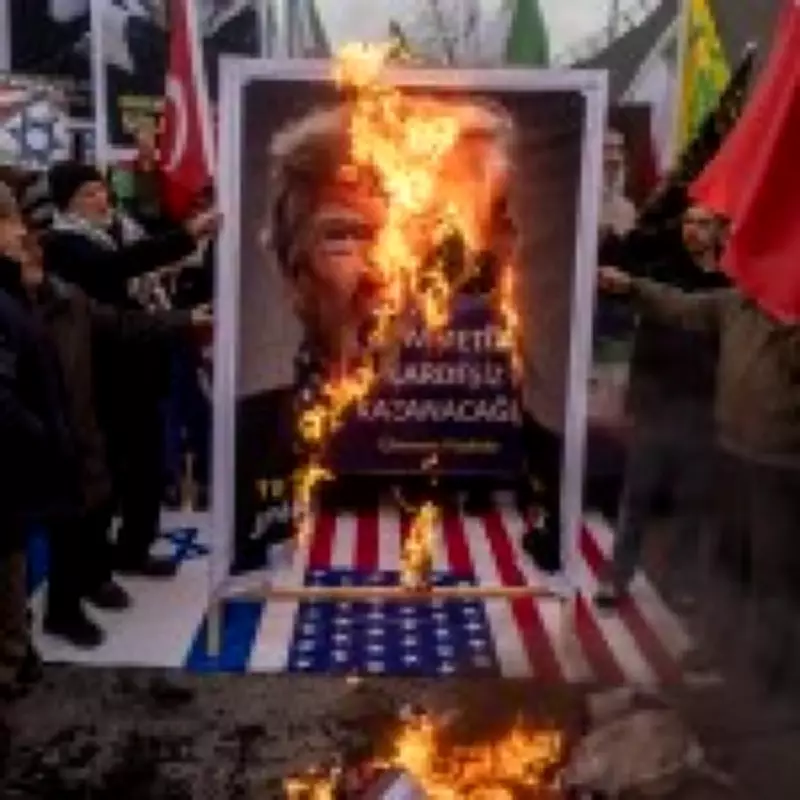
Trump Issues Defiant Response to Iran's Supreme Leader Over War Warning
Former US President Donald Trump has delivered a sharp rebuke to Iran's supreme leader, who cautioned that any American military action against Iranian soil would ignite a broader regional conflict. The 86-year-old Ayatollah Ali Khamenei issued what analysts describe as his most direct threat to the United States in recent years, referencing the deployment of the USS Abraham Lincoln aircraft carrier during Tehran's suppression of protests.
Khamenei's Stark Warning During Revolution Commemoration
Speaking to supporters at his compound in Tehran as Iran began commemorating the 1979 Islamic Revolution, Khamenei accused the United States of coveting Iran's substantial oil, natural gas, and mineral resources. 'The Americans must be aware that if they wage a war this time, it will be a regional war,' he declared, suggesting Washington seeks to 'seize this country, just as they controlled it before.'
When questioned about these remarks, Trump offered a characteristically blunt retort. 'Why wouldn't he say that? Of course, he's gonna say that,' Trump told reporters, before highlighting American military preparedness. 'We have the biggest, most powerful ships in the world over there, very close, a couple of days, and hopefully we'll make a deal. If we don't make a deal, then we'll find out whether or not he was right.'

Iran's Supreme Leader Denies Aggression While Condemning Protests
Khamenei maintained that Iran is not the instigator of conflict, stating, 'We are not going to be unfair to anyone, we don't plan to attack any country.' However, he warned that any nation showing 'greed' or attempting to attack Iran would face a 'heavy blow' from the Iranian people.
The supreme leader also significantly hardened his stance regarding the recent nationwide protests, which initially erupted over economic grievances but evolved into a direct challenge to his authority. He described the unrest as 'similar to a coup' that had been suppressed, accusing protesters of targeting critical state infrastructure including police stations, government buildings, Revolutionary Guard facilities, banks, and mosques.
Divergent Accounts of Protest Crackdown Casualties
Human rights organisations report dramatically higher casualty figures than Iranian authorities acknowledge. The US-based Human Rights Activists News Agency, utilising networks within Iran, documents over 49,500 detentions and at least 6,713 deaths, predominantly among demonstrators. In stark contrast, the Iranian government's official death toll as of late January stood at 3,117, with 2,427 categorised as civilians and security forces, while labelling the remainder as 'terrorists.' This disparity recalls historical patterns where Iran's theocracy has underreported fatalities during periods of civil unrest.
Trump's Red Lines and Nuclear Concerns
The former president has previously established clear conditions for potential US military intervention, specifically citing the killing of peaceful protesters or the mass execution of detainees. Trump has also increasingly focused on Iran's nuclear ambitions, a subject of previous negotiations that were disrupted by regional hostilities. This diplomatic tension unfolds against the backdrop of Iran's judicial processes, where international pressure appears to have influenced outcomes. Notably, shopkeeper Erfan Soltani, who faced the death penalty for involvement in anti-regime protests, was recently released on bail following Trump's threats of military strikes should executions proceed.
The escalating rhetoric between Washington and Tehran underscores the fragile state of US-Iran relations, with both sides positioning themselves amid domestic political pressures and longstanding geopolitical rivalries. As commemorations of Iran's revolution continue, the world watches whether heated words will translate into concrete actions that could destabilise an already volatile region.