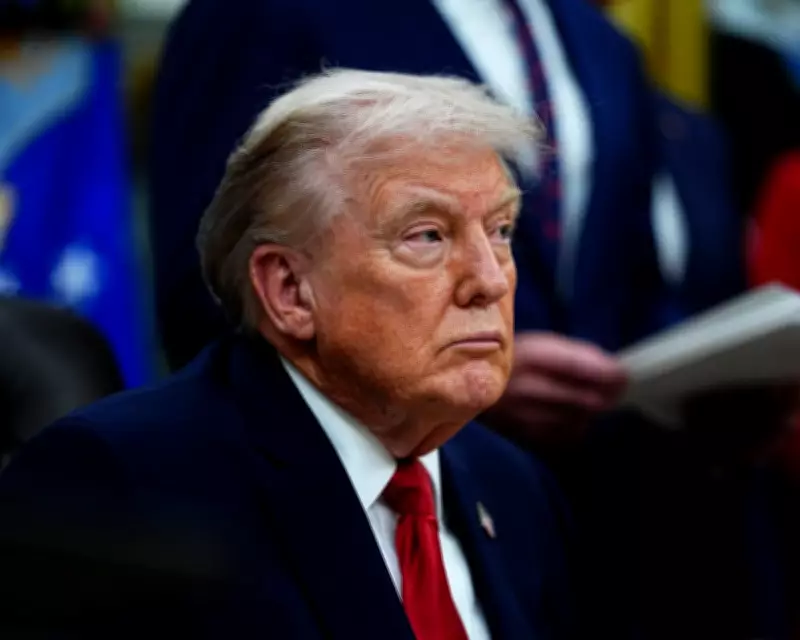
In a significant escalation of pressure on the Cuban government, former President Donald Trump has signed an executive order that establishes a framework for imposing tariffs on nations that supply oil to Cuba. The order, announced from the Oval Office on Thursday, declares a national emergency and empowers US secretaries to assess punitive measures against countries engaging in such trade with the island nation.
National Security Justification for New Tariff Policy
The White House has justified this aggressive move by citing what it describes as Cuba's dangerous associations with hostile foreign powers. According to an official statement, the Cuban government maintains alleged ties with Russia, Hamas, and Hezbollah, relationships that the administration claims pose an unusual and extraordinary threat to American national security and foreign policy interests.
"These actions constitute an unusual and extraordinary threat to US national security and foreign policy, requiring immediate response to protect American citizens and interests," the White House declared, emphasizing the need for swift action against what it perceives as Cuba's destabilizing alliances.

Targeting Cuba's Vulnerable Energy Supply
Cuba represents a particularly vulnerable target for such economic pressure, being an import-dependent Caribbean nation of approximately 8 million people with an economy roughly equivalent to that of Rhode Island. The Communist Party has maintained control for six decades, but the country faces severe energy challenges that make it susceptible to supply disruptions.
The island nation has already implemented gasoline rationing and periodic electricity blackouts as it struggles with dwindling oil reserves. According to recent reports, Cuba maintains only 15 to 20 days worth of oil inventory, creating a precarious situation that could be exacerbated by the new US policy.
International Reactions and Diplomatic Tensions
The Trump administration had been pressuring various countries to cease oil shipments to Cuba in the weeks leading up to Thursday's announcement, creating diplomatic friction with several nations. Most notably, tensions have emerged with Mexico, where President Claudia Sheinbaum has defended her country's right to maintain energy relationships with Havana.
"The humanitarian aid will continue, as it does to other countries," Sheinbaum stated during a recent press conference. "Mexico has always shown solidarity with the entire world. They are sovereign decisions."
Despite this defiant stance, Sheinbaum acknowledged that Mexican oil shipments to Cuba have temporarily paused, creating uncertainty about future energy flows. Mexico has served as a crucial supplier, providing approximately 20,000 barrels daily throughout much of last year, representing a significant portion of Cuba's energy imports.
Venezuela's Diminished Role and Economic Consequences
Cuba's energy crisis has been compounded by the loss of its principal oil supplier, Venezuela. Following the arrest of Venezuelan leader Nicolás Maduro and his wife by US forces, Cuba lost access to the approximately 70,000 daily barrels that Venezuela previously provided. Interestingly, reports suggest Cuba frequently resold substantial portions of this Venezuelan oil rather than using it domestically.
The economic pressure on Cuba has produced visible consequences beyond energy shortages. Tourist visits have plummeted dramatically amid the economic turmoil and Trump's openly stated goal of toppling the communist government. The former president expressed confidence in this strategy, telling reporters earlier this week: "Cuba will be failing pretty soon. They got their money from Venezuela. They got the oil from Venezuela. They're not getting that anymore."
Political Context and Administration Figures
The executive order represents the latest chapter in the long-standing tension between the United States and Cuba, with Secretary of State Marco Rubio playing a prominent role in shaping policy. As the son of Cuban emigrants who left the island before Fidel Castro's 1959 revolution, Rubio has been a fierce opponent of the regime established by Castro and his successors.

While the White House has yet to specify exact tariff rates for countries violating the new policy, the establishment of this framework signals a more aggressive approach to isolating Cuba economically. The order creates a formal process through which the secretaries of state and commerce can evaluate and implement tariffs against nations that sell or otherwise provide petroleum products to Cuba.
This development marks another front in the Trump administration's broader foreign policy approach, which has frequently employed economic measures as tools of diplomatic pressure. The focus on Cuba's energy supply represents a strategic targeting of one of the island nation's most critical vulnerabilities, with potential implications for regional stability and international trade relationships.