

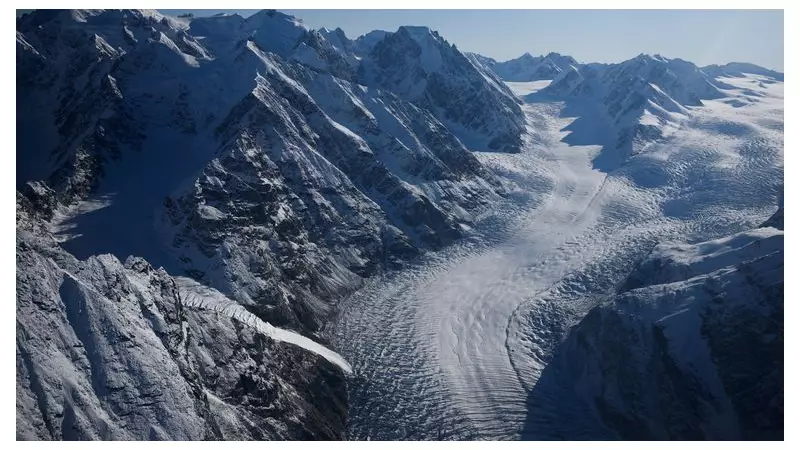
President Donald Trump's reported interest in acquiring Greenland is not a historical anomaly but a reflection of enduring strategic calculations. The world's largest island has long held a significant place in American defence planning, a fact underscored by its occupation during the Second World War and the subsequent establishment of a critical US military base.
The Triad of US Strategic Interests in Greenland
The United States' focus on Greenland is driven by three core, interconnected pillars of national security. Understanding these reveals why the remote Arctic territory remains a geopolitical prize.
First is ballistic missile early warning. While maps can be deceptive, the shortest flight path for intercontinental ballistic missiles between Russia and the continental US traverses the Arctic, directly over Greenland. This geographical reality makes the island indispensable for tracking and potentially intercepting inbound threats. This principle also explains why commercial aircraft on transatlantic routes often fly a 'great circle' path that brings them nearer to the pole.

Second are the emerging Arctic trade routes. Climate change is rapidly thawing historically impassable sea lanes. The Northern Sea Route along Russia's coast and the fabled Northwest Passage could slash the shipping distance from Europe to Asia by thousands of miles. The US views ensuring freedom of navigation in these new waterways as a paramount security concern, with Greenland offering a commanding position.
Third is Greenland's vast, untapped resource wealth. The island is estimated to hold substantial deposits, including uranium and an estimated 50 billion barrels of oil and gas, alongside rare earth minerals. While the harsh climate has hampered extraction, technological advances and melting ice are making these resources increasingly accessible.
Potential Paths to Control: From Diplomacy to Force
Given these high stakes, what avenues might a determined US administration pursue? Historically, the primary approach has been negotiation. The US already operates the Pituffik Space Base (formerly Thule Air Base), built in 1953 under a 1951 defence treaty with Denmark. Denmark has indicated openness to discussing an expanded US military presence. However, analysts suggest Washington may doubt Copenhagen's long-term capacity to counter growing Russian and Chinese influence in the Arctic region.
Purchase is another well-trodden path. In 1946, the US famously offered $100 million (equivalent to roughly $1.3 billion today) to buy Greenland, only to be firmly rebuffed with the statement that the island was not for sale. This precedent casts doubt on the viability of a simple commercial transaction.
This leads to the third, most drastic option: military action. From a purely tactical standpoint, a US seizure of Greenland presents a low-risk military operation. The US already has forces on the ground, and Greenland possesses no independent military. Denmark, responsible for the island's defence, would be incapable of resisting American aggression.
The Catastrophic Consequences of a NATO-on-NATO Attack
While militarily straightforward, the strategic fallout of an attack on a fellow NATO ally would be seismic and transformative. Such an act would almost certainly shatter the alliance in its current form, destroying the foundational trust upon which it is built.
This self-inflicted crisis would plunge European security into chaos at a time when the threat from Russia is acutely felt. The move would isolate the US, call its alliances into question globally, and create a power vacuum in the Arctic that adversaries would be swift to exploit. Therefore, while the military option might appear the simplest means to secure Greenland's strategic assets, its political and global security cost would be incalculably high, marking a definitive end to the post-war Atlantic order.






