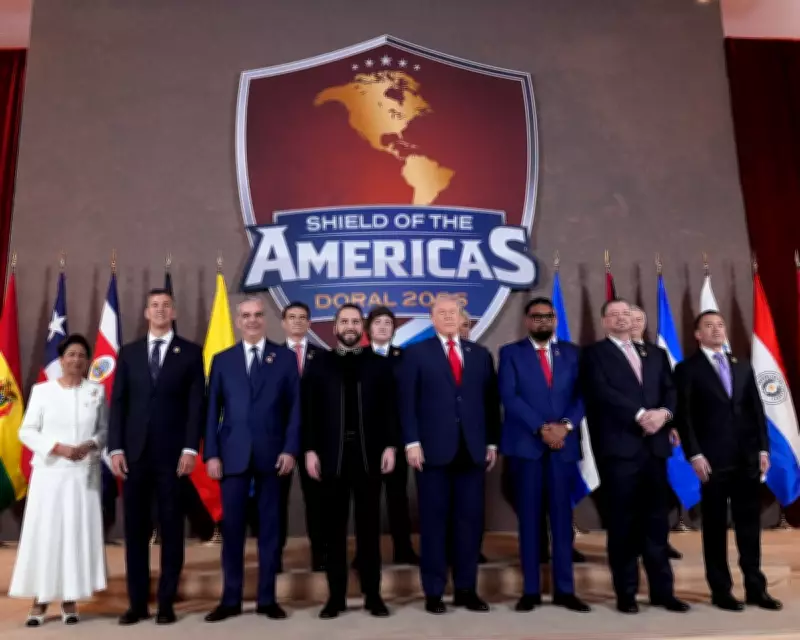
Trump Convenes 'Shield of Americas' Summit with 12 Latin American Leaders in Miami
On March 7, 2026, former U.S. President Donald Trump hosted a significant gathering at his golf club in Doral, Florida, bringing together 12 leaders from Latin American nations for the 'Shield of the Americas' summit. The event focused on fostering regional cooperation to combat cartel violence and counter Chinese economic and political interests in the western hemisphere.
Summit Attendees and Key Discussions
The summit featured a notable lineup of leaders, including Kamla Persad-Bissessar of Trinidad and Tobago, Santiago Peña of Paraguay, Luis Abinader of the Dominican Republic, Nayib Bukele of El Salvador, Mohamed Irfaan Ali of Guyana, Rodrigo Chaves Robles of Costa Rica, and Daniel Noboa of Ecuador in the front row. In the back row were Rodrigo Paz Pereira of Bolivia, Javier Milei of Argentina, José Raúl Mulino of Honduras, and Jose Antonio Kast of Chile. Trump emphasized the need for a unified approach, stating, 'Just as we formed a coalition to eradicate Isis, we now need a coalition to eradicate the cartels.' He highlighted Mexico as the epicenter of cartel violence, asserting that these groups are destabilizing the region.
Regional Security and Counter-Cartel Efforts
Trump's call for a 'counter-cartel coalition' comes amid heightened security concerns, following recent U.S. involvement in operations such as the raid in Jalisco, Mexico, which led to the death of Nemesio Oseguera Cervantes, leader of the Jalisco New Generation cartel. While complimenting Mexican President Claudia Sheinbaum, Trump criticized the cartels' growing influence, saying, 'The cartels are running Mexico. We can't have that. Too close to us, too close to you.' The summit also addressed Venezuela, with Trump praising interim President Delcy Rodríguez for collaboration, following the U.S. recognition of the Venezuelan government.

Countering Chinese Influence and the 'Donroe Doctrine'
A central theme of the summit was countering Chinese expansion in the Americas. Trump outlined what he termed the 'Donroe doctrine,' aimed at preventing hostile foreign influence, particularly in strategic areas like the Panama Canal. He stated, 'We will not allow hostile foreign influence to gain a foothold in this hemisphere.' U.S. Secretary of State Marco Rubio reinforced this by thanking the regional leaders for their alliance, subtly criticizing other allies for lack of support in recent conflicts.
Broader Implications and Future Outlook
The summit underscored a shift in U.S. foreign policy priorities under Trump, focusing more on hemispheric security and economic interests. U.S. Defense Secretary Pete Hegseth noted that the U.S. had been overly focused on distant borders, neglecting its own region. Discussions also touched on Cuba, with Trump predicting its collapse due to economic struggles, while expressing openness to negotiations. The event highlighted ongoing efforts to strengthen ties with Latin American nations amid global geopolitical tensions.