

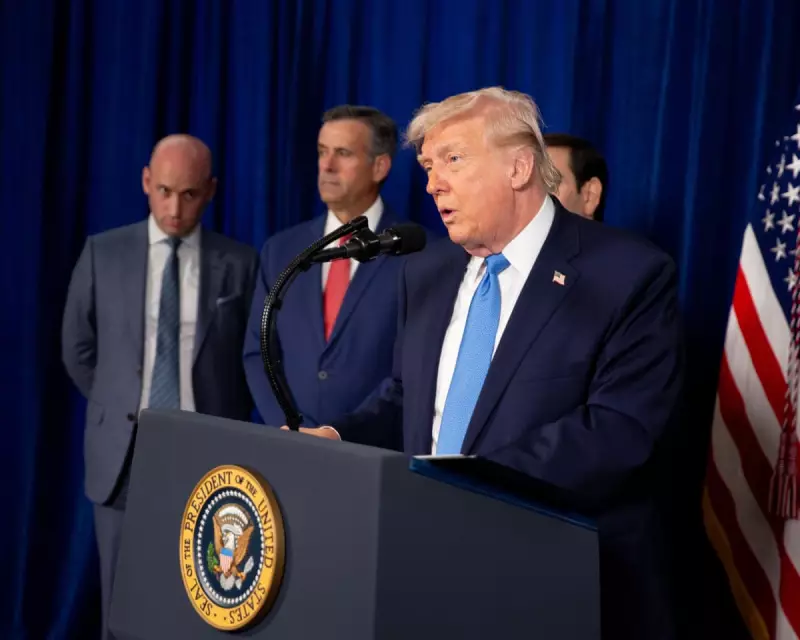
The foreign policy landscape of the United States has taken a dramatic and dangerous turn. President Donald Trump has ordered military strikes against Venezuela, aiming to seize and oust its leader, Nicolás Maduro. This bold action, which has thrown a nation of approximately 28 million people into turmoil, signals a stark departure from decades of hard-learned lessons and risks triggering a new era of American interventionism.
From Ukraine Inspiration to Venezuelan Intervention
The roots of this aggressive posture can be traced to a revealing moment on February 22, 2022. As Vladimir Putin moved troops into eastern Ukraine, Trump reportedly admired the tactic, musing that the US could "use that on our southern border." That initial spark of inspiration appears to have ignited into a full-blown doctrine. In a speech announcing the Venezuelan operation, Trump boasted of "overwhelming military power," echoing past operational triumphs like the "shock and awe" campaign in Baghdad that later descended into strategic quagmires.
Trump's approach suggests a belief that the hardest part—decapitating the regime—is over. He declared an intention to "run the country," promising peace, prosperity, and freedom, alongside a willingness to put "boots on the ground" to secure Venezuela's vast oil reserves. His initial plan to install Maduro's vice president, Delcy Rodríguez, collapsed within hours when she denounced the US as an illegal, imperialist invader.

The 'Trump Corollary' and a Hemisphere on Edge
The ramifications of the Caracas strike extend far beyond Venezuela's borders. Trump explicitly framed the attack as a reassertion of US dominance, stating, "American dominance in the Western Hemisphere will never be questioned again." This aligns with a newly declared "Trump Corollary" to the 1823 Monroe Doctrine, outlined in last month's National Security Strategy. It claims a mandate to remove almost any external influence from the Americas by any means necessary.
This marks a significant evolution in US military focus. The exhausted global war on terror is being transmuted into a war on 'narco-terror' and border-crossing threats within the Western Hemisphere. Trump's definition of these threats is expansively porous, encompassing migrants, gangs, cartels, and even what he terms "the enemy from within." This was underscored when he paused his Venezuela address to discuss deploying troops in American cities.
A Menu for Future Conflict
The question now haunting international observers is: where next? Trump has already provided a worrying list of potential targets. He once promised to annex Greenland and retake the Panama Canal. Following the ousting of Maduro, the same rationale could be applied elsewhere. Trump recently claimed "the cartels are running Mexico," a statement that could easily be used to justify intervention. Secretary of State Marco Rubio has also issued warnings to Cuba's government.
Even in a best-case scenario for Venezuela—the improbable emergence of a stable, pro-American democracy—success could embolden the administration to test how far it can go in remaking the region. However, as history repeatedly shows, best cases are rare in regime-change warfare.
Donald Trump's luck with hit-and-run military strikes may be about to run out. The initial, violent step is often the easiest. The enduring challenge lies in the fraught and bloody aftermath that the US has struggled with from Afghanistan to Libya. As Trump himself once said, "Great nations do not fight endless wars." His actions in Venezuela now pose a critical question: what kind of nation is Trump's America becoming, and at what cost to global stability?






