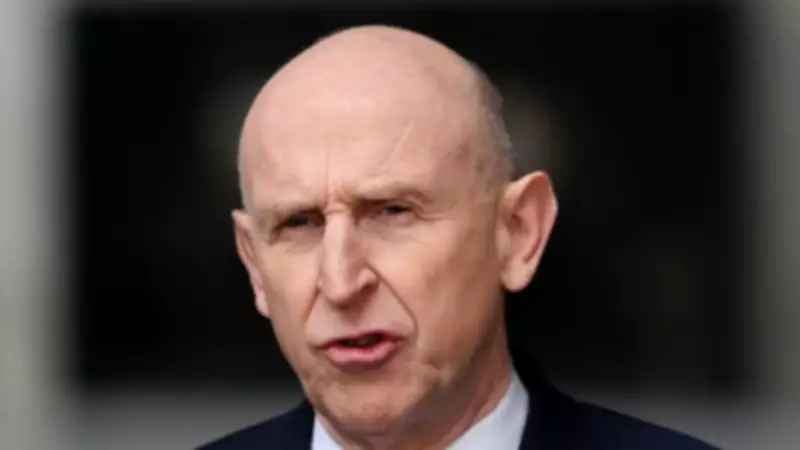
UK Defence Secretary Provides Detailed Account of Middle East Military Operations
Defence Secretary John Healey has publicly disclosed specific information regarding the United Kingdom's ongoing military activities in the Middle East, confirming that British forces are actively engaged in intercepting and neutralizing Iranian drones. This revelation comes in the immediate aftermath of coordinated strikes by the United States and Israel targeting Iran, which resulted in the death of Iran's long-serving supreme leader, Ayatollah Ali Khamenei.
Defensive Posture and Increased Military Presence
In a televised interview on Sunday Morning With Trevor Phillips, Mr. Healey explicitly stated that the United Kingdom played no role in the offensive strikes conducted against Iran on Saturday. He emphasized that the UK's involvement is strictly defensive in nature, aimed at safeguarding British personnel, national interests, and regional allies. Prime Minister Sir Keir Starmer had previously announced that British aircraft were already airborne in the region as part of these protective measures.
"We are taking down the drones that are menacing either our bases, our people, or our allies," Mr. Healey declared. "We've stepped up alongside the Americans. We've stepped up our defensive forces in the Middle East. We're flying those sorties."

Specific Incidents and Enhanced Deployments
Further details emerged regarding specific security incidents. Sky News' defence and security correspondent, Deborah Haynes, reported that a counter-drone unit successfully engaged and destroyed a threatening drone near a coalition base in Iraq housing British troops. Mr. Healey confirmed that approximately 300 UK personnel were stationed at a base in Bahrain that came under attack from Iranian missiles and drones on Saturday, with some personnel located dangerously close to the impact zones.
In response to the escalating threat, the UK has significantly bolstered its military assets in the region. Additional British warplanes, advanced radar systems, and other critical weapon systems have been dispatched to strategic locations in Qatar and Cyprus. These assets are currently operational and participating in what Mr. Healey described as a comprehensive "regional coordination" effort.
Political Reactions and Legal Ambiguity
The defence secretary faced pointed questions regarding the potential for the UK to join the United States in future offensive operations. Mr. Healey declined to speculate, stating, "I'm not going to speculate." This stance drew criticism from Conservative shadow foreign secretary, Dame Priti Patel, who questioned the government's reluctance to adopt a more proactive, collaborative stance with American allies, suggesting it left British nationals at risk.
Mr. Healey also addressed reports that the UK refused permission for the US to launch strikes from sovereign British bases, though he declined to comment on the specifics. He issued a stark warning about the "rising risks of increasing Iranian indiscriminate retaliatory attacks." When pressed on the legality of the US and Israel's actions under international law, he deferred, stating it was a matter for the US to justify and not within his remit as UK Defence Secretary.
High-Level Diplomatic Coordination
In a related development, Downing Street confirmed that Prime Minister Sir Keir Starmer held a telephone conversation with US President Donald Trump on Saturday night. The leaders discussed the volatile situation in the Middle East, with Sir Keir outlining the UK's participation in coordinated regional defensive operations. Number 10, however, adhered to protocol by not providing a full detailed account of the diplomatic exchange.