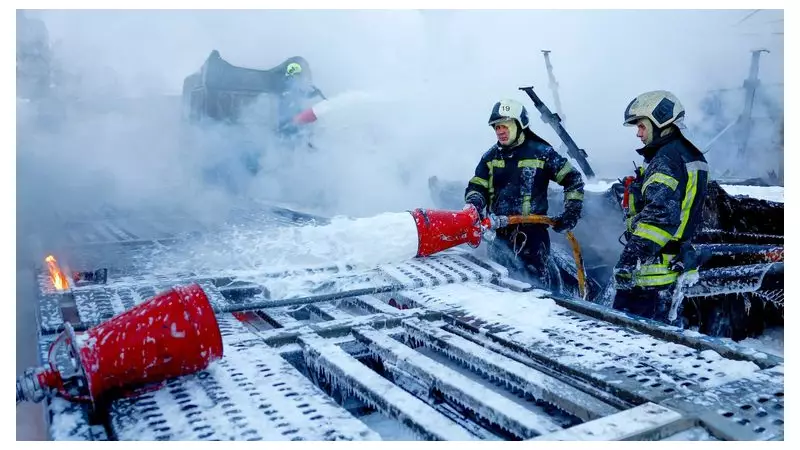
In a stark juxtaposition of diplomacy and destruction, fresh peace talks between the United States, Russia, and Ukraine were overshadowed by what Ukrainian officials have labelled a "cynical" and "barbaric" military assault. As delegations convened for a second day of negotiations in Abu Dhabi on Saturday, 24th January 2026, Russian forces launched a devastating barrage of missiles and drones targeting Ukraine's two largest cities, Kyiv and Kharkiv.
Massive Attack Coincides with Delicate Diplomacy
The timing of the assault, which occurred in the early hours of Saturday morning, has been interpreted by military analysts as a deliberate attempt to influence the ongoing peace discussions. Professor Michael Clarke, a respected defence analyst, suggested the strikes were designed to project an image of an unstoppable Russian military to the White House, thereby applying pressure on the negotiating process.
The human and infrastructural cost was severe. Ukrainian authorities reported that one person was killed and 31 others were injured in the attacks. Dramatic footage emerged showing firefighters scrambling to tackle blazes ignited by the strikes, which hit a range of civilian sites including, reportedly, a maternity hospital and a shelter for displaced people.

Nationwide Power Crisis Amid Freezing Temperatures
The assault triggered a major national crisis, with power cuts affecting approximately 1.2 million buildings across Ukraine. The blackouts were particularly perilous in the capital, Kyiv, where temperatures plummeted to a frigid -13°C (8.6°F). This targeting of energy infrastructure represents, according to UN human rights chief Volker Turk, "a clear breach of the rules of warfare."
The Russian defence ministry offered a contrasting narrative, claiming its forces had targeted legitimate military and industrial installations, alongside energy and transport infrastructure used by the Ukrainian armed forces.
Contrasting Atmospheres: Respect at the Table, Carnage from the Sky
Despite the violence, a surprising sense of progress was reported from the closed-door sessions in the United Arab Emirates. US officials described the atmosphere between the Russian and Ukrainian delegations as "respectful" and even "positive," noting unexpected chemistry as the teams worked through complex issues. The two sides were reported to have shared lunch, a symbolic gesture amid the conflict.
"There’s been a lot of carnage. A lot of killing. But there was respect," one US official remarked during a White House briefing. This diplomatic effort, reportedly six weeks in the making and partly staged by a prior meeting between Donald Trump and Volodymyr Zelenskyy in Davos, has yielded enough encouragement for all parties to commit to further talks.
Path Forward: More Talks and a Potential Summit
President Zelenskyy confirmed that the central focus of the Abu Dhabi discussions was "the possible parameters for ending the war." Both he and Washington described the talks as "productive" and "constructive." A US official, speaking anonymously to Reuters, revealed that the negotiations delved into "real granular detail" and that another meeting is scheduled for the following Sunday in Abu Dhabi to push the potential deal "towards its final culmination."
Perhaps most significantly, US officials indicated that the idea of a direct bilateral meeting between Presidents Zelenskyy and Vladimir Putin is now "very close." A UAE government spokesperson suggested such a summit, which could also involve former US President Donald Trump, "didn't appear far away." There is even talk of future delegations meeting in Russia or Russians travelling to Kyiv.
Underlying Tensions and Ukrainian Resolve
However, fundamental obstacles remain. The Kremlin continues to demand that Ukraine cede all territories occupied by Russian forces, plus the remainder of the eastern Donbas region—a condition Kyiv shows little appetite to accept, a stance reflected in Ukrainian public opinion polls. In a controversial proposal, Russia floated using frozen Russian assets in the US, worth nearly $5 billion, to fund reconstruction in the Donbas cities it has destroyed, an idea President Zelenskyy dismissed as "nonsense."

President Zelenskyy stated that a key task for his negotiators in Abu Dhabi was to convey how relentless Russian strikes, like the one that coincided with the talks, actively undermine the diplomatic process. Ukrainian Foreign Minister Andrii Sybiha condemned the latest attack, stating it proved "Putin's place is not at [a] Board of Peace, but in the dock of the special tribunal."
As the world watches, the path to peace remains fraught, caught between moments of unexpected diplomatic rapport and the brutal, ongoing reality of war.