

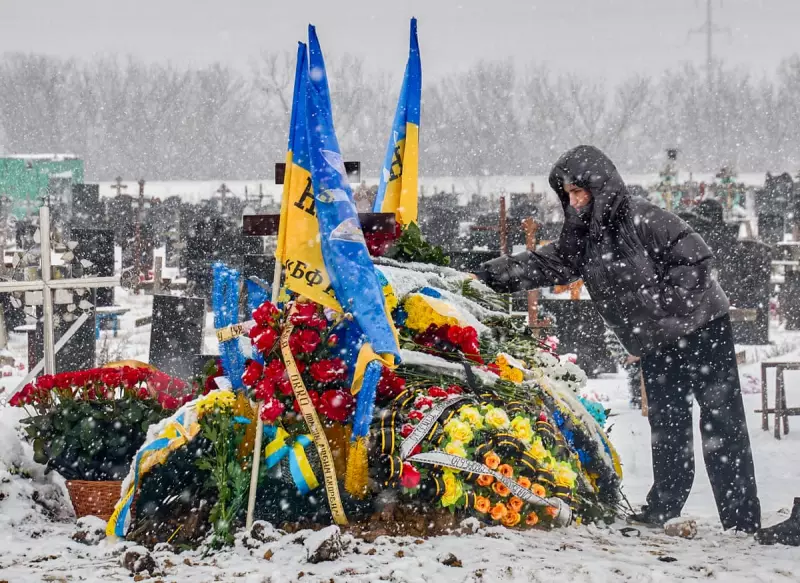
As the new year dawns, a profound sense of war-weariness hangs over Ukraine, with President Volodymyr Zelenskyy's assertion that a peace agreement is "90% ready" doing little to dispel the feeling that a lasting resolution remains frustratingly out of reach.
The Hollow Promise of a Quick Peace
In his New Year's Eve address, President Zelenskyy struck a sombre note, directly countering the narrative often promoted by former US President Donald Trump. "I would give anything in the world if, in this address, I could say that peace will also come in just a few minutes," he told the nation. "Unfortunately, I cannot say that yet." While indicating a deal was largely prepared, he crucially added, "Those 10% contain, in fact, everything."
This statement underscores the immense gulf between diplomatic progress and a workable, sustainable peace. It comes nearly a year after Trump's return to office, where his promise to end Russia's war within 24 hours has proven empty. Instead, the close of 2025 saw a flurry of US-led diplomacy, beginning with the leak of a contentious draft peace plan co-authored by Washington and Moscow.

Diplomatic Pressure and Ukrainian Resilience
The proposed plan, which would have required Ukraine to cede the Donbas region, was presented to Kyiv as a 'take it or leave it' offer. US Army Secretary Dan Driscoll reportedly gathered NATO diplomats in Kyiv for what one attendee called "a nightmare meeting," warning that rejecting the deal would lead to worse terms later. Zelenskyy, with European backing, successfully resisted what many Ukrainians would view as capitulation, forcing a renegotiation.
Yet, even with a revised framework now supposedly 90% complete, significant obstacles loom. Russian officials have consistently stated they will only sign an agreement addressing the "root causes" of the conflict—a position seen in Kyiv as a demand for Ukrainian surrender of sovereignty. With another winter of power cuts, air raids, and separated families, the societal strain is palpable. A soldier named Serhiy, home on leave from volatile frontlines, captured the national mood: "I think by this stage, probably the majority would be ready to go for a bad deal; anything to stop the fighting."
Political Crosscurrents and the Shadow of Elections
The new year also brings intensified political challenges for Zelenskyy. His presidential term, begun in 2019, is now in its seventh year under martial law, which prevents elections. While his leadership faces criticism, there is a broad consensus that a wartime vote would be destabilising. "It would only cause harm," said opposition MP Serhiy Rakhmanin. "He's the commander-in-chief... It would only help the enemy."
Despite this, Trump has echoed Kremlin talking points, labelling Zelenskyy illegitimate due to the lack of elections. In response, Zelenskyy has asked parliament to explore the legal mechanisms for a wartime vote, challenging Western allies to detail how security could be guaranteed. Meanwhile, former army commander and current ambassador to London, Valerii Zaluzhnyi, is widely seen as the most potent electoral challenger, though he remains publicly focused on the war.
In a significant staff shift, Zelenskyy recently appointed the head of military intelligence, the audacious Kyrylo Budanov, as his chief of staff. This move could signal a new, more security-focused approach to negotiations from Kyiv.
A Fragile Path Forward in 2026
As 2026 begins, optimism is in short supply. The hope that Trump might fully back Ukraine once he realised Vladimir Putin's intransigence has faded. The best-case scenario for many is a grim holding pattern: that Ukrainian military and societal resilience can outlast Russia until the Kremlin's position weakens.
MP Rakhmanin outlined a narrow path to a viable deal, requiring a confluence of three factors: more systematic European military and financial support, a stabilisation of the frontline, and the onset of serious economic problems for Russia. "If these three factors come together, then things can work out," he said. "But if even one of them doesn't work in our favour, then it's going to be extremely difficult."

The year's end was marked by a stark reminder of the conflict's volatility, with Russia accusing Ukraine of a drone attack on Putin's residence—a claim dismissed by Kyiv and US intelligence as a fabrication. It highlighted how easily a pretext could be manufactured to shatter any future ceasefire. For now, peace remains a percentage game where the final digits hold the fate of a nation.





