Unprecedented US-Israeli Joint Military Campaign Targets Iranian Regime
The United States and Israel have announced the commencement of an unprecedented joint military operation against Iran, initiating with a comprehensive bombing campaign explicitly aimed at regime change. This coordinated assault represents a significant escalation in regional tensions, with immediate and far-reaching consequences across the Middle East.
Widespread Strikes Hit Iranian Heartland
Israeli fighter jets and American missiles struck hundreds of targets across Iran, sending panicked residents fleeing from major urban centers. Among the primary targets were Iran's supreme leader, Ayatollah Ali Khamenei, and President Masoud Pezeshkian, along with numerous weapons facilities strategically located throughout the country. The operation, codenamed "Operation Lion's Roar" by Israeli forces, was launched in coordination with former US President Donald Trump, who publicly called on Iranians to rise against their government.
An Israeli military official stated the campaign's objective was "degrading the regime's capabilities" and emphasized operations would continue for "as long as necessary." Before Trump's formal announcement, a swarm of Tomahawk missiles and F-16 aircraft were already en route to hundreds of predetermined targets across Iranian territory.

Key Infrastructure and Leadership Compounds Targeted
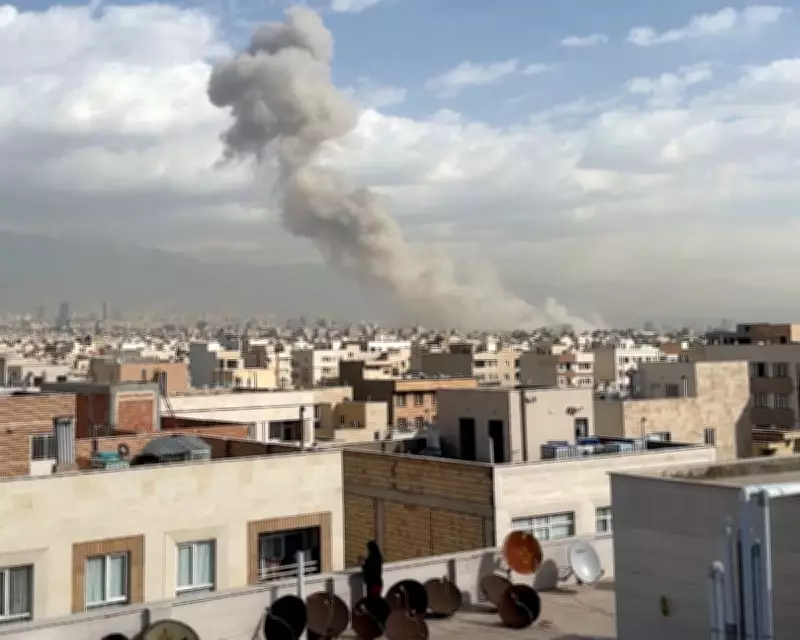
The barrage of American and Israeli munitions landed across Iran, striking crucial security and political targets in Tehran, including the official residence of Supreme Leader Khamenei. Additional strikes hit ballistic missile caches on the country's peripheries. Satellite imagery from Airbus, released through Soar Atlas, shows multiple structures within Khamenei's secure compound appearing heavily damaged or completely destroyed, with visible destruction and black smoke emanating from the site.
Hundreds of strikes impacted at least fourteen cities across Iran, representing a significantly more extensive campaign than previous US-Israeli attacks during last summer's twelve-day war. Targets included intelligence and security headquarters, residences of Iranian officials, and ballistic missile launchers and storage facilities—a tactical approach designed to limit Iran's capacity to retaliate against the ongoing assaults.
Civilian Casualties and Humanitarian Impact
According to Iranian state media, at least fifty-one people were killed and more than sixty wounded in a strike on a girls' school in Minab, located in the southern Hormozgan province. This attack was independently verified by Reuters, which also confirmed footage from the school's aftermath. Minab hosts an Islamic Revolutionary Guard Corps base, though the school itself appears to have suffered catastrophic damage.
Panic consumed Tehran's streets as explosions rocked the densely populated capital. Israeli military spokespeople warned Iranian citizens to distance themselves from military and industrial facilities, while Iranian authorities instructed residents to flee major cities for safety—scenes reminiscent of mass exoduses during previous conflicts. Smoke rose above Tehran's skyline as people ran for cover amid continuing strikes, with many security institutions located in residential areas increasing the likelihood of civilian casualties.
Swift Iranian Retaliation Expands Conflict Zone
Iran's response to the military campaign was immediate and expansive. The country launched waves of missiles toward Israel while simultaneously striking US military bases in five Gulf nations—Qatar, Kuwait, the United Arab Emirates, Bahrain, and Riyadh, Saudi Arabia. This action pushed past previous red lines that had excluded the Gulf region from direct Washington-Tehran hostilities.
Within hours, the conflict consumed much of the Middle East, with residents in Damascus, southern Lebanon, and Amman reporting explosions overhead as Israel intercepted incoming Iranian missiles. Gulf states reacted with outrage, condemning the attacks and reserving the right to respond. The United States additionally conducted strikes against Popular Mobilization Forces in Iraq, injuring several members of the Iranian-backed militia group.

Regional Defense Systems Activated
The speed at which the conflict turned regional proved dizzying, with its geographical scope exceeding that of last summer's twelve-day war within mere hours. Israelis spent much of Saturday in blast shelters as air-raid sirens sounded nearly constantly. Israel's Home Front Command instructed citizens to take shelter as Iran launched successive waves of ballistic missiles, most of which were intercepted by the Iron Dome missile defense system before reaching populated areas.
Meanwhile, footage from Bahrain showed missile strikes near a US naval base, while images from Tehran captured people running for cover and vehicles engulfed in flames after direct hits. The conflict's rapid escalation has created unprecedented instability across the Middle East, with no immediate diplomatic resolution in sight as military operations continue on multiple fronts.