

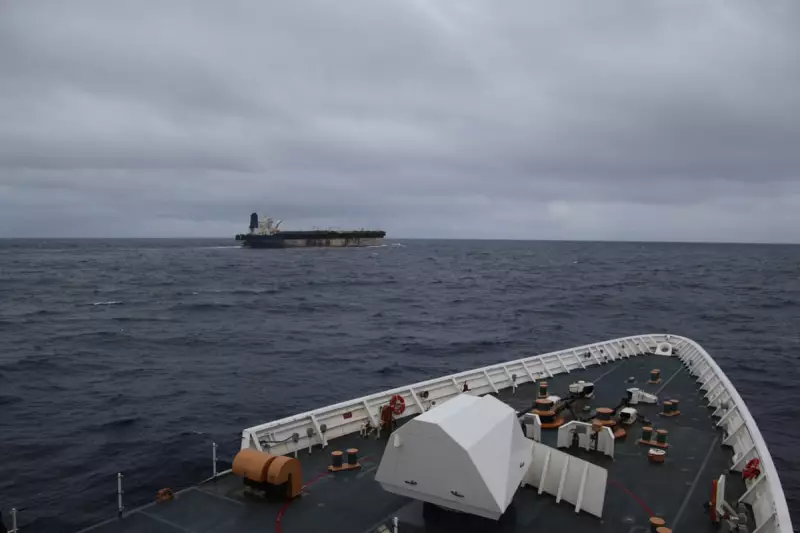
A colossal, rust-streaked oil tanker has become the unlikely epicentre of a tense international confrontation after being seized by American forces in the frigid waters of the North Atlantic. The vessel, the 300-metre-long Marinera, was boarded by the US Coast Guard on Wednesday, despite carrying no crude oil, following days of intense surveillance and a dramatic naval pursuit involving Russian assets.
The Notorious 'Ghost Ship' and the Sanctions Crackdown
The Marinera is a veteran of the so-called 'shadow' or 'ghost' fleet, a network of vessels used by countries including Russia, Iran, and Venezuela to circumvent Western economic sanctions. For years, such ships have moved cargoes and discounted fuel across the globe. The US Treasury had already placed the Marinera under sanctions in July 2024, accusing it of carrying illicit goods for the Iranian-backed militant group Hezbollah.
Washington's efforts to clamp down on this illicit maritime trade intensified significantly last month. This followed former President Donald Trump's imposition of a naval blockade targeting sanctions-busting tankers near Venezuela, a primary destination for the shadow fleet. The Marinera, having evaded capture in the Caribbean Sea in December, changed its name from Bella 1 and altered course towards northern Russia before its eventual interception.

A Russian Flag and a Calculated Gamble
The stakes of seizing the Marinera were far higher than previous actions against shadow fleet vessels. In a crucial recent development, the tanker's crew had hastily painted a Russian flag on its hull last month, and Moscow had formally registered the ship. This act effectively moved the vessel out of the shadows and into a direct challenge of Western authority, with Russia lodging a diplomatic protest demanding the US halt its pursuit.
Analyst Craig Kennedy of Harvard University suggested Moscow's reflagging was a deliberate attempt to gain leverage and test US resolve, possibly assuming Washington would not board a Russian-flagged ship on the high seas. "This was Russia trying to gain leverage by intervening in the US blockade," Kennedy stated. "And then it backfired." He added that the Kremlin may have miscalculated how far the Trump administration would go, especially following the recent capture of Venezuela's president.
Speculation, Surveillance, and a High-Seas Showdown
The intense focus on the ostensibly empty tanker has fuelled widespread speculation about its true cargo. Theories suggest it could be hiding high-value Russian weapons within its hull, potentially destined for Venezuela via a route historically used for illicit trade between Iran and the South American nation.
The operation to seize the ship was meticulously planned. For days, US surveillance aircraft monitored the Marinera's every move. Notably, a British Royal Air Force RC-135W Rivet Joint spy plane was tracked flying from RAF Waddington in Lincolnshire towards the tanker's location, with the UK Ministry of Defence confirming it provided "pre-planned operational support." The situation escalated when Russia reportedly dispatched naval assets, including a submarine, to escort the tanker, hours before US forces moved in.
The US justified the seizure by citing "violations of US sanctions." This dramatic event marks a significant escalation in the transatlantic power struggle over sanctions enforcement and underscores the growing boldness of Russia's maritime strategy in challenging Western dominance on the high seas.






