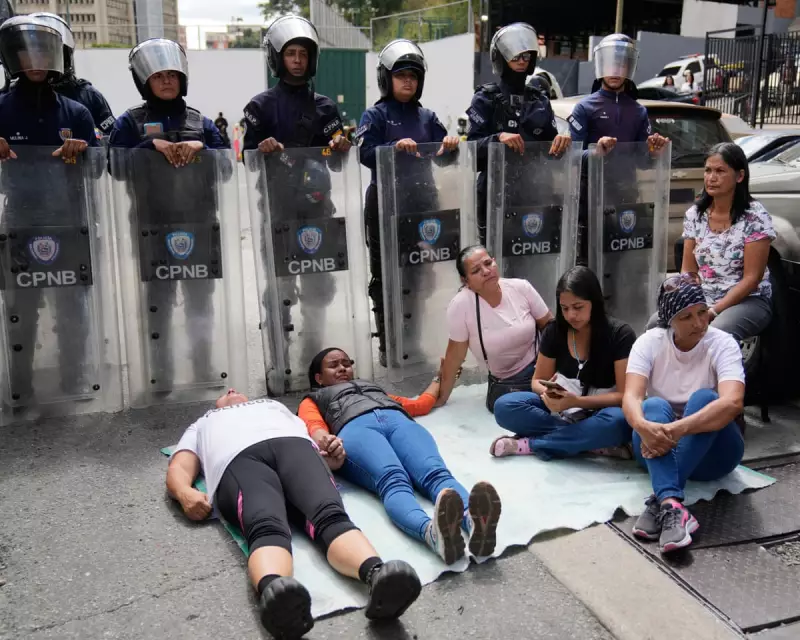
Families Maintain Vigil Outside Venezuelan Detention Centre Demanding Full Release of Political Prisoners
In the tense atmosphere surrounding Caracas's Zona 7 detention centre, relatives of Venezuela's political prisoners have established a determined protest camp, lying down before riot police and refusing to leave without their incarcerated family members. This dramatic scene unfolds as Venezuela's political landscape undergoes seismic shifts following the dramatic seizure of former leader Nicolás Maduro by US forces.
The Protester's Plight: Waiting Without Answers
Mileidy Mendoza, a 30-year-old woman among approximately twenty protesters - some elderly women in their seventies - has spent the last fortnight camped outside the east Caracas facility. "I'm staying right here ... we aren't going anywhere without our relatives," Mendoza declared, her partner Eric Díaz among those detained inside the compound behind lines of shield-bearing riot police.
Mendoza expressed frustration at the slow pace of releases, questioning authorities: "What are they waiting for? For someone else to die?" Her reference pointed to a recent tragedy where a police officer died in the Zone 7 prison a month after arrest for allegedly sharing messages critical of Maduro's regime.

Limited Releases Amid Political Transition
Venezuela's acting leader Delcy Rodríguez, Maduro's former vice-president, announced prisoner releases on 8 January, just five days after Delta Force commandos captured Maduro and transported him to New York custody. Rodríguez characterised these releases as evidence of "a new political moment" in a nation that descended into dictatorship as Maduro employed repression to maintain control during severe economic decline.
Former US President Donald Trump welcomed the development, telling reporters: "They have released a lot of political prisoners in Venezuela." However, human rights advocacy group Foro Penal reports only approximately 250 prisoners have gained freedom, leaving over 600 political detainees still confined in Venezuelan correctional facilities.
'Drip Drip' Strategy or Genuine Reform?
Orlando Moreno, a human rights activist operating clandestinely, believes the gradual "drip drip" release pattern represents an attempt by Maduro's successors to alleviate international pressure without implementing substantive change. "There hasn't been a true liberation of prisoners. There have been some releases," Moreno observed, noting that new detainees like Alfredo Márquez - arrested on 12 January while attending church - continue entering the system.
"While some are going out the front door, others are coming in through the back," Moreno remarked, highlighting the ongoing nature of political arrests despite the transitional government's claims of reform.
Prominent Figures and Anonymous Citizens Alike
Among those remaining imprisoned stands Juan Pablo Guanipa, a prominent opposition figure instrumental in the movement widely believed to have defeated Maduro in the 2024 election. Guanipa's son Ramón, a 29-year-old psychology student, recounted seeing his father just once for twenty minutes since masked "anti-subversion" agents captured him last May on terrorism, treason, and foreign conspiracy charges.
"The first thing he said to me was that he wouldn't bow down to these people, not even behind bars," Ramón Guanipa remembered. He rushed to Caracas when releases were announced amid rumours his father would be freed, but Juan Pablo Guanipa remains detained. "I assume something happened along the way. There was some kind of hitch," the younger Guanipa speculated. "Someone within the regime said: 'No, Juan Pablo Guanipa isn't getting out.'"
Other detainees like Eric Díaz represent ordinary citizens ensnared in the regime's security dragnet. Mendoza explained Díaz, father to eight- and nine-year-old children, previously worked for the government organising lighting and banners at political rallies until his November arrest during a vehicle search. Officials vaguely cited "phone pairing" as his offence without providing clarification.

Contrasting Scenes: Joyful Reunions Versus Ongoing Despair
The tense, despair-filled atmosphere outside Zone 7 contrasts sharply with joyful family reunion images circulating on social media involving released prisoners. Videos show emotional moments: a child leaping into her father's arms in Lara state after over a year's separation; politician Enrique Márquez embracing his weeping wife following detention in El Helicoide, Venezuela's most notorious political prison; and an activist wrapping himself in Venezuela's flag upon emerging from a Ciudad Bolívar jail.
Early Thursday brought another release - Rafael Tudares, son-in-law of presidential candidate Edmundo González, who many believe legitimately won the 2024 election. Tudares gained freedom over a year after being seized while taking his children to school.
Analysts Question Regime's True Intentions
Javier Corrales, author of Autocracy Rising: How Venezuela Transitioned to Authoritarianism, cautioned that prisoner releases alone don't signify meaningful change. "Releasing [political] prisoners is always an amazing thing ... But it means nothing ... in terms of ending the repression," Corrales asserted.
Orlando Moreno echoed this scepticism: "When it comes to the repression and the terror, absolutely nothing [has changed]. People are still very afraid because they know the people still in power are criminals who can persecute, threaten ... detain and torture you."
University of North Texas at Dallas Latin America expert Orlando Pérez suggested the slow release pace reveals Rodríguez's regime "making enough changes to keep the US satisfied, but not enough to be meaningful in terms of democratisation." Pérez noted armed pro-regime colectivos continue intimidating opponents on streets, indicating "these are not the actions of a regime that's in the process of democratising. They're the actions of a regime that's in the process of trying to pragmatically consolidate power under a new context."
Wider Protests Beyond Caracas
Forty kilometres from Zone 7, in the dormitory town Guatire, dozens of women have established another protest camp outside maximum security prison Rodeo I. Massiel Cordones, sitting on a plastic chair in the encampment, recounted her son José Ángel Barreno Cordones's journey from childhood military parade enthusiast to army lieutenant in 2018 - the year Maduro faced first election-rigging accusations.
Two years later, her son received imprisonment for alleged involvement in Operation Gideon, a failed Maduro overthrow attempt. Arrested at 22, he now serves a 30-year sentence for treason, terrorism, and arms trafficking at age 28. Cordones travelled seven hours from Falcón state upon hearing about releases but, after a fortnight sleeping rough outside the prison, still awaits news.
"I won't lie, staying here is exhausting, but because I have this hope that my son is going to get out, the days just fly by," Cordones stated, sustained by local solidarity providing washing facilities and food deliveries. At night, protesters join hands in prayer or sing Venezuela's national anthem with its resonant lines: "Down with chains!" and "Let's scream out loud: 'Death to oppression!'"
"We've had everything we need," Cordones reflected. "The only thing truly missing for us is to see our children released - to see those doors swing open and freedom arrive."