

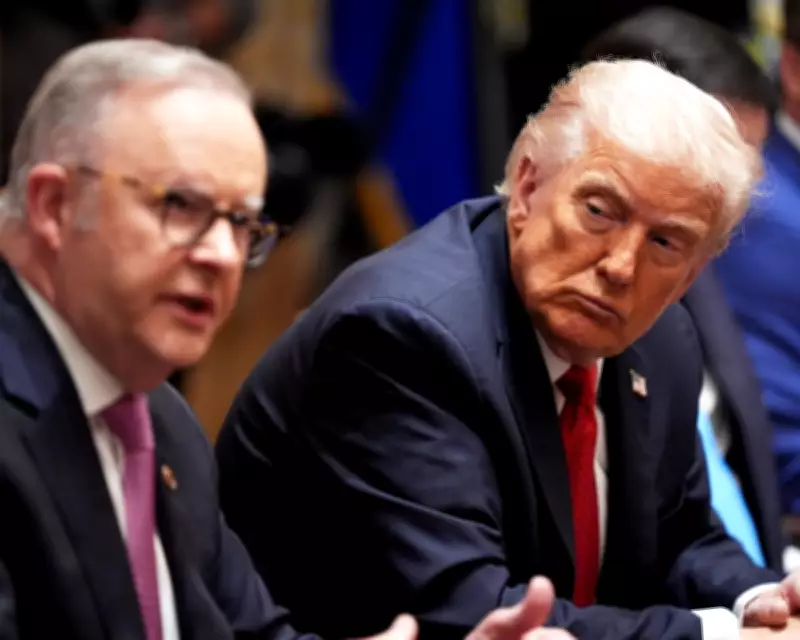
Albanese Stands Firm Against Trump's Demands for Military Support in Iran Conflict
Australian Prime Minister Anthony Albanese has firmly rejected former US President Donald Trump's criticism over Australia's decision not to offer military assistance in the ongoing conflict between the United States, Israel, and Iran. This diplomatic stance comes as global tensions intensify around the strategic Strait of Hormuz, where Iran maintains significant control over vital shipping lanes.
Trump's Criticism and Global Reactions
In a recent series of inflammatory statements, Donald Trump has targeted multiple NATO allies for their reluctance to engage militarily in the dangerous standoff in the Persian Gulf region. Trump specifically expressed surprise at Australia's failure to provide customary military support, while simultaneously ridiculing British Prime Minister Keir Starmer and the Royal Navy for what he characterized as inadequate and delayed responses.
The international community appears to be sending a clear message to the former president: "You broke it, you own it." This sentiment reflects growing global frustration with Trump's approach to foreign policy, particularly regarding conflicts in the Middle East.

Australia's Diplomatic Position
While maintaining a relatively low profile in public statements, the Australian government has aligned itself with other Western nations in resisting pressure to escalate military involvement. Both Prime Minister Albanese and Deputy Prime Minister Richard Marles have navigated complex diplomatic waters as they attempt to reconcile contradictions in current US foreign policy.
The Australian leadership faces a significant challenge: balancing the nation's long-standing security dependence on the United States against the broader consequences of what many perceive as reckless American foreign policy under Trump's influence.
The Strait of Hormuz Crisis
The current crisis centers on Iranian control of the Strait of Hormuz, a critical chokepoint for global oil shipments. As the fuel crisis worsens and various economic sectors call for government assistance, the situation presents complex challenges for international diplomacy.
Trump's approach has involved deploying additional military forces to the Gulf region while extending diplomatic deadlines, a strategy that many allies view as counterproductive and potentially disastrous. Historical parallels to conflicts in Korea, Vietnam, Iraq, and Afghanistan suggest that increased military presence without clear objectives rarely yields positive outcomes.
Global Economic Implications
The standoff in the Strait of Hormuz has already begun damaging the global economy, with potential for sudden and dangerous escalation. Iran's position controlling vital energy shipping routes gives the nation significant leverage, essentially standing "on the throat of the global oil market" according to analysts.
International leaders have become increasingly vocal about their concerns. German Defense Minister Boris Pistorius recently delivered blunt criticism of Trump's lack of exit strategy, while Canadian Prime Minister Mark Carney highlighted the broader consequences of Trump's presidency during discussions at Davos.
Australia's Strategic Dilemma
The Albanese government finds itself in what observers describe as a "cleft stick" situation - torn between Australia's traditional security alliance with the United States and the practical realities of a US foreign policy approach that many consider unpredictable and potentially damaging to global stability.
Australia appears to be pursuing a pragmatic approach: accepting Iranian control of the Strait of Hormuz (similar to how nations accommodate Egypt's control of the Suez Canal) while encouraging the United States to prioritize diplomatic solutions over military confrontation.
The Future of International Relations
The current crisis highlights what many analysts see as the collapse of the traditional international rules-based order that has long been a cornerstone of Australian foreign policy. Constructing a new framework for international relations has become increasingly critical for protecting Australia's economic, political, and strategic interests in an increasingly volatile global landscape.

As the situation continues to evolve, with Iran gradually gaining strategic advantage while spreading the economic consequences of the conflict across the global community, Australia's diplomatic positioning will remain crucial. The nation's approach reflects a broader shift toward working with international partners rather than submitting to the demands of individual world leaders, regardless of their political power or influence.





