

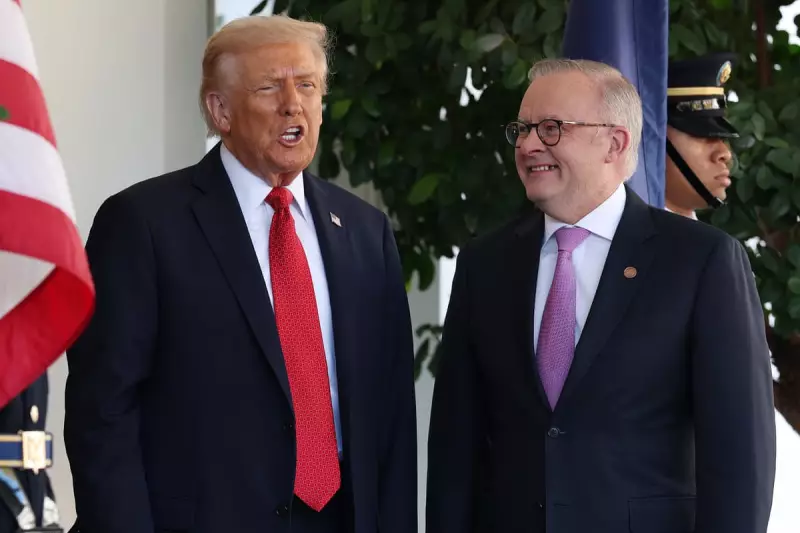
Australia's Diplomatic Dilemma in the Trump Era
Prime Minister Anthony Albanese faces a complex diplomatic challenge as he navigates Australia's relationship with an increasingly unpredictable United States under President Donald Trump. While maintaining stability remains crucial, experts argue that acknowledging fundamental shifts in the global order represents an essential first step toward developing effective foreign policy responses.
The Changing Landscape of International Relations
Recent developments have highlighted the profound transformation occurring within international diplomacy. Canadian Prime Minister Mark Carney's stark assessment at the World Economic Forum described the current era as representing a "rupture, not a transition" in the established rules-based order. This perspective has resonated strongly within political circles, with copies of Carney's speech reportedly circulating widely through Parliament House in Canberra.
The situation has become particularly pressing as President Trump continues to challenge international norms, threatening sovereign nations, proposing aggressive tariffs against allies, and questioning longstanding security arrangements. These actions have created significant uncertainty for traditional US partners, including Australia, which has long relied on American leadership within the global framework.

Australia's Strategic Response
Despite these dramatic changes, there appears to be limited public indication of how the Albanese government plans to adjust its approach as Australia's most important ally undergoes substantial transformation. The government has continued to emphasise regional engagement through Pacific and Southeast Asian partnerships while simultaneously maintaining rhetorical support for the established international order.
Albanese has positioned Australia as a "middle power" within this evolving landscape, investing significant political capital in strengthening regional institutions since assuming office in 2022. Foreign Minister Penny Wong has worked extensively to build cooperative relationships across the Asia-Pacific region, even as the government continues to reference the security framework provided by traditional international structures.
International Perspectives and Parallels
The Australian approach contrasts somewhat with responses from other leaders facing similar challenges. British Prime Minister Keir Starmer has publicly rebuked Trump's economic coercion tactics, while European Commission President Ursula von der Leyen has promised coordinated pushback against aggressive US policies. These leaders have joined Albanese in progressive political forums, presenting themselves as an alternative power base capable of protecting democratic institutions against populist challenges.
Carney's powerful metaphor about removing signs from shop windows has particular resonance in this context. The Canadian leader suggested that continuing to pretend the old international order remains functional only perpetuates a damaging illusion. His call for "middle powers" to act collectively reflects growing recognition that smaller nations must cooperate more effectively in this transformed environment.
The AUKUS Question and Strategic Autonomy
One of the most significant concerns for Australia involves the future of the AUKUS security agreement. The government recently committed an additional $1.5 billion toward nuclear-powered submarines scheduled for delivery in the 2030s, bringing total expenditure beyond $4.5 billion. While Trump has endorsed the arrangement, questions remain about its long-term viability and Australia's position as the sole financial contributor to this distant capability.
Former Australian ambassador to Washington John McCarthy has called for a more realistic assessment of the alliance, suggesting Australia should move beyond the "sanctification" of US relations and develop greater strategic autonomy. Such conversations, while potentially difficult, could help establish a more resilient foreign policy approach capable of enduring beyond the current US administration.

Balancing Stability with Adaptation
Albanese's cautious approach reflects the delicate balance required in managing relations with an unpredictable American administration. The government has employed carefully formulated responses to provocative statements, such as Trump's suggestions about Greenland, emphasising diplomatic norms without directly confronting the US president.
However, as the international landscape continues to shift dramatically, there is growing recognition that Australia must develop more sophisticated responses. Acknowledging that fundamental changes have occurred represents not merely an academic exercise but a practical necessity for effective policymaking in an era where traditional assumptions no longer hold.
The challenge for Australian leadership involves maintaining essential alliances while simultaneously preparing for a world where power dynamics have fundamentally altered. This requires both immediate diplomatic skill and longer-term strategic planning to ensure national interests remain protected regardless of international developments.





