

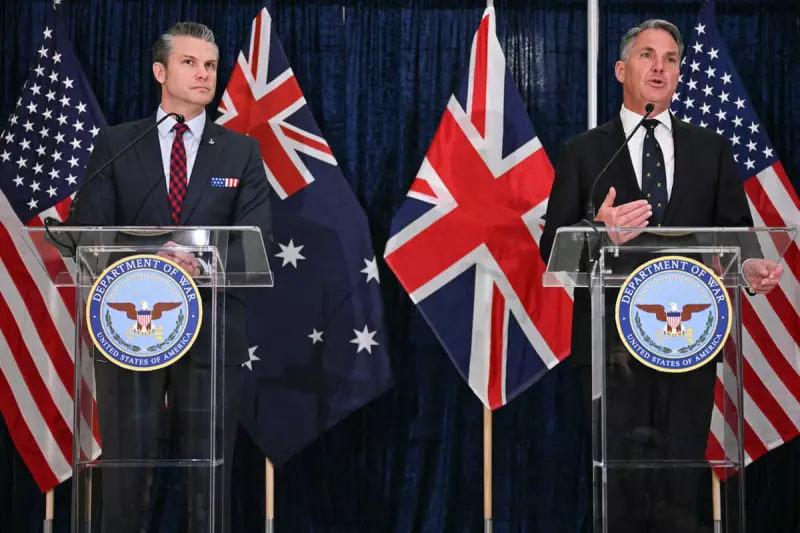
In a striking diplomatic manoeuvre that has sent ripples through international corridors, Australia has publicly challenged the United States over its actions in Venezuela. The confrontation unfolded at the United Nations, where Australian representatives posed a series of pointed legal questions concerning Washington's potential violations of established international law.
A Formal Challenge at the United Nations
The core of Australia's intervention centres on the legal principle of sovereignty. The Australian delegation has explicitly asked the US to clarify how its policies towards Venezuela align with the fundamental UN Charter prohibition against the use of force and the non-intervention in the domestic affairs of sovereign states. This is not an informal query but a formal, documented challenge submitted within the UN framework, marking a significant and deliberate escalation.
This move is deeply intertwined with the long-running case of Julian Assange. The Australian government, under increasing domestic pressure to secure the WikiLeaks founder's release from UK custody and prevent his extradition to the US, appears to be leveraging a broader geopolitical stance. By holding the US to account on one front, it seeks to strengthen its moral and legal bargaining position on another. The timing is strategic, illustrating a calculated shift in Canberra's approach to its traditional ally.

The Ripple Effects of a Shifting Alliance
The implications of this challenge are profound. It signals a growing willingness among traditional US partners to independently scrutinise and question American foreign policy, especially when it appears to contravene the very international rules-based order Washington often champions. For the United States, this public questioning by a key ally like Australia is an uncomfortable diplomatic setback, potentially encouraging other nations to voice similar concerns.
For Venezuela, the Australian intervention provides an unexpected, albeit indirect, form of validation. It brings renewed international legal scrutiny to the US's campaign of sanctions and political pressure, which Caracas has long decried as an illegal act of economic warfare. The questions posed by Australia lend weight to arguments that such measures may constitute a breach of international norms.
A New Diplomatic Calculus
This episode represents more than a single policy dispute; it reflects a changing global landscape. Australia's action demonstrates that even the closest of alliances are subject to recalibration when core principles of national interest and international law are at stake. The move expertly links the specific plight of an individual citizen, Julian Assange, with a universal principle of state sovereignty, creating a powerful diplomatic narrative.
The world now watches to see how the United States will formally respond to this legal critique. Will it offer a detailed justification of its Venezuela policy under international law, or will it dismiss the challenge? The outcome will set a precedent for how international law is invoked and debated among allies in an increasingly multipolar world. Australia's bold step has not only questioned a superpower's actions but has also underscored the enduring and complex tension between power politics and the rule of law.






