

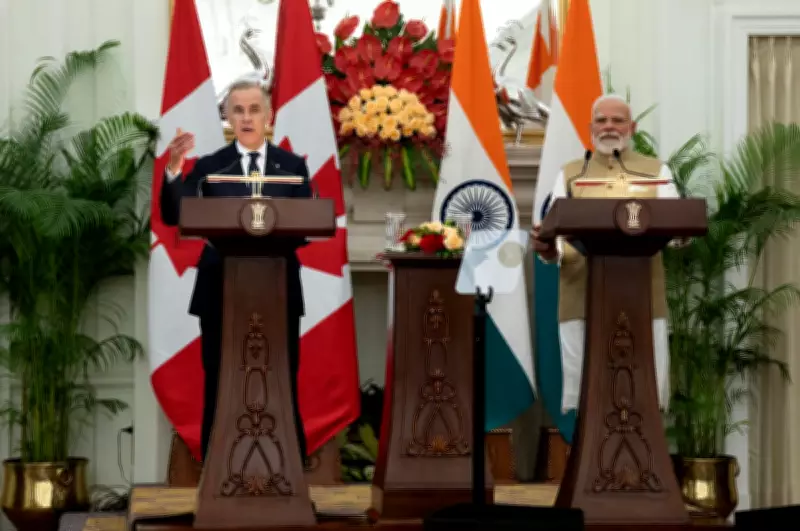
Canadian Prime Minister Mark Carney is confronting escalating pressure to clarify his stance on whether Indian interference in Canada remains an active threat, following his high-profile meeting with Indian Prime Minister Narendra Modi in New Delhi. The encounter occurred on March 2, 2026, during Carney's four-day diplomatic trip aimed at revitalizing bilateral ties with India, the world's most populous nation.
Trade Focus Amidst Security Concerns
Carney's visit was predominantly centered on trade discussions, with the Canadian leader expressing optimism about finalizing a comprehensive free-trade agreement with India, the globe's fifth-largest economy, by the end of the current year. The two nations solidified their economic partnership by signing multiple memorandums of understanding and a groundbreaking $2.6 billion uranium deal. Canada has set an ambitious target to elevate two-way trade with India to approximately C$70 billion by the year 2030.
Modi publicly commended Carney for his efforts to reset the previously stalled relationship between the two countries. In a significant development, Modi accepted Carney's invitation to visit Canada, with both leaders announcing plans for a subsequent meeting on Canadian soil. Carney emphasized the concept of "principled pragmatism" during his engagements, acknowledging that not all international partners will uniformly share Canada's core values.

Unanswered Questions on Interference Allegations
Despite the trade-focused agenda, Carney faced intense scrutiny regarding allegations of Indian interference in Canadian affairs. A senior Canadian official recently asserted that the government was "confident" India's campaign of threats and violence had ceased, suggesting this confidence enabled Carney's delegation to proceed with the trip. However, Carney's office cancelled a scheduled press conference in New Delhi, citing lengthy governmental meetings and a constrained travel itinerary to Australia, leaving reporters without direct answers.
Canadian Foreign Affairs Minister Anita Anand distanced herself from the senior official's remarks, stating in New Delhi that she would not personally use such terminology. The controversy stems from longstanding accusations against the Indian government, particularly concerning the 2023 assassination of Sikh activist Hardeep Singh Nijjar in Canada. Investigations have implicated an official from India's Vancouver consulate, alleged to be an intelligence officer, in supplying information related to Nijjar.
Ongoing Security Threats and Political Reactions
Canada's intelligence community has consistently highlighted India's role in transnational repression. In June, the Canadian Security Intelligence Service (CSIS) described Nijjar's murder as a "significant escalation in India's repression efforts," indicative of a broader campaign by Delhi to intimidate dissidents abroad. As recently as November, the head of CSIS identified China and India as the primary perpetrators of foreign meddling and transnational repression in Canada.
Adding to the tension, a prominent Sikh activist received a police warning last week about a credible threat against his family's lives, which he attributes to Indian operatives. Liberal MP Ruby Sahota issued a statement challenging the notion that these threats have been resolved, emphasizing that such assertions do not align with the current security realities facing Canada.
Indian envoy to Ottawa, Dinesh Patnaik, has consistently denied any Indian involvement in foreign interference within Canada. The official readout from Carney's meeting with Modi noted that Carney "underscored that Canada will continue to take measures to combat" transnational repression, though it provided no further specifics. As diplomatic relations evolve, the balance between economic cooperation and addressing security concerns remains a delicate challenge for both nations.






