

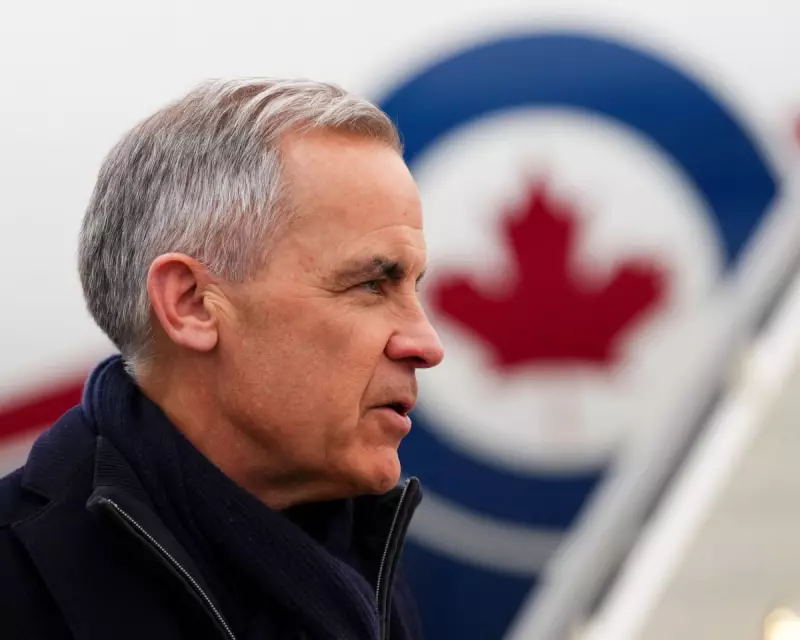
Prime Minister Mark Carney of Canada made a significant appearance at the World Economic Forum in Davos, Switzerland, delivering a speech that has been widely interpreted as a stark departure from his previous multilateralist stance. Once known as a "rockstar banker" advocating for international cooperation, Carney now presents himself as an unflinching realist, ready to confront the challenges of a world where traditional norms are crumbling.
A New Doctrine for a Fractured Era
In a speech penned by Carney himself, the Canadian leader articulated a clear doctrine for navigating what he described as a landscape of fractured international norms. He bluntly stated, "the strong do what they can, and the weak suffer what they must," echoing ancient wisdom to underscore the current geopolitical realities. Carney warned that compliance with old rules no longer guarantees safety, emphasising that "the old order is not coming back. We should not mourn it." He added, "Nostalgia is not a strategy," a phrase that resonated strongly with the audience of politicians, media, and business leaders, who responded with a standing ovation.
Allusions to Trump and US Unreliability
While not explicitly naming Donald Trump, Carney's remarks alluded to growing concerns about the White House's efforts to dismantle the post-war architecture of collective problem-solving. Jack Cunningham, a professor of international relations at the University of Toronto, noted that Carney has exposed the inaccuracy of attempts to appease or accommodate such departures from norms. Cunningham explained that leaders are increasingly realising they cannot "manage" Trump for the remainder of his term, as the systems of international order crafted with US help are now disintegrating.

Carney cautioned that great powers, thinly veiled as references to the US, are using economic integration as weapons, with tariffs as leverage and supply chains as vulnerabilities. This warning comes amid Trump's recent threats to impose levies on European nations opposing his bid for Greenland. However, Carney also warned against retreating into diplomatic and economic fortresses, arguing that such a world would be poorer and less sustainable.
Middle Powers Must Adapt Together
For middle powers like Canada, Carney asserted that adaptation is not optional but essential. He posed a critical question: should these nations simply build higher walls, or pursue more ambitious strategies? Carney advocated for the latter, stating, "If you are not at the table, you are on the menu." He highlighted that great powers can afford to go it alone due to their market size and military capacity, but middle powers lack such leverage and must act collectively to avoid subordination.
Variable Geometry and Flexible Alliances
Carney outlined a policy of "variable geometry," which involves forming different coalitions for various issues based on shared values and interests. This approach represents a shift from the concrete certainties of the post-war order he once championed. Examples include Canada's support for Ukraine's defence and solidarity with Greenland and Denmark, as well as efforts to link trade with Asian and European nations. Bob Rae, Canada's former ambassador to the United Nations, praised the speech as both blunt and optimistic, noting that Carney refuses to bend to nations seeking to break global systems and instead calls for strengthened cooperation among allies.
In response, Trump posted on social media about meeting "various parties" regarding Greenland in Davos, reiterating his view that US interest in the island is crucial for security. Carney countered by warning that negotiating from weakness leads to accepting subordination rather than exercising true sovereignty. He urged nations not to be blinded by the rise of hard power, asserting that the power of legitimacy, integrity, and rules remains strong if wielded collectively.
This speech marks Carney's emergence as a key voice in global politics, offering a pragmatic yet principled path forward for middle powers in an era defined by unpredictability and shifting alliances.






