

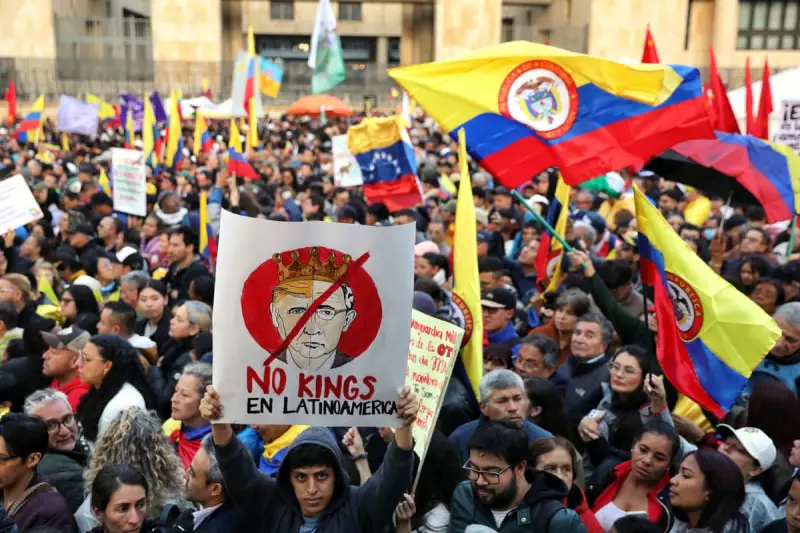
Thousands of demonstrators have flooded the streets of Colombian cities in a powerful display of anger against former US President Donald Trump's threats of military action in South America. The protests were called by Colombia's left-wing President, Gustavo Petro, following Trump's alarming comments about potential interventions in both Venezuela and Colombia.
"Out With The Yanks": A Continent on Edge
The rallies, held on Wednesday, saw some of the largest crowds in the capital, Bogotá, where supporters gathered in Bolívar Plaza. In the border city of Cúcuta, hundreds marched towards its 19th-century cathedral, waving Colombian flags and chanting "Fuera los yanquis!" ("Out with the Yanks!"). The protests were a direct response to Trump's stated interest in military action within Colombia, following a dramatic US special forces raid in Caracas last Saturday that resulted in the capture of Venezuelan President Nicolás Maduro and First Lady Cilia Flores, and the deaths of dozens of bodyguards.
Protesters expressed deep-seated fear and outrage. Janet Chacón, a 55-year-old businesswoman, labelled Trump "the devil … the most abhorrent person in the world." Another, José Silva, 67, dismissed Trump's claim to be a "president of peace," calling him "the president of war … a maniac" and urging the US Congress to act. The sentiment on the streets was clear: this was viewed as an imperialist resource grab, not a humanitarian mission.

Petro's Diplomatic Tightrope and Trump's Provocations
President Petro condemned the Venezuela operation as illegal in his speech to supporters. However, his tone shifted following a phone conversation with Trump, which the former US president described on Truth Social as a "great honour." Petro indicated a willingness to meet but stressed vigilance, stating, "We cannot lower our guard. Words need to be followed by deeds."
Trump's provocations have been stark. Just days before the protests, he called Petro "a sick man who likes making cocaine and selling it to the United States"—a baseless allegation against the leader of the world's largest cocaine producer. When asked about a Venezuela-style intervention in Colombia, Trump replied, "It sounds good to me." He has also hinted at action in Mexico against drug cartels, stating, "We're going to have to do something."
Regional Shockwaves and Fears of a Wider Conflict
The attack on Venezuela and threats to Colombia have sent shockwaves across Latin America, sparking solidarity protests in Mexico City, São Paulo, and Buenos Aires. Demonstrators uniformly condemned what they see as a "Yankee invasion." Brazilian congressman Reimont Otoni, leading protests in Rio, asserted the message was: "Donald Trump, get your hands off Latin America. Latin America isn’t the US’s back yard."
In Colombia, protesters like teacher Marta Jiménez, 65, accused Trump of solely wanting Venezuela's oil. Others, like Juan Carlos Silva, 59, feared Colombia was next and compared Trump's actions to those that could spark a global conflict. The US embassy in Bogotá warned its citizens to avoid the demonstrations, citing a potential for violence.
Analysts are horrified by the diplomatic fallout. Benjamin Gedan, a former National Security Council director for South America, criticised Trump's approach as "astoundingly disinterested in US diplomatic relationships and the US image in the world," arguing he maximises "diplomatic wreckage." Gedan noted that by framing the Venezuela intervention around oil access rather than democracy, Trump alienated potential regional allies.
This latest crisis marks the most dramatic escalation in Trump's renewed engagement with Latin America, which has also included threats to "take back" the Panama Canal, interference in Brazilian and Honduran politics, and a massive bailout offer to Argentina's right-wing president. The events have left the region bracing for what might come next, with many fearing a new era of overt US military interventionism.






