

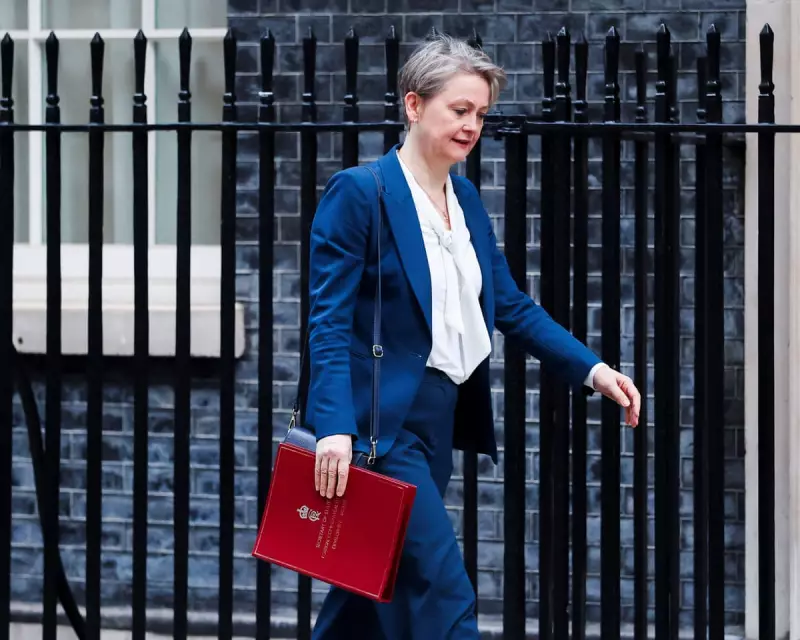
Foreign Secretary Yvette Cooper has come under fire from across the political divide for her carefully measured reaction to the US-led operation that captured Venezuelan leader Nicolás Maduro. Her refusal to explicitly condemn the action or state whether it breached international law during a gruelling Commons session has sparked intense debate.
The Diplomatic Tightrope: Ukraine's Security at Stake
The key to understanding Cooper's stance lies not in Caracas, but in events scheduled for Paris the following day. As Cooper faced a 90-minute parliamentary grilling on Monday night, a major diplomatic announcement was being finalised in the French capital.
A draft joint statement from a coalition of nations, including the US, was set to promise binding security guarantees for Ukraine in case of future Russian aggression. For the Foreign Office, this fragile agreement was paramount. The credibility of these guarantees, negotiated for months at a military level, hinged on US participation.

These assurances are seen as a critical, viable alternative to Ukraine's now-shelved NATO membership ambitions and a precondition for any future negotiated settlement with Russia that Kyiv and Europe could accept. Provoking Donald Trump with criticism over Venezuela was deemed an unacceptable risk that could have seen him withdraw from the Ukraine pact.
The Rubio Factor and a "No-Brainer" Calculation
Central to this diplomatic calculus was US Secretary of State and National Security Adviser Marco Rubio. British officials credit Rubio with coaxing Trump back to the table on Ukraine protection, placing Europe "deeply in his debt".
Critically, the operation against Maduro was widely viewed as a Rubio-masterminded mission. With Vice President JD Vance notably absent from the planning, UK diplomats concluded it was vital not to question the legal basis of what Rubio considered a major personal and strategic victory.
One British official described the choice as a "no-brainer": weighing public criticism over the removal of an unrecognised leader against safeguarding the painstakingly negotiated US security guarantees for Ukraine. The UK had already ceased sharing intelligence on Venezuelan drug boat attacks with the US.
UK's Long Game and a Shifting World Order
Despite her public caution, Cooper sent coded hints to MPs that she had raised the principle of international law with Rubio in weekend discussions. Furthermore, she is attempting to insert UK influence into Washington's uncertain plans for Venezuela's future, leveraging historical ties dating back to UK support for Simón Bolívar.
Cooper told Parliament that stability requires a democratic transition reflecting "the will of the people," and touted UK diplomat Colin Dick's understanding of the Venezuelan opposition. However, Rubio, a Latin America specialist, appears to have concluded the opposition is incapable of governing without triggering a Libya-style civil war.
The episode raises profound questions for the Foreign Office. The fact that Prime Minister Keir Starmer was not consulted about the Maduro operation, while journalists can seemingly access Trump, challenges the assumption of a special relationship built on shared values and intelligence.
As the US under Trump embraces a foreign policy governed by "strength" and "force," as articulated by deputy chief of staff Stephen Miller, the UK faces a Hobbesian reality. It must now navigate a world where the "rules-based order" is under threat, forcing a fundamental reassessment of how to seek influence in an era defined by "America First".






