

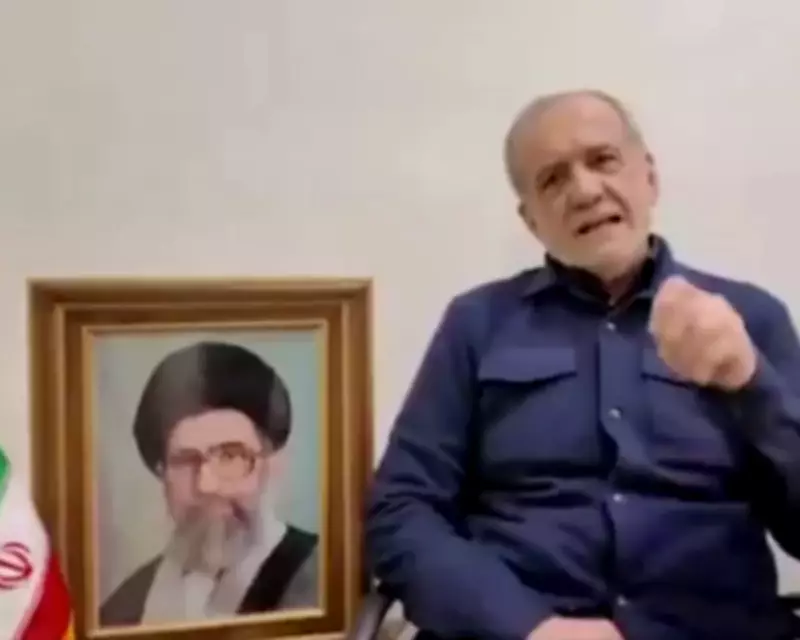
Iranian President's Televised Apology Ignites Political Firestorm
In a dramatic televised address, Iranian President Masoud Pezeshkian issued a formal apology to neighboring countries that had been attacked by Iranian forces, triggering immediate and fierce backlash from hardline factions within the country. The president's unprecedented statement has exposed significant rifts within Iran's political and military establishment during a period of heightened regional tensions.
Contradictory Messages and Military Pushback
The surprise offer by President Pezeshkian to refrain from attacking neighboring countries—provided their airspace and US bases within their territories are not used against Iran—was met with apparent contradiction from military authorities. The Islamic Revolutionary Guard Corps (IRGC) issued a statement emphasizing that while they respect neighboring countries' sovereignty, all US and Israeli military interests in the region remain legitimate targets for "crushing and fierce blows."
This military response effectively created a parallel narrative to the president's conciliatory message, highlighting the complex power dynamics within Iran's leadership structure. Foreign Minister Abbas Araghchi further complicated matters by focusing on escalation risks rather than de-escalation, specifically citing a US attack on a freshwater desalination plant on Qeshm Island that impacted water supply to thirty villages.

Calls for New Supreme Leadership
The political turmoil has prompted calls from conservative clerics and hardline media outlets for the rapid installation of a new Supreme Leader to marginalize President Pezeshkian's influence. Ayatollah Makarem Shirazi emphasized that selecting new leadership is "essential in light of the ongoing political confusion," with speculation that an announcement could come as early as this weekend.
The 88-member Assembly of Experts has delayed electing a successor to the assassinated Ayatollah Ali Khamenei, potentially due to deadlock or to allow moderate political forces to gain influence over war strategy. This power vacuum has created uncertainty about established lines of authority, with some analysts suggesting the military may be making targeting decisions independently.
Regional Reactions and Diplomatic Fallout
Gulf states have expressed growing anger about Iranian attacks, particularly since they claim to have clearly communicated that US bases and their airspace would not be used in American operations against Iran. States including Qatar have reported damage to civilian infrastructure including oil refineries, hotels, and airports—targets that extend beyond purely military facilities.
Bahrain reportedly became the first Gulf country to fire back at Iran following continued attacks on its facilities, though these reports remain unconfirmed. Gulf Cooperation Council foreign ministers are scheduled to meet on Sunday to formulate a coordinated response to the evolving situation.
Internal Criticism and Political Interpretations
Within Iran, President Pezeshkian's remarks generated a spectrum of interpretations and criticism. Ali Asghar Nakhaeirad, a Mashhad MP, argued that Arab countries hosting US bases are "accomplices" in attacks against Iran and should be punished rather than apologized to. He suggested that instead of apologies, Iran should "raze the palaces of the emirs to the ground."
Conversely, Mashallah Shamsolvaezin, a member of the government information council, viewed the apology positively as demonstrating both the president's personal humility and Iran's flexible foreign policy toward neighboring countries. This division reflects broader uncertainty about whether all US bases remain legitimate targets or only those actively used against Iran.
Strategic Implications and Future Uncertainty
The internal dispute reveals how wartime conditions have diffused power within Iran's political system, with established authority structures in flux. A western diplomat described the president's address as merely "one data point," noting uncertainty about whether reduced Iranian attacks represent deliberate policy or military necessity.

President Pezeshkian insisted his offer resulted from collective decision-making by the temporary tripartite group running the country following Khamenei's assassination, while others suggested it emerged from recent talks with Gulf states. Meanwhile, the release of at least three high-profile political prisoners since Khamenei's killing indicates potential political maneuvering among competing factions.
As regional tensions continue, the fundamental question remains whether Iran's military and political leadership can present a unified front, or whether internal divisions will complicate both regional diplomacy and military strategy in the coming weeks.





