

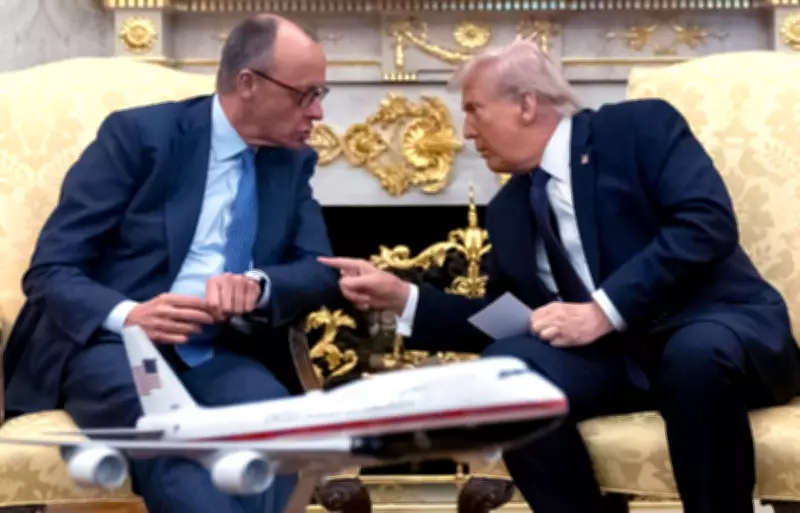
German Chancellor Merz Emphasizes Ukraine's Territorial Integrity in Talks with Trump
German Chancellor Friedrich Merz held a crucial meeting with former US President Donald Trump in the Oval Office on Tuesday, where he underscored the imperative for Ukraine to maintain its territorial integrity amid the ongoing conflict with Russia. Merz, during his third visit to the presidential office, conveyed to Trump that Ukraine should not be forced into accepting further territorial concessions, highlighting the war-torn nation's security interests as paramount.
Merz's Firm Stance on Continued Support for Kyiv
In discussions with reporters, Merz revealed that he presented a map of Ukraine to Trump to illustrate the devastating impact of the war, now in its 1,470th day following Russia's full-scale invasion four years ago. He stated, "We all want to see this war coming to an end as soon as possible. But Ukraine has to preserve its territory and their security interests." Merz expressed confidence that Trump comprehended the gravity of the situation, emphasizing the necessity for sustained international backing for Kyiv.
Trump responded by assuring Merz that negotiating a peace deal to conclude the Russia-Ukraine war remains a top priority on his agenda. He further commented on the US's capacity to supply munitions, suggesting that America possesses ample resources to combat Iran and simultaneously provide weapons to Europe for use in Ukraine.

Call for Increased Pressure on Moscow
Merz also urged Trump to intensify pressure on Russian President Vladimir Putin, accusing Moscow of stalling tactics that contradict American leadership. "Russia is playing for time here, and in doing so is also acting against the will of the American president. In today's talks, I called for increasing the pressure on Moscow," Merz asserted. He stressed that any peace agreement must have European endorsement to ensure durability, rejecting deals negotiated without continental input.
Concurrently, trilateral talks involving the US, Russia, and Ukraine are underway, aiming to broker a peace settlement. However, Merz cautioned that only a pact supported by Europe can achieve lasting stability, warning against agreements imposed from above.
Related Developments in European Sanctions and Military Strategy
In a separate incident, Belgium seized a suspected Russian "shadow fleet" oil tanker, the Ethera, in the North Sea, holding it on a €10 million bond after inspections uncovered 45 violations, including technical defects and false flag registration. Belgian Mobility Minister Jean-Luc Crucke declared, "The ship will only leave the port once it is compliant and the deposit has been paid." Russia has previously denounced such seizures as acts of piracy, escalating tensions over western sanctions evasion.
On the military front, the US has rapidly deployed the Low-Cost Uncrewed Combat Attack System (LUCAS) drone in Iran, modeled after Iranian technology, as part of efforts to accelerate weapons programs influenced by drone warfare observations from Ukraine. Defense officials noted that this swift deployment, occurring just eight months after its Pentagon unveiling, reflects lessons learned from the conflict, where both sides utilize thousands of low-cost unmanned systems.
EU-Ukraine Discussions on Energy and Aid
European Commission President Ursula von der Leyen and Ukrainian President Volodymyr Zelenskyy engaged in discussions regarding the Druzhba pipeline, a focal point in disputes with Hungary and Slovakia that has delayed approval of a €90 billion EU loan to Kyiv. A commission spokesperson confirmed the call but withheld specifics, while von der Leyen mentioned on social media that topics included the loan, Russian sanctions, and the Middle East's impact on energy prices and defense material availability.






