

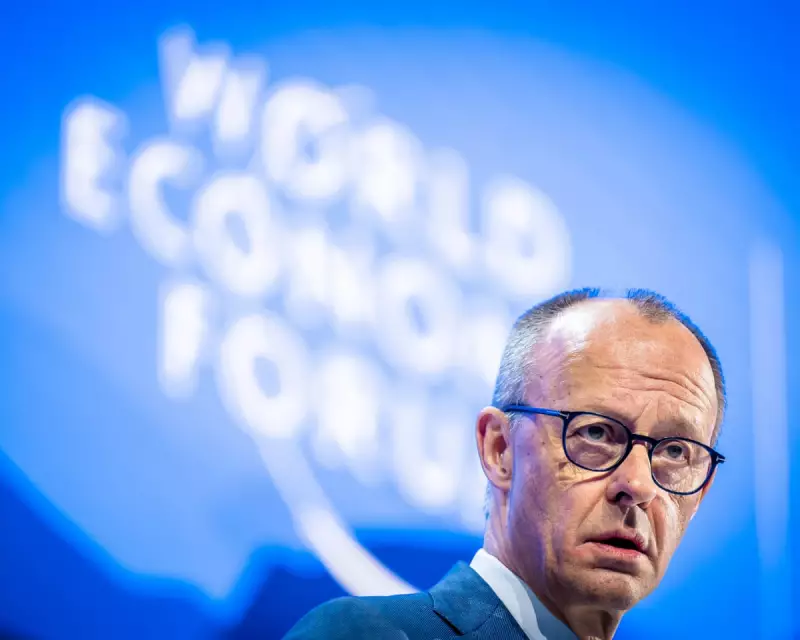
German Chancellor Delivers Stark Warning About New Global Reality
German Chancellor Friedrich Merz has delivered a sobering assessment of international relations during his address to world leaders at the World Economic Forum in Davos, declaring that the global community is entering a challenging new era of "great power politics."
Global Order Changing at 'Breathtaking Pace'
Speaking to assembled dignitaries and business leaders on Thursday, Merz warned that the foundations of the established world order are being shaken and unravelled at what he described as a "breathtaking pace." The German leader pointed to multiple geopolitical developments driving this transformation, including Russia's ongoing war in Ukraine, China's ascension into the ranks of major global powers, and the radical reshaping of American foreign and security policy under former President Donald Trump.
"This new world of great powers is being built on power, on strength and when it comes to it, on force," Merz stated emphatically. "It is not a cosy place." He urged his fellow leaders gathered in the Swiss resort not to passively accept this emerging reality but to actively work to "shape the future" through decisive action.

Echoing Concerns About Power Dynamics
Merz's stark assessment aligned with concerns expressed earlier in the week by Mark Carney, Canada's prime minister, who told forum participants that intensifying rivalry between major powers was causing significant ruptures in the international system. The German chancellor directly referenced Carney's remarks, noting that the Canadian leader had observed: "We must no longer rely only on the power of our values. We must also recognise the value of our power."
"I share that view," Merz affirmed. "And when I look into this hall, I want to say: we share it. That is a good starting point." He emphasized that the greatest strength available to democratic nations remains their ability to build partnerships and alliances among equals based on mutual trust and respect.
Historical Lessons and Contemporary Dangers
The German leader delivered a particularly poignant warning about the dangers of a world where only raw power matters, noting that such an environment proves dangerous first for smaller states, then for middle powers, and ultimately even for the great powers themselves. Drawing from his nation's difficult history, Merz reflected: "I do not say this lightly. In the 20th century, my country, Germany, went down this road to its bitter end. It pulled the world into a black abyss."
This reshaping of global power structures has emerged as a central theme throughout this year's World Economic Forum discussions, particularly as NATO alliances face testing pressures from various geopolitical developments.
European Response and Transatlantic Relations
Merz outlined what he believes Europe must do to navigate this new era of great power competition effectively. He called for enhanced European unity and improved competitiveness as essential components for pushing back against emerging power dynamics. This would require substantial investment in defence capabilities, implementation of measures to boost economic competitiveness, and strengthened unity among European nations and their "like-minded partners" worldwide.
The German chancellor also addressed recent developments concerning former President Trump's interest in acquiring Greenland, welcoming Trump's announcement about reaching a "framework of a deal" with NATO regarding the territory. Merz warned unequivocally that any threat to acquire European territory through force would be completely "unacceptable."
Regarding Trump's previously threatened tariffs over the Greenland dispute, Merz stated firmly: "New tariffs would undermine the foundations of transatlantic relations. Europe's answer would be united, calm, measured and firm." This statement came as Trump departed Davos on Thursday afternoon, having earlier threatened European countries with "big retaliation" if they sold their holdings of US Treasury bonds.

Financial Dimensions of Geopolitical Tensions
The financial implications of these geopolitical tensions surfaced during forum discussions, with US Treasury Secretary Scott Bessent addressing concerns about European nations potentially divesting from American debt instruments. Bessent insisted he remained unworried about such possibilities, despite suggestions from some financial analysts that European sales of US Treasury holdings could occur. The Treasury secretary notably dismissed Denmark's investment in US bonds as "irrelevant," mirroring his assessment of Denmark's broader geopolitical significance.
Merz's comprehensive address at Davos highlighted the profound shifts occurring in international relations, emphasizing that democratic nations must recognize both the value of their principles and the necessity of maintaining tangible power in an increasingly competitive global landscape.





