

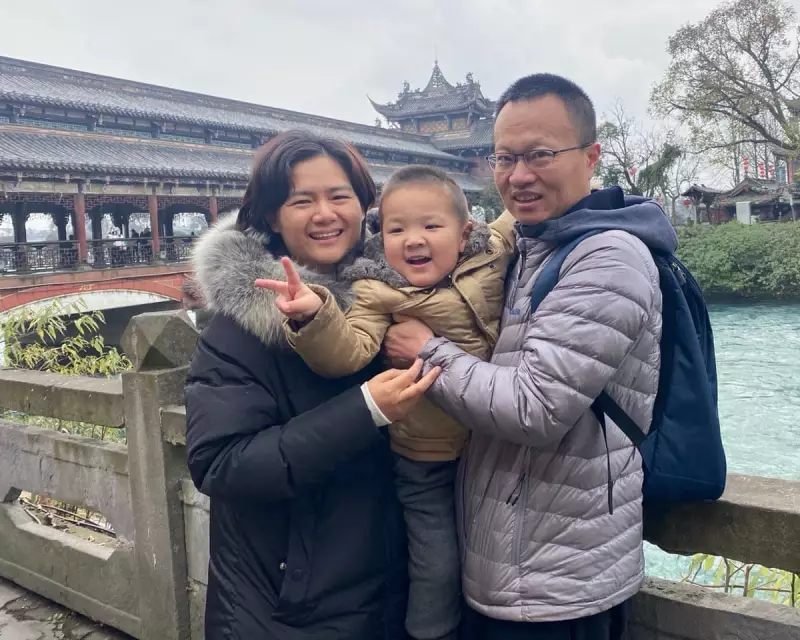
A senior pastor from one of China's most prominent unofficial Christian churches is being held in a detention centre in southern China, while his wife and young son have fled the country. The case of Gao Yingjia is part of what observers describe as the most severe crackdown on Christians in the country since 2018.
Midnight Raid and Family's Flight
The arrest unfolded in the early hours of the morning. Gao Yingjia and his wife, Geng Pengpeng, were hiding at a friend's house in a Beijing suburb when plain-clothed individuals claiming to be police officers knocked at the door at 2am. With their six-year-old son asleep upstairs, the couple went downstairs to meet them, aware their time had run out.
Two months on, Gao remains detained in Guangxi province, facing a charge of "illegal use of information networks". His wife, Geng, has since escaped overseas with their son, now grappling with an agonising decision.

"We both knew that as Christians in China, there were risks," Geng stated. "But to be honest, you can never be fully prepared." She now questions her reality, asking, "Sometimes I wonder, is this real?"
A Widening National Crackdown
Gao was a senior pastor at Zion Church, a large underground "house church" network with thousands of members across China. His detention in October coincided with the arrest of Zion's founder, Jin Mingri (also known as Ezra Jin), and nearly 30 other pastors and members. Eighteen of those detained have been formally arrested and could face long prison sentences.
This action is not isolated to Zion Church. In a separate incident last week, the NGO Human Rights in China reported that more than 100 people were detained in Wenzhou, Zhejiang province, during raids on Christian groups. Pressure in Wenzhou had mounted for months following a dispute over installing a Chinese national flag inside a local church.
The crackdown appears nationwide. In May, pastor Gao Quanfu from the separate Light of Zion church was arrested with his wife. Several members of the Golden Lampstand Church network were reportedly given lengthy prison sentences for fraud. Throughout the summer, over 100 Zion Church members were questioned by police.
The End of an Era for Unofficial Worship?
China officially recognises five religions: Buddhism, Taoism, Islam, Protestantism, and Catholicism. However, all religious activity must occur within state-sanctioned institutions. For decades, many Christians have worshipped in unofficial house churches to avoid government oversight.
Zion Church, founded in 2007, once operated openly from a converted nightclub in Beijing. Following a major crackdown in 2018—which saw another house church leader, Wang Yi, sentenced to nine years for inciting subversion—Zion was forced to close its physical space. It adopted a hybrid model of online sermons and small, secretive in-person gatherings.
Ian Johnson, author of The Souls of China, noted that after 2018, unofficial churches went underground, with Zion being one of the most successful. He suggests the October arrests are meant to send a clear message that such activity is "not acceptable." Johnson described the latest moves as potentially "the final nail in the coffin" for these churches.
The government's stance has been reinforced by new rules. In September, China banned unlicensed religious groups from holding online sermons. President Xi Jinping has also chaired meetings urging the "Sinicization of religions," aligning faith practices with state ideology.
International Alarm and Uncertain Future
The crackdown has drawn international condemnation. US Secretary of State Marco Rubio condemned the actions and called for the church leaders' release, urging China to "allow all people of faith... to engage in religious activities without fear of retribution."
Despite the risks, unofficial Christianity has shown resilience. After the 2018 crackdown, Jin Mingri believed his church would continue to grow. His daughter, Grace Jin Drexel, confirmed that Zion's core membership subsequently grew from 1,500 to 5,000, with online sermons reaching even more.
Just weeks before his arrest, when asked if he feared detention, Jin reportedly replied, "Hallelujah, a new wave of revival will follow."

Official estimates suggest around 3% of China's population is Christian, a figure stable for over a decade. However, a 2018 survey indicated as many as 7% may believe in a Christian deity, suggesting many worship in silence. The current crackdown may further push faith out of public view, cementing the state's control over religious expression in China.





