

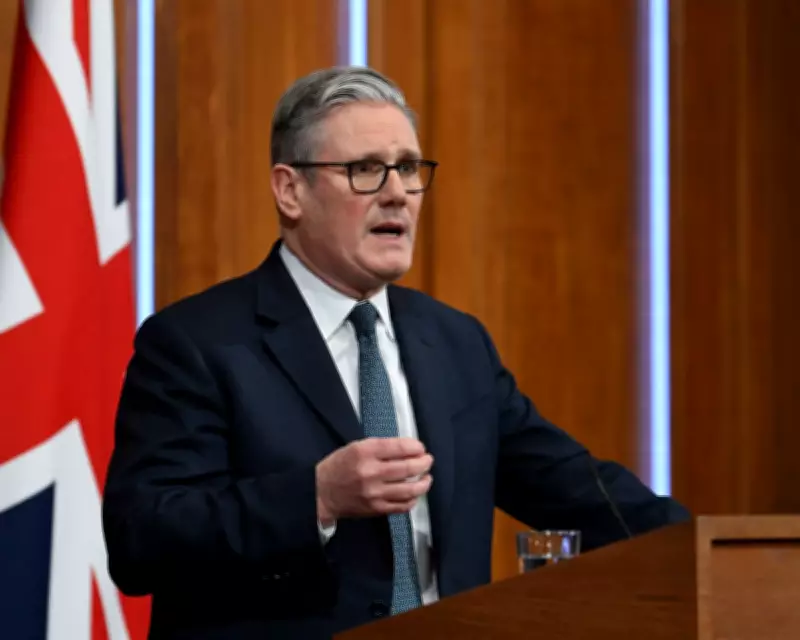
Starmer Advocates for Negotiated Settlement in Iran Conflict, Defends UK's Diplomatic Approach
Prime Minister Keir Starmer has stated that the ongoing conflict involving Iran in the Middle East may persist "for some time," while emphasizing that a negotiated settlement with Tehran represents the "best way forward" in the long term. During a press conference at Downing Street, Starmer outlined the UK's commitment to de-escalation, contrasting with US President Donald Trump's focus on regime change and dismissal of negotiations as "too late."
UK's Decision to Abstain from Initial Strikes
Starmer defended his choice to block the UK's participation in initial offensive strikes by the United States and Israel over the weekend, asserting that he "stands by" this judgment. He denied that this decision has harmed the special relationship between the UK and the US, highlighting ongoing cooperation at military bases where British and American forces are working together. "The special relationship is operating right here at an important point," Starmer remarked, addressing concerns about bilateral tensions.
Criticism and Response from the Prime Minister
Despite his stance, Starmer has faced criticism from Gulf states and Cyprus for perceived insufficient protection of regional allies and British citizens from Iranian strikes. Additionally, he has been subject to personal attacks from President Trump. In response, Starmer emphasized the UK's deployment of military assets, including four more Typhoon fighter jets to Cyprus and two anti-missile helicopters, to safeguard British nationals. "It means having the strength to stand firm by our values and our principles, no matter the pressure to do otherwise," he stated firmly.

Cabinet Unity and National Security Council Support
The prime minister insisted that "all ministers" on the national security council supported the UK's position on the use of British bases, countering reports of cabinet opposition led by Energy Secretary Ed Miliband. Starmer clarified that no formal request from the US for defensive strikes was received until Saturday afternoon, making any earlier decision moot. "We then worked through the details with the US over the next day... the decision on Sunday was a decision of all ministers among us," he explained, underscoring collective responsibility.
Evacuation Efforts and Warnings for British Citizens
Starmer provided updates on evacuation efforts, noting that over 4,000 people have returned to the UK on commercial flights from the UAE, with additional government charter flights from Oman underway. However, he issued a warning for hundreds of thousands of Britons still in the region, describing the operation as "one of the biggest of its kind" and "many times bigger than the evacuation from Afghanistan." He assured that the government "will not stop until our people are safe," but cautioned that the process "is not going to happen overnight."
Long-Term Diplomatic Strategy
Reiterating the UK's longstanding foreign policy, Starmer advocated for a negotiated settlement with Iran that addresses its nuclear ambitions. "The longstanding British position is that the best way forward for the regime and the world is a negotiated settlement with Iran where they give up their nuclear ambition," he said. This approach, he argued, aligns with the national interest and justifies the UK's abstention from initial military actions, positioning diplomacy as a cornerstone of resolving the crisis.






