

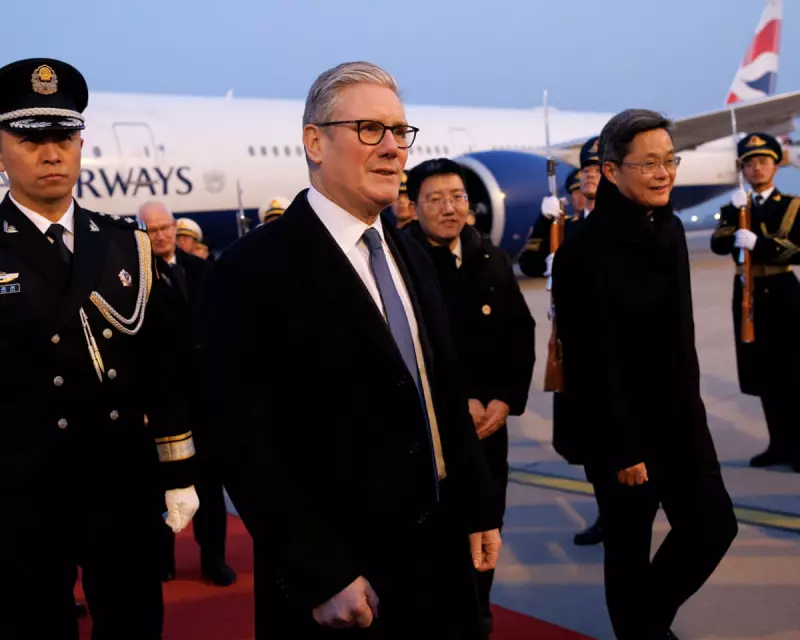
Prime Minister Keir Starmer arrived in Beijing on 28 January 2026, embarking on a high-stakes diplomatic mission that underscores the complex challenges facing the United Kingdom in its relationship with China. The visit marks a significant moment in UK foreign policy, coming after an eight-year hiatus since a British prime minister last travelled to the Chinese capital.
The Diplomatic Tightrope: Commerce Versus Security
Sir Keir Starmer finds himself attempting to perform what observers describe as a difficult balancing act. On one hand, he must pursue commercial opportunities with an economic powerhouse that accounts for nearly one-fifth of global GDP and boasts manufacturing output exceeding all G7 nations combined. China's formidable artificial intelligence sector represents the only genuine competitor to American dominance in this crucial field, while its leadership in green energy technology presents attractive prospects for international cooperation.
On the other hand, the prime minister must protect national security interests when engaging with what many describe as an authoritarian behemoth. This delicate diplomatic dance occurs against an ominous global backdrop where traditional alliances have become increasingly unstable. The United Kingdom's historical relationship with Beijing has typically been anchored, and sometimes dictated, by its alliance with Washington. However, Donald Trump's presidency introduced new complications through what critics describe as marauding behaviour toward former allies, including sabotage of NATO commitments and indiscriminate tariff impositions.

The Conservative Critique and Labour's Defence
Conservative critics have accused Sir Keir of performing what they characterise as a "kowtow" to President Xi Jinping, though these accusations often focus more on enumerating grievances with Chinese Communist Party rule than proposing viable alternative policies. Former Conservative minister Kemi Badenoch claimed she would not make the trip in Sir Keir's position, a stance that Labour supporters argue demonstrates insufficient understanding of prime ministerial responsibilities.
The prime minister has defended his approach by noting that Britain had become something of an outlier in Europe regarding engagement with China, and that maintaining functional dialogue with such a significant global power represents rational foreign policy. Sir Keir has pledged to "raise what needs to be raised" with President Xi, employing standard diplomatic language that allows for discussion of sensitive topics while maintaining professional decorum.
Points of Contention: The Challenges of Engagement
Numerous serious concerns complicate the UK-China relationship and cannot be brushed aside in pursuit of economic benefits. These include the dismantling of civil rights protections in Hong Kong, the imprisonment of pro-democracy businessman and British citizen Jimmy Lai, and what some Labour MPs previously characterised as genocide against the Uyghur minority when in opposition.
Additional points of tension include Beijing's support for Vladimir Putin's war in Ukraine, aggressive espionage activities described by a former MI6 chief as a "full press" operation, and intimidation of dissidents within Britain's Chinese diaspora community. These issues create what many observers see as a fundamental contradiction between upholding democratic values and pursuing commercial interests with an authoritarian regime.
The Prime Minister's Foreign Policy Approach
In a substantial exposition of his foreign policy approach last year, Sir Keir insisted that engagement with China would never lead him to "trade off security in one area, for a bit more economic access somewhere else." This represents a fine ambition, though in practice, the competing demands of commercial opportunity and strategic wariness inevitably create tensions that require careful navigation.

The prime minister has previous form when it comes to denying the existence of such conflicts of interest. He refuses to accept, for instance, that his courtship of President Trump and his reset of relations with the European Union pull Britain in potentially contradictory directions. The contradiction between upholding democratic values and engaging with President Xi's government appears even more stark, presenting Sir Keir with one of his most significant foreign policy challenges.
Looking Forward: The Path Ahead for UK-China Relations
While few serious analysts suggest refusing engagement with China represents a viable policy option, many question whether the prime minister can successfully navigate the inherent tensions in this relationship. The contradiction between democratic principles and pragmatic diplomacy with Beijing will require more than pre-summit assurances to resolve satisfactorily.
As Sir Keir Starmer continues his visit to Beijing, the world watches to see whether Britain can develop a coherent China strategy that balances economic opportunity with security concerns and human rights considerations. The outcome of this diplomatic mission could shape UK foreign policy for years to come, establishing precedents for how democratic nations engage with authoritarian superpowers in an increasingly multipolar world.





