

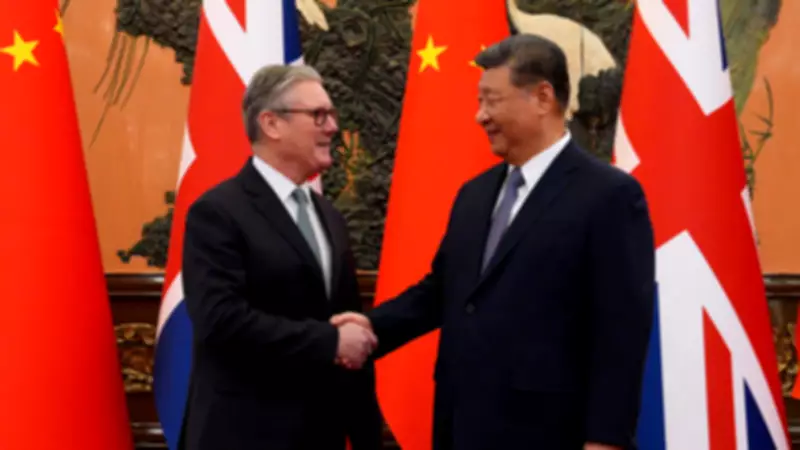
Amid the swirling political chaos surrounding Donald Trump's disruptions to traditional alliances, Prime Minister Keir Starmer's recent trip to China has arrived at a remarkably opportune moment for Beijing. For China, which aspires to position itself as the world's most reliable superpower, this visit offers impeccable optics to showcase stability and leadership on the global stage.
A Middling Power Seeks Reset
Let's be candid: in the eyes of China, the United Kingdom is not viewed as a particularly significant or influential player on the world scene. Post-Brexit, the UK's global impact has notably diminished, and it is often regarded as a middling power at best. This perception is compounded by a decade of inconsistent China policy, limited diplomatic outreach, and increasingly hawkish attitudes within both the British Parliament and the general public.
Given this backdrop, it is hardly surprising that China did not extend the full five-star treatment to Starmer that it reserves for some visiting leaders. However, despite these challenges, there were clear indications that the Chinese authorities were pleased to host a British Prime Minister, largely for the symbolic value it provides.

Optimism and Warmth in Diplomatic Exchanges
Much of the public discourse during the visit was marked by a notable sense of optimism and even warmth. From the Chinese perspective, this encounter represents a potential moment of reset, with genuine opportunities on the horizon. While the official Chinese releases did not delve into exhaustive detail regarding specific agreements, there was a palpable sense that progress was being made.
The discussions highlighted hopes for enhanced cooperation in several key areas:
- Education and healthcare sectors
- Financial services
- Joint research into cutting-edge fields such as artificial intelligence, biosciences, new energy, and low-carbon technologies
This appears to be a mutually beneficial arrangement: services constitute the UK's most crucial export to China, while China leads the world in manufacturing green energy technologies and is perpetually seeking expanded markets for these products.
Navigating Sensitive Issues
It is evident that more contentious matters were also addressed behind closed doors, with China keen to control the narrative on certain topics. On the issue of Taiwan, the UK reaffirmed that its position "remains unchanged and will not change." Taiwan, a self-governing island that China claims as its own, is not officially recognised as an independent entity by most countries, including the UK. Securing public restatements of this stance is of paramount importance to Beijing.
Additionally, Keir Starmer had pledged to raise the case of Jimmy Lai, the imprisoned Hong Kong democracy campaigner. The Chinese readout succinctly noted that both parties agreed "Hong Kong's prosperity and stability are in the common interest of both countries." This phrasing is likely diplomatic code indicating that the issue was discussed, but China remains unwavering in its position.
The US Factor and Global Dynamics
Perhaps the most intriguing aspects of the visit were the subtle, yet unmistakable, references to the United States. Chinese officials highlighted concerns about "unilateralism, protectionism, and power politics" running rampant, describing the current era as "turbulent and fluid." From Beijing's viewpoint, the significance of today's meeting lay not solely in tangible achievements, but in who was observing the proceedings.
Playing the Long Game
The optics of the British Prime Minister revitalising this relationship at precisely the moment when Donald Trump is sowing discord in traditional transatlantic partnerships are exquisite for China. Under President Xi Jinping, China has long cultivated the narrative that it is, in fact, the world's most reliable superpower, advocating that nations should look to it—rather than the US—for stable global leadership.
The current chaos engendered by Trump, coupled with a growing list of European powers seeking to engage with China, significantly bolsters this sales pitch. China does not anticipate abrupt shifts in allegiance, but it certainly perceives the broader situation as ripe with opportunity.

In his opening remarks, Xi Jinping quoted a Chinese proverb penned by Chairman Mao: "range far your eyes over long vistas." The implication is clear: it is wise to step back, consider the bigger picture, and avoid becoming overly distracted by short-term gains or losses. China consistently plays a long and strategic game. Rekindling a relationship with this middling power is undeniably a part of that grand strategy.





