

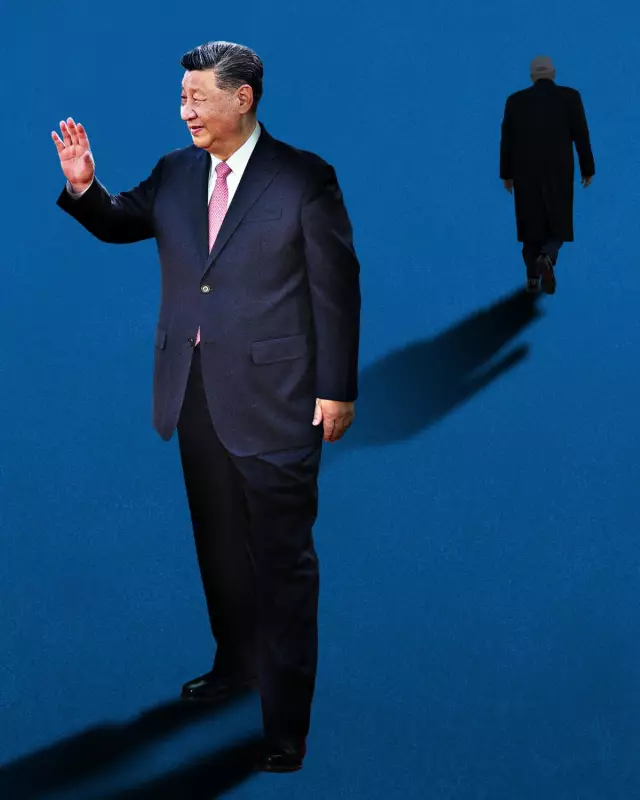
In a striking geopolitical realignment, Beijing appears to be heeding Napoleon's age-old advice: 'Never interrupt your adversary when he's making a mistake.' This maxim resonates as China capitalises on the turmoil sown by Donald Trump's unpredictable leadership, drawing Western allies closer despite longstanding tensions.
Charm Offensive Amidst American Instability
China has launched a concerted charm offensive targeting Western leaders, a strategy facilitated by Trump's increasingly erratic power grabs on the global stage. Recent events, such as his threats over Greenland and tariff disputes, have left European nations questioning the reliability of the United States as a partner.
An editorial in the Chinese state-run Global Times underscored this pitch, urging Europe to consider building a 'China-EU community with a shared future' to avoid a return to the 'law of the jungle.'

Western Nations Recalibrate Alliances
In the search for stability, US allies are turning to China, a country many in Washington view as an existential threat. Eva Seiwert, a senior analyst at the Mercator Institute for China Studies, notes that with US policy looking unpredictable, European leaders are keeping channels with Beijing open, risking deeper dependencies on China.
Mark Carney, Canada's prime minister, exemplified this shift during his visit to Beijing, where he announced a new strategic partnership with China. He described the global order as at a point of 'rupture,' not merely transition, and agreed to lower tariffs on Chinese electric vehicles from 100% to 6.1%, a move that diverges from US alignment.
China's Cautious Response and Global Perceptions
Officially, China approaches this rebalancing with caution. Song Bo, a fellow at Tsinghua University, points out that Chinese policymakers are reluctant to publicly admit the fundamental changes in the global order, given China's historical benefit from the post-Cold War system.
Ryan Haas, a senior fellow at Brookings, observed on social media that Beijing seems to be following Napoleon's maxim by not interrupting Trump's mistakes. This aligns with President Xi Jinping's talk of 'great changes unseen in a century,' echoing Carney's sentiment of global rupture.
UK and European Dynamics
UK Prime Minister Keir Starmer is set to visit China with a complex agenda. While he has a warmer relationship with Trump, he faces domestic pressure to be tough on China regarding security and human rights. Steve Tsang of the Soas China Institute suggests Starmer will seek to improve economic ties without viewing China as a more reliable partner than the US.
Similarly, Finland's Prime Minister Petteri Orpo will visit Beijing, navigating issues like China's support for Russia in the Ukraine war, which has strained relations with Nordic states.
Challenges and Future Prospects
The pivot to Beijing is fraught with challenges. Song notes that the European Commission remains hostile to China, creating a disconnect with warmer bilateral ties. The war in Ukraine and concerns over economic dependence on China, reminiscent of past reliance on Russia, pose significant barriers.
Despite these hurdles, middle powers are increasingly looking to China for multilateral stability in the face of Trump's disruptive actions. China insists it does not celebrate Trump's behaviour, but the outcome may nonetheless bolster Beijing's position on the world stage.






