

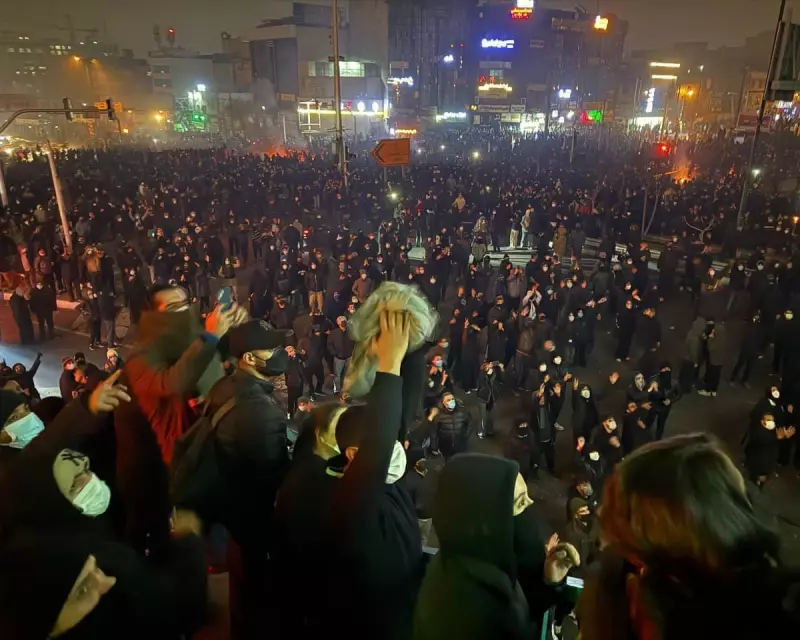
Donald Trump is facing urgent calls from Iranian opposition figures to act on his promises to support protesters facing violent repression in Tehran, but his administration is receiving starkly conflicting advice on the potential consequences of American intervention.
The Dilemma of US Intervention
President Trump has vowed that the United States would "shoot at Iran" if its security forces attacked demonstrators. However, analysts note his team lacks a developed response to the rapidly unfolding crisis, with no major movement of US military assets reported. Key Middle East partners, including Qatar, are urging restraint.
Military options and other possibilities are reportedly being presented to the president, according to the New York Times and Wall Street Journal. The situation is complicated by Tehran's high population density, where roughly 12 million people live, making targeted aerial campaigns highly risky for civilians. A previous US-Israeli assault in June resulted in over 1,000 Iranian deaths, temporarily fuelling nationalism.

Appeals for Action and Warnings of Backfire
Over the weekend, a coalition of seven prominent Iranian political, civil, and cultural figures sent a letter to President Trump. The signatories, including Nobel peace prize winner Shirin Ebadi and journalist Javad Akbarin, urged him to recognise the scale of the repression, which they described as a crime against humanity. They warned that "every minute of delay will expand the dimensions of the crime."
Reza Pahlavi, the son of the former Shah, has also appealed for US action while advising protesters on self-protection. However, many external observers caution that American involvement could prove counter-productive.
Danny Citrinowicz, a former senior Israeli defence intelligence specialist on Iran, questioned whether limited US action would hinder the regime's crackdown or instead raise expectations for deeper involvement that Washington cannot fulfil.
Expert Analysis: Why Intervention Could Strengthen the Regime
Sanam Vakil of Chatham House's Middle East programme argued that US intervention's primary impact would likely be to "shore up elite unity and suppress fractures within the regime" at a moment of internal vulnerability. The Iranian government is already pushing a narrative that the unrest is engineered from abroad.
In a televised address, Iran's President, Masoud Pezeshkian, appealed for national unity against an external enemy encouraging rioters. While acknowledging that 80% of protesters had legitimate grievances, he labelled those burning buildings as terrorists.
Esfandyar Batmanghelidj, chief executive of Bourse and Bazaar, pointed to the Trump administration's failed promises in Ukraine, Gaza, and Venezuela as evidence it lacks the strategy or bandwidth to steward a political transition in Iran.
Rob Macaire, the former UK ambassador to Tehran, noted that US strikes "may not necessarily play out as people expect," citing the June attacks. He highlighted the gap between Trump's rhetoric and the complex reality, stating the regime has no answers to the protesters' economic anger, but nor is there a clear alternative leadership to enthrone.
The overarching warning from multiple analysts is clear: if Washington misjudges its response to the Tehran regime's repression, it risks entrenching the very power structures the protesters are fighting against.






