

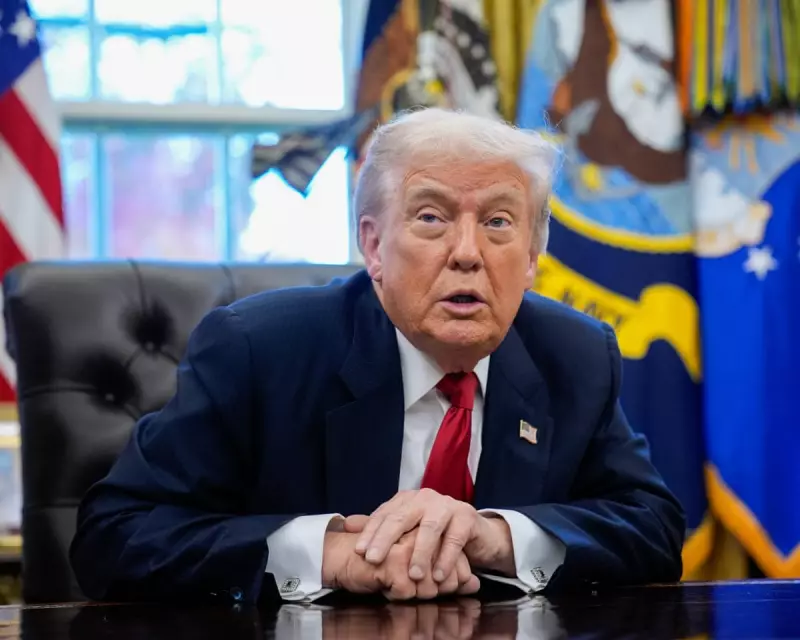
Former US President Donald Trump has given a remarkably candid and wide-ranging interview to the New York Times, laying out a stark vision of a world order governed by national strength and military power rather than international norms. The conversation, held just days after a controversial operation in Venezuela, covered topics from the future of that South American nation to the security of Taiwan and the value of the NATO alliance.
A New Doctrine: Power Over Precedent
Trump, buoyed by what he perceives as the success of the operation to seize Venezuelan President Nicolás Maduro and assert control over the country's oil, spoke freely about his approach to global leadership. He dismissed the relevance of international law, stating plainly, "I don't need international law." When pressed on the limits of his power abroad, he pointed only to his own morality and mind.
On Venezuela, Trump was unequivocal about America's long-term intentions. Contradicting earlier attempts by his cabinet to downplay US involvement, he asserted he was "in charge" and that the US would be running the country for "much longer" than a year. He claimed to be getting along well with interim president Delcy Rodríguez and framed the seizure of Venezuelan oil as a move that would provide money the country "desperately needs."

Alliances and Acquisitions: Questioning NATO's Worth
The interview revealed a president deeply sceptical of traditional alliances. Trump renewed his push for the United States to acquire Greenland, not ruling out the use of military force to do so. He argued that outright ownership, rather than operating bases under an existing treaty, was "psychologically needed for success."
This ambition placed him in direct conflict with the NATO alliance, of which Greenland's sovereign power, Denmark, is a member. When asked by White House correspondent David E Sanger whether obtaining Greenland or preserving NATO was more important, Trump declined to answer, acknowledging it "may be a choice." He dismissed the alliance's utility without US leadership, stating, "If you look at NATO, Russia I can tell you is not at all concerned with any other country but us."
Taiwan's Status and Nuclear Treaties
Trump sought to downplay fears that his actions in Venezuela could embolden China to move against Taiwan. He argued the scenarios were not comparable, citing drug flows and prison releases from Venezuela. While he said it was up to Chinese leader Xi Jinping what action to take, Trump stated he would be "very unhappy" with any change to the status quo.
He expressed confidence that Xi would not attempt an invasion while he, Trump, was president, suggesting it might be a move for a successor. On nuclear arms control, Trump indicated he would let the New START treaty with Russia expire in February, saying, "If it expires, it expires. We'll just do a better agreement." He insisted any new pact must include China, which is rapidly expanding its nuclear arsenal.
The nearly two-hour discussion, as reported by the Times, showed Trump in various guises—from conspiratorial to casually hospitable, even taking a call from Colombian President Gustavo Petro in front of the journalists. The interview paints a picture of a leader unconstrained by diplomatic convention, intent on reshaping global power dynamics through a lens of uncompromising national interest.






