

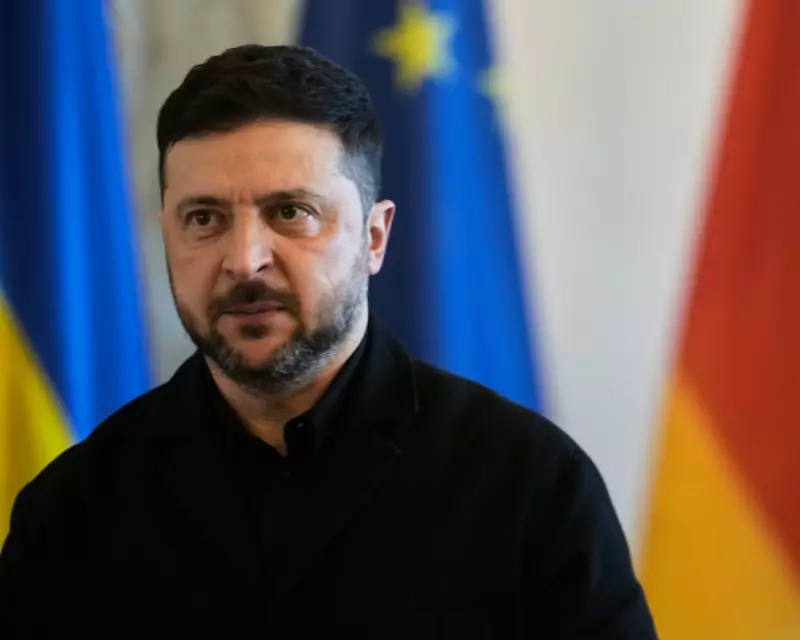
Ukrainian President Volodymyr Zelenskyy has arrived in Berlin for a critical series of meetings with European and American officials, as pressure mounts to find a path to end the ongoing war with Russia. The talks, hosted by German Chancellor Friedrich Merz, come amid a concerted push from the United States to broker a swift conclusion to the conflict.
European Unity and American Pressure
Leaders from Britain, France, Germany, NATO, and the EU are convening with President Zelenskyy at the German chancellery on Monday evening. This show of European solidarity follows previous criticism of US-led peace proposals considered too favourable towards Moscow. The working dinner also includes an invitation to Donald Trump's special envoy, Steve Witkoff, and the former US president's son-in-law, Jared Kushner, who are conducting parallel peace negotiations in the German capital.
Witkoff indicated that significant progress was made after a five-and-a-half-hour meeting with Zelenskyy on Sunday, though he provided no specific details. A photograph from the chancellor's office symbolised the complex dynamics, showing Merz seated beside Zelenskyy in a gesture of support, facing Witkoff and Kushner across the table, though the German leader did not participate in the substantive discussions.

Key Sticking Points and Concessions
The search for a viable peace agreement faces major hurdles, primarily concerning the status of Ukraine's eastern Donbas region, which remains largely under Russian occupation. In a significant shift, Zelenskyy expressed a readiness to abandon Ukraine's pursuit of NATO membership if Western nations provided legally binding security guarantees equivalent to the alliance's Article 5 mutual defence clause.
"Today, bilateral security guarantees between Ukraine and the US, Article 5-like guarantees for us from the US, and security guarantees from European colleagues... are an opportunity to prevent another Russian invasion," Zelenskyy stated via a WhatsApp chat with reporters. He also voiced hope that Washington would support freezing the current frontline, rather than Ukraine ceding the entire Donbas, calling this the "fairest possible option."
A European Security Crossroads
European leaders have framed the outcome of these talks as decisive for the continent's long-term security. Chancellor Merz warned that the era of 'Pax Americana'—reliance on US military power for European security—is largely over. He asserted that Russian President Vladimir Putin's goal is a fundamental redrawing of European borders and a restoration of the Soviet Union's former reach. "If Ukraine falls, he won't stop," Merz told a conservative conference in Munich. Russia has denied any intention to attack NATO members.
French President Emmanuel Macron pledged ongoing support for Ukraine, vowing on social media that "France is, and will remain, at Ukraine's side to build a robust and lasting peace." Meanwhile, in London, the new head of MI6, Blaise Metreweli, was set to deliver her first major speech, labelling Russia an "aggressive, expansionist" threat and promising enduring British support for Kyiv.
As discussions continue, the European Union is scrambling to finalise a plan to use frozen Russian assets to finance Ukraine in the coming years, with a leaders' meeting scheduled for later this week. The Kremlin stated it expects a US briefing on the Berlin discussions and noted that the issue of Ukraine's NATO aspirations remains a "cornerstone" subject for Moscow.






