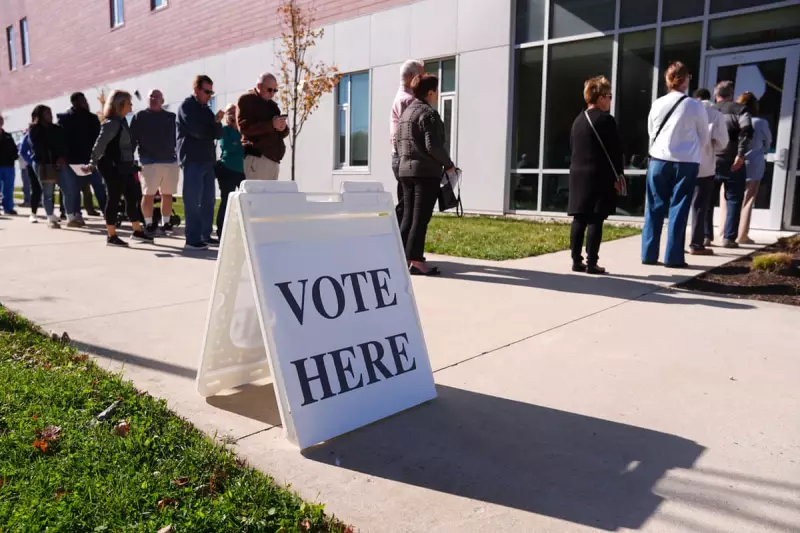
Dramatic Swing in Latino Vote Reshapes US Political Landscape
In a stunning reversal of recent political trends, Latino voters delivered overwhelming support to Democratic candidates during Tuesday's off-year elections, threatening Republican redistricting strategies that had banked on sustained gains with this crucial demographic.
The Numbers Behind the Political Earthquake
The scale of the Democratic resurgence became clear through detailed exit polling from the 27 October 2025 elections. In New Jersey, Democratic representative Mikie Sherrill captured 68% of Latino voters compared with Republican Jack Ciattarelli's 31%, according to NBC News. This represented a dramatic reversal from the 2024 presidential result where Donald Trump won 46% of Latino voters to Kamala Harris's 51%.
In Virginia, Democrat Abigail Spanberger, a fluent Spanish speaker, secured an impressive 67% of Latino voters. Perhaps most telling were the shifts in municipalities with Latino populations exceeding 60%, where Trump had been competitive or even victorious in 2024. These same precincts swung dramatically toward Democrats in 2025, with shifts ranging from 15 to more than 40 percentage points.

MSNBC chief data analyst Steve Kornacki highlighted Passaic county, which is approximately 45% Latino, where Sherrill won by 15 points after Trump had carried it by three points the previous year.
Understanding the Rapid Reversal
María Teresa Kumar, president of Voto Latino, explained that the election results reflected deeper concerns within the Latino community. "What we saw on Tuesday wasn't just a vote for specific candidates: it was a vote against the current situation that the Trump administration has sparked," she said. "People are feeling that it's becoming increasingly dangerous to be Latino in this country."
According to exit polling conducted by SSRS, the data supported this analysis. In California, 63% of voters – and 70% of Latino voters specifically – said the Trump administration's immigration actions had "gone too far". In Virginia, those figures reached 56% overall and 77% among Latino voters.
A Democratic congressional aide familiar with Latino voter engagement offered a straightforward explanation: "Latinos didn't swing back to Democrats because they suddenly became liberal. They swung back because the economy improved and Republicans crossed a line on immigration enforcement. People were scared – not politically activated, but genuinely scared."
Consequences for Future Elections and Redistricting
The Latino voter swing creates immediate vulnerabilities in Republican-drawn congressional maps. In Texas, GOP mapmakers had drawn several south Texas districts with narrow margins, calculating that Trump's 2024 gains represented a stable coalition. Those districts now appear more competitive than intended.
Meanwhile, Democrats are seizing opportunities to redraw maps in states where they hold power, with California voters approving a ballot measure allowing the state's independent redistricting commission to redraw congressional boundaries.
Despite the backlash to immigration enforcement, economic concerns remained the top issue for Latino voters across all states where exit polling was conducted. The Democratic aide noted that while "immigration is rarely the top issue on its own", "ICE raids are activating, and when people feel targeted in their daily lives, that changes votes."
The timing of the electoral shift coincided with heightened immigration enforcement activity. Just days before the New Jersey election, Ruperto Vicens Marquez, a restaurant owner in Atlantic Highlands with work authorization and three young children, was detained by Immigration and Customs Enforcement (ICE), prompting community outcry.
Kumar believes Latino voting behavior shifts based heavily on turnout, but also on economic conditions, candidate quality and the emotional salience of particular issues. "Republicans misread Latino voters this year," she said. "Instead of doing oversight and accountability, they abdicated their responsibility to the whims of the president."

The results underscore a fundamental reality about Latino voters that both parties have struggled to accept: the community is not a monolith, and does not represent a permanent coalition for either side. As Kumar concluded, "It's a swing vote … and so it's for the Democrats to lose, and they have to start speaking to the real duress that the community is in."