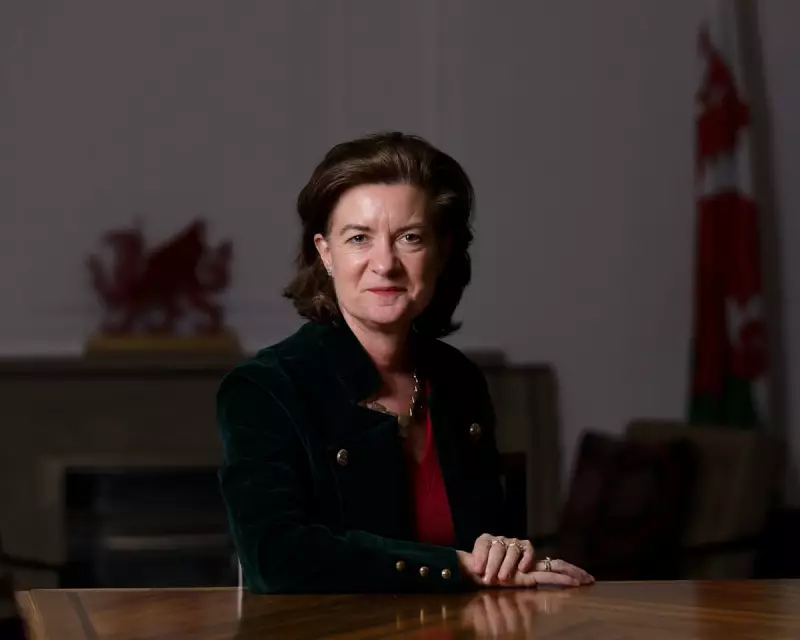
Welsh First Minister Eluned Morgan has issued a defiant pledge to maintain her party's status as the world's most successful democratic political force, despite stark warnings that Welsh Labour could be pushed into third place in next year's crucial Senedd elections.
A Century of Dominance Under Threat
Recent polling indicates a potential seismic shift in Welsh politics. For the first time in a century, Labour's long-held dominance in Wales is at serious risk. Surveys suggest that both Reform UK and Plaid Cymru could secure more seats than Morgan's party in the elections scheduled for May 2024.
Morgan, who became Labour's first female head of government in the UK during the summer of 2024 following Vaughan Gething's resignation over a donations scandal, acknowledged the pressure. "Of course I feel the pressure but I'm also determined to turn this round," she stated. "We're the most successful democratic political party on the planet. It's a long winning streak. We're up for the fight."

The party's vulnerabilities were highlighted by a significant defeat in the high-profile Caerphilly byelection during the autumn. Morgan described the loss as "difficult" but emphasised her role as a leader determined to "turn a page".
New Generation, New Vision for Wales
Morgan pointed to a changing of the guard within the Welsh Labour group in the Senedd as an opportunity for renewal. Founding figures of Welsh devolution, such as former First Minister Mark Drakeford and Social Justice Secretary Jane Hutt, are stepping down.
"They have been here right from the beginning," Morgan said. "But what we have now is the end of austerity and what I'm setting out is a vision, where Wales will move from post-industrial society to one embracing a digital future."
She outlined key policies designed to drive this transformation, including:
- A pioneering nuclear power station project on Anglesey (Ynys Môn), announced in November.
- The creation of two dedicated artificial intelligence (AI) growth zones in south Wales.
Contrasting Her Party with the Challengers
The First Minister launched a robust defence against her main rivals, framing the election as a choice between stability and risk. She argued that a Plaid Cymru-led government would be distracted by the constitutional question of independence, leading to "constant talk about the constitution and a constant battle with the UK government".
On Reform UK, which campaigned heavily in Caerphilly, Morgan was scathing. "Reform have no experience of running anything. That is one hell of a risk for the people of Wales to take," she warned. She dismissed the idea of competing on their "negativity" and "division-making", focusing instead on a positive agenda.
Morgan highlighted Wales's reliance on overseas workers, particularly in the NHS, stating that 48% of doctors and dentists in her mid and west Wales region were trained abroad. She suggested public services and investment would be jeopardised under Reform.
While she expressed previous impatience with UK Labour, Morgan noted she was pleased with recent UK policy shifts on the winter fuel allowance and the two-child benefit cap. She proudly claimed that UK Labour was now following Welsh Labour's lead on initiatives like free school breakfasts and youth employment guarantees.
Addressing private suggestions from some within Labour that a spell in opposition could allow for reinvention, Morgan called the prospect of losing power an "awful thing" for Wales. She pointed to flagship policies like free prescriptions, not available in England, which could be lost.
"Instability is very, very dangerous for the country at a time when the world is facing instability," Morgan concluded. "I think that what we can offer is stability in an age of instability." The battle to preserve Welsh Labour's century-long political hegemony has now formally begun.