

On the frontline of Germany's battle against people smuggling, Chief Inspector Igor Weber and his Pasewalk force engage in a relentless daily game of cat and mouse. Their jurisdiction covers a section of the vast Polish border, a prime location for those attempting to enter Germany unlawfully.
The Grim Reality of Human Cargo
At police headquarters, the evidence of a sophisticated criminal enterprise is stark. Officers display a line of confiscated vehicles used for trafficking. Among them is a gutted refrigerated van, its cold, hard floor once occupied by 18 people transported like livestock. Inside, only sodden sleeping bags and discarded clothes remain. A hole in the roof exposed passengers to rain and the elements during their gruelling journey.
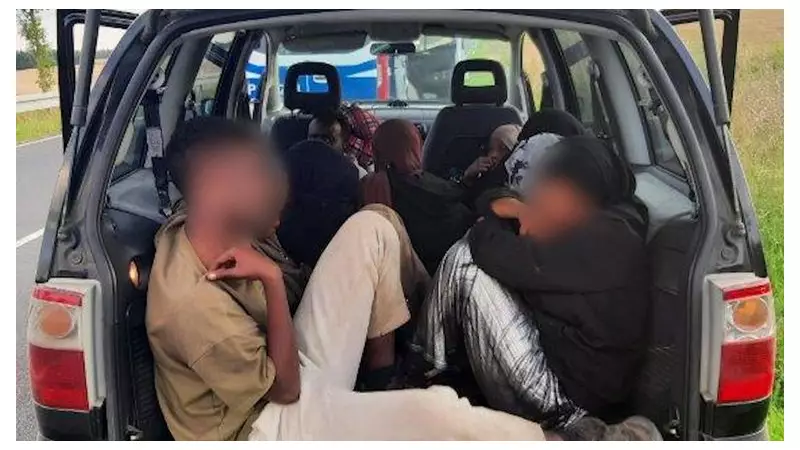
This is not an isolated case. Police images reveal other harrowing scenes: nine East Africans crammed into a car without seats or seatbelts; 16 exhausted Somalis resting on grass after being intercepted. Many of these individuals have been travelling for months, often via a route from Africa, the Middle East or Asia through Russia, Belarus, and the Baltic states into Poland, before targeting Germany's northeast.

A Well-Funded Criminal Racket
The 400km border with Poland, weaving through isolated farmland, dense forests, and villages, offers perfect cover. Chief Inspector Weber demonstrated the smugglers' tactics at a quiet checkpoint. Spotter cars are sent to vantage points to check for police controls. If the coast is clear, vehicles packed with migrants dash through. Smugglers even photograph their clients by a German sign as proof of delivery before abandoning them to continue on foot.
"No border is 100% closed - that doesn't exist," stated Chief Inspector Weber. "People always manage to overcome even the biggest walls or fences, but you can make that more difficult." Official figures suggest Germany's tougher approach is having an impact, with illegal entries down by 25% in 2025 compared to the previous year. Deportations have also risen sharply.
Hardening Attitudes and Human Limbo
Germany's political landscape has shifted dramatically since the welcoming atmosphere of 2015. The rise of the far-right Alternative for Germany (AfD) party and a public hardening on immigration have pushed the ruling coalition to adopt stricter policies. Foreign minister Johann Wadephul defended the measures, stating the need to show "we are able to control who is coming to Germany."
However, these policies leave hundreds of thousands in limbo. At a Berlin church, Pastor Dr Gottfried Martens ministers to 1,400 asylum seekers from Afghanistan and Iran. He spoke of Sayed, an Afghan man whose recent asylum rejection fills him with terror. "They rejected me and said it's safe to go back to Afghanistan," Sayed told Sky News, his face hidden. "Everyone knows the consequences... They won't survive there."
Pastor Martens believes the government's tough stance is driving people away. "Our people see no other way than to look for a country outside of the European Union, which is in fact the UK," he warned.
Could Germany's Problem Become Britain's?
This warning raises a critical question for the United Kingdom. With Germany slashing asylum applications and increasing deportations, where do those fleeing persecution go next? Experts point to the UK as a likely destination, especially since Brexit has made it significantly harder for Britain to return people to EU member states under the Dublin Regulation.
While Germany's 2025 statistics show a decline in illegal migration, the crisis may not be solved but displaced. The complex, well-funded smuggling networks are adaptable. If routes into Germany are constricted, criminal gangs may simply redirect their human cargo towards other perceived safe havens, with Britain high on the list. The daily cat-and-mouse game on the Polish border could soon have serious implications for UK border security and immigration policy.






