

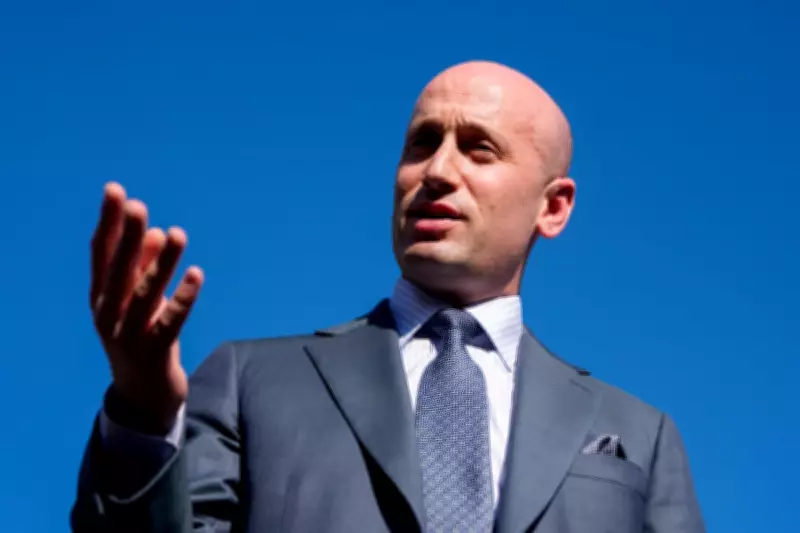
Stephen Miller, the deputy White House chief of staff for policy and a key adviser to former President Trump, has been actively promoting a vision where states take a more assertive role in immigration enforcement, and Tennessee is emerging as the first testing ground for this controversial strategy. In early October 2025, Miller was seen engaging with the media outside the White House, underscoring his ongoing influence in shaping immigration policies. His efforts have now materialised in Tennessee through a suite of legislative proposals that could redefine the balance between state and federal powers in this contentious area.
Model Legislation and Its Broad Implications
Earlier this month, reports from the Knoxville News Sentinel revealed that Miller had been collaborating with Tennessee's speaker of the house, Cameron Sexton, in Washington DC to develop model legislation intended for adoption by states nationwide. This initiative has quickly progressed, with Sexton announcing eight bills designed to integrate state and local officials into the federal immigration framework. The legislation mandates that police officers, judges, teachers, and social workers report undocumented individuals to Immigration and Customs Enforcement (ICE), while also criminalising the release of information about enforcement activities to the public.
Jason Zachary, a Knoxville-area representative and deputy speaker, emphasised the support from the highest levels, stating in a video that the president has backed their efforts on social media, with Tennessee poised to lead the way. This move builds on Tennessee's existing infrastructure, including an immigration enforcement division established last year under the department of safety and homeland security, which operates with significant confidentiality, shielding records from public scrutiny.

Constitutional Challenges and Legal Controversies
One of the most contentious aspects of the proposed bills is the requirement for local school systems to verify the lawful status of K-12 students. Those without legal residency could face tuition charges or even denial of enrollment, directly challenging the landmark 1982 US Supreme Court case, Plyler v Doe, which guarantees undocumented children the right to a free public education. This sets the stage for a potential revisitation of the decision in the current Roberts court, with advocates like Lisa Sherman-Luna of the Tennessee Immigrant and Refugee Rights Coalition expressing alarm over the creation of what she describes as "secret police" infrastructure with zero accountability.
Sherman-Luna highlighted the risks, noting that the state legislature appears undeterred by constitutional concerns, betting on a favourable Supreme Court ruling to reshape legal precedents. The legislation also includes provisions that would make it a felony for state or local officials to negligently release identifying information of officers involved in immigration enforcement, a measure seemingly targeted at Nashville mayor Freddie O'Connell, who had previously published ICE agent names as part of transparency efforts.
Financial and Social Ramifications
The bills extend beyond enforcement to impose financial penalties on non-compliant municipalities, allowing Tennessee's attorney general to withhold state funds and shared sales tax revenue. Given Tennessee's reliance on high sales tax rates, this poses a potent threat to cities like Memphis and Nashville, which have historically clashed with the state over progressive policies. John Ray Clemmons, chair of the Democratic caucus in Tennessee, criticised the focus on immigration as a distraction from pressing issues such as healthcare access and public school funding, arguing that it exploits a broken federal system.
Republican lawmakers, however, justify the legislation by citing the economic burden of undocumented migrants on Tennessee taxpayers. Ken Yager, senate Republican caucus chairman, asserted that rural communities bear the strain, with resources diverted from local needs. The proposed measures require monthly reporting on non-citizens receiving public benefits and an annual comprehensive report on the costs of illegal immigration, aiming to quantify and address these perceived impacts.

Broader Economic and National Effects
As model legislation, Tennessee's proposals could have far-reaching economic consequences. For instance, they would criminalise the use of commercial driver's licenses by individuals without lawful immigration status, echoing conflicts seen in states like California and New York. This could lead to Tennessee state troopers checking the immigration status of out-of-state drivers, creating deportation risks for cross-country truckers and influencing transportation policies nationwide.
Immigration activists in Tennessee are mobilising against these restrictive measures, but Sherman-Luna notes they are under-resourced, with political attention often diverted to federal races and Washington DC chaos. She argues that the fight against authoritarian tendencies is crucial in southern states like Tennessee, where such legislation could set a precedent for others to follow.
In summary, Tennessee's embrace of Stephen Miller's state-led immigration enforcement plan represents a significant test of constitutional boundaries and federal-state dynamics, with implications that could ripple across the country, affecting education, law enforcement, and economic stability.





