

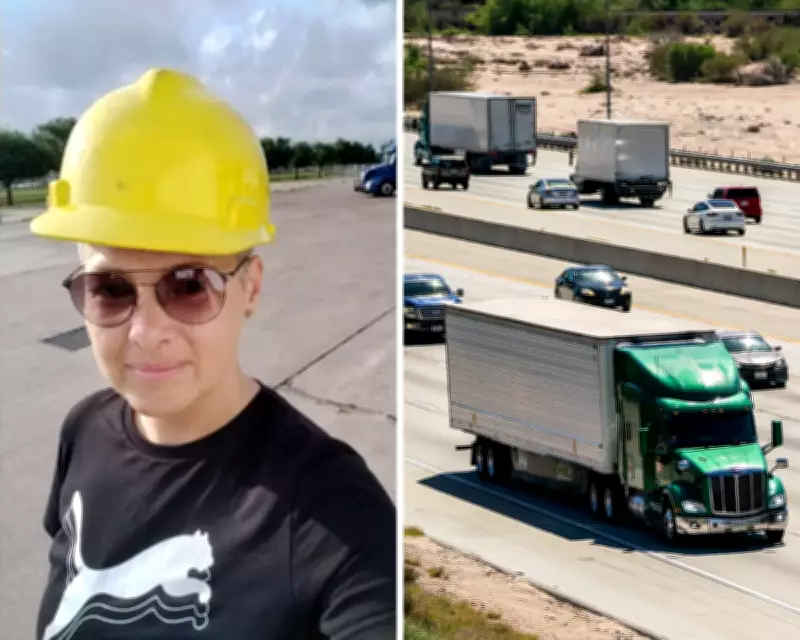
Ukrainian Trucker Chooses War Zone Over US Detention Amid License Crackdown
Karina Krainova, a Ukrainian truck driver who fled Russia's invasion, made a heartbreaking decision last fall: return to her war-torn homeland rather than risk detention by US immigration authorities. Her choice came as new federal restrictions threatened commercial driver's licenses for noncitizen truckers, including thousands of Ukrainians who sought refuge in America.
From Safe Haven to Sudden Uncertainty
Krainova entered the United States legally in 2024 under the Biden administration's Uniting for Ukraine program, which granted temporary safe haven and work authorization to hundreds of thousands of Ukrainians. She enrolled in truck driving classes in January 2025, proudly passing her commercial driving exam in Myrtle Beach, South Carolina the following month.
"I wanted to clarify the new rules because I didn't want to be stopped by ICE officers at a gas station or on the road and be placed in detention," Krainova explained during a phone conversation from Odesa in southern Ukraine.

Her fears materialized when she was asked to show her license during a routine check. "I was asked to show my license and I did and I said I had work authorization and that I had paroled into the US," she recalled. "Then they asked me if I had a green card and I said no. After that, a supervisor came and said I couldn't drive a truck and that my license would be canceled."
Systematic License Cancellations
The South Carolina motor vehicles department confirmed that Krainova's license was canceled on October 6, 2025, nearly a year before its official expiration date. According to state records, 135 other immigrant truck drivers have seen their licenses canceled in South Carolina alone, with similar patterns emerging across multiple states.
While the Uniting for Ukraine program provided renewable work permits, it did not create a pathway to permanent residency or citizenship. This left participants vulnerable to policy changes, particularly as the Trump administration implemented stricter requirements for immigrant drivers.
The broader crackdown extends beyond Ukrainian refugees to affect asylum seekers and other immigrants with work authorizations nationwide. During his State of the Union address, President Trump called on lawmakers to ban states from granting new driving licenses to immigrants in the country illegally.
Industry Impact and English Proficiency Requirements
The trucking industry relies heavily on immigrant labor to transport approximately 2.7 billion tons of food annually across the United States. More than 720,000 foreign-born truck drivers help keep goods moving, but new English proficiency requirements are removing thousands from the workforce.
According to federal estimates, approximately 9,500 drivers have been taken off the roads in recent months for failing to meet English language requirements alone. The US transportation department now requires drivers to demonstrate sufficient English comprehension to read road signs and communicate with law enforcement.
"The secretary's number one priority is ensuring the safety of Americans, whether in a car, truck or bus," the department stated. "Under his leadership, the department is taking commonsense approaches to increasing safety conditions on our roads by ensuring drivers operating big rigs and semi-trucks are doing so lawfully."
Personal Stories of Displacement
For Krainova, the license cancellation meant choosing between potential detention and returning to a war zone. "I preferred going back home to my husband than being detained for months and being treated the way other immigrants are in those detention centers," she said.
Life in Odesa remains precarious as Russia continues attacking residential areas. "For the past two weeks, the temperature hasn't dropped below freezing, so we have electricity turned on most of the day and it is much easier to get warm at home," Krainova described. "Trams and buses are still out of service for another month, [and] unfortunately, there have been many attacks on residential buildings where civilians live."

Legal Challenges and Industry Response
Last November, a federal court in Washington DC temporarily halted an interim version of the Trump administration's restrictions. However, by then, Krainova had already returned to Ukraine. An updated, final version of the rules went into effect last week, leaving thousands of immigrant truckers uncertain about their futures.
Steve Gordon, California's DMV director, criticized the federal approach: "This federal administration is using their war on immigration to remove qualified, hardworking commercial drivers from our workforce who meet language and safety rules."
The policy shift follows an incident involving an undocumented immigrant from India who was charged with vehicular homicide in Florida after making an illegal U-turn. In response, Florida now requires all commercial driver's license exams to be administered exclusively in English, with more Republican-led states considering similar measures.
Voices From the Road
Serhii Krakivskyi, another Ukrainian who entered the US through the same program, obtained his commercial driver's license in New Jersey in October 2024. He now drives approximately 3,500 miles weekly across multiple states.
"I do agree with a lot of things that they're implementing like knowing the language, but it's not fair that those who speak the language well like me are concerned and nervous on the road," Krakivskyi said from inside his 18-wheel truck. "My driving record is very clean, I don't have any tickets – why are we all being put under the same rule?"
Krakivskyi, who worked at the Ukrainian military's prosecutor's office before migrating, expressed concern about inconsistent enforcement: "I'm concerned that the questions from a native speaker inspector might be unclear since I've studied English at an academic level. I don't think there's a problem of principle, I think it's the approach."
As the trucking industry grapples with these changes, immigrant drivers face impossible choices between continuing their livelihoods in America or returning to dangerous conditions in their home countries. The human cost of policy shifts continues to unfold on highways and in homes across the nation.





