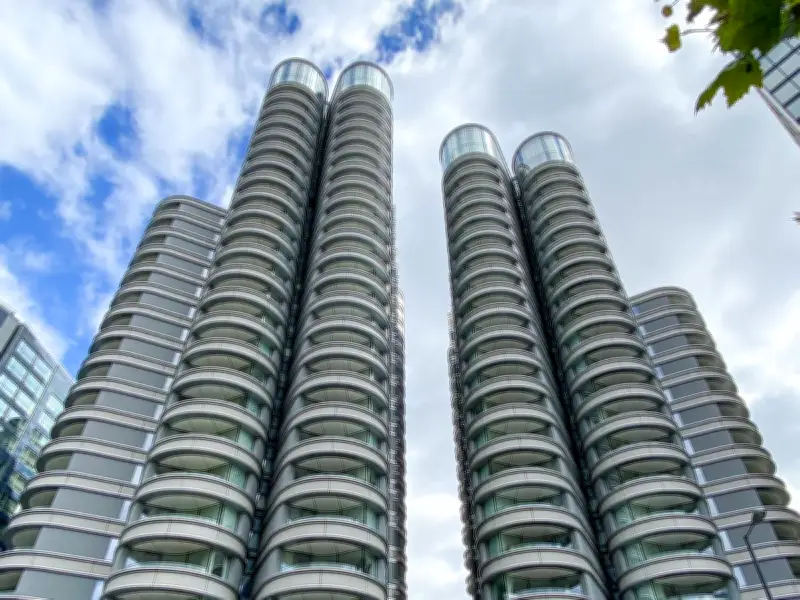
An architecture firm has been accused of ignoring 'foreseeable risks' after a man was struck and killed instantly by a falling window pane, a court heard. Mick Ferris, 53, was crushed when a window fell 26 storeys from the penthouse of The Corniche, a tower block on London's Albert Embankment, on October 2, 2018. Mr Ferris, a driver for Clarkes Of London, had been returning to his coach when the glass fell at 10.40am.
Previous incident ignored
At Inner London Crown Court on Tuesday, July 7, jurors were told that a window panel had already fallen from the same development a year earlier in August 2017, but the building's design had not been changed as a result. Prosecuting, Gordon Menzies said: 'It's reasonably practicable for clever people to do a simple thing and design a window that doesn't fall out once every year.'
Architecture firm Foster + Partners, who also designed The Gherkin, were behind the first designs for The Corniche development, and are on trial charged with failing to discharge a duty under section 3(1) of the Health and Safety at Work Act 1974. Three other companies, Lindner Prater Ltd, Wintech Ltd and St James Group Ltd, who were also involved in the development, are facing the same charge.

Design flaw with outward-opening windows
Prosecuting, Gordon Menzies said: 'Originally these windows had been designed to open inwards, an approach that the pros say is safe and simple – however the design was changed from inward opening to outward opening. The prosecution's case is that the final design of these windows was not safe, and because of the design there was a serious risk that a gust of wind could prise them off their hinges.'
The design meant that the outward facing windows were held in place by a single metal 'restrictor' attached to the window, the court heard. Mr Menzies continued: 'It had no effective failsafe, no reliable back-up, there were many things that could go wrong with the restrictors and if they did, consequences could be catastrophic.'
Missed opportunities
Jurors were told 'miraculously no-one was killed or injured' when the first window panel fell from the building on August 18, 2017, yet the developers failed to use the incident as a reason to 'go back to the drawing board'. Jurors were shown an email sent to Fosters in the wake of the first incident noting 'concerns raised' about another window falling in the future. 'It's reasonably practical for someone in Fosters' position when someone is querying your design to actually go back and look at it properly,' said Mr Menzies.
He added that construction workers were told 'not to open the windows at all', and small written warnings were put up next to the windows for residents. The prosecution took jurors through eight 'missed opportunities' where the developers could have considered the risk of the outward facing windows. 'Effectively the designers were hoping the residents would not forget to close their windows,' said Mr Menzies.
Fatal consequences
It was not until after Mr Ferris' death that the design was revised, with inward opening windows being used instead. The window pane, which weighed 130kg and was roughly 85cm wide and 190cm tall, fell around 300ft and killed Mr Ferris on impact. Mr Menzies observed that Fosters + Partners and St James Group Ltd are likely to disagree about who made the decision to have outward facing windows at all. Prosecutors added that glass covered buildings are 'something of a speciality' for Fosters + Partners.
St James Group Ltd took up the role of 'principle designer' in 2015, which meant they had a 'duty to co-ordinate matters in relation to health and safety', the court heard. The Corniche is listed as an 'exclusive riverside address' made up of 252 two, three, and four-bedroom apartments which overlook a number of London landmarks. The trial continues.