

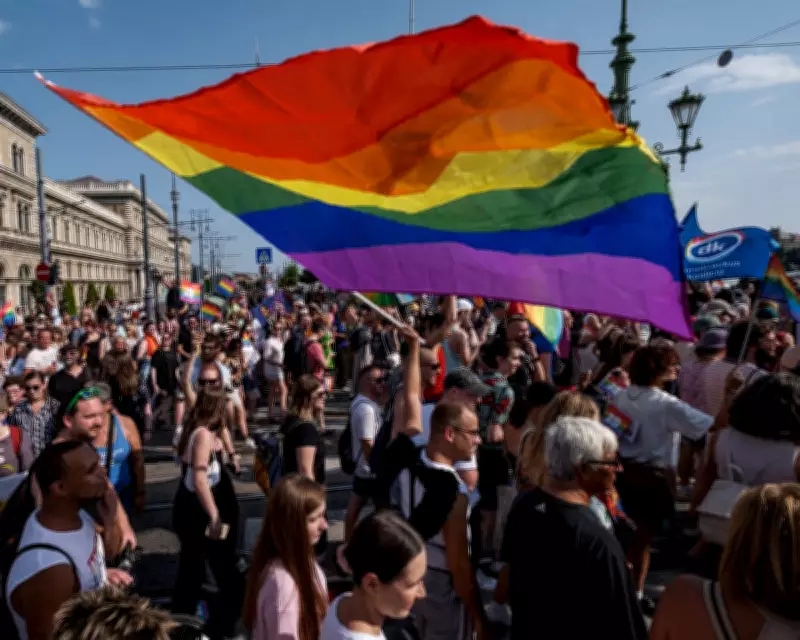
EU's Top Court Condemns Hungary's Anti-LGBTQ+ Law as Discriminatory
The European Court of Justice (ECJ), the highest court in the European Union, has delivered a landmark ruling that Hungary's anti-LGBTQ+ law, passed in 2021, is discriminatory, stigmatising, and in breach of fundamental democratic values. This decision sets up an immediate challenge for the incoming Hungarian government led by Péter Magyar, who is set to take power next month after a landslide election victory.
Wide-Ranging Judgment Against Hungarian Legislation
In a comprehensive judgment, the ECJ stated that the 2021 law, which bans content about LGBTQ+ people from schools and primetime television, conflicts with a society based on pluralism and core rights such as the prohibition of discrimination and freedom of expression. The court emphasised that the law is "contrary to the very identity of the union as a common legal order in a society in which pluralism prevails." It rejected Hungary's argument that national identity could justify such a breach of fundamental values.
This ruling marks the first instance where the ECJ has found a member state guilty of violating EU law solely based on breaching the bloc's fundamental values outlined in Article 2 of its treaty. These values include respect for human dignity, democracy, equality, the rule of law, and the protection of minority rights.

Implications for Incoming Prime Minister Péter Magyar
Péter Magyar, who won the election by promising to combat corruption and improve living standards, has been notably silent on whether he will reverse the anti-LGBTQ+ policies implemented by former Prime Minister Viktor Orbán during his 16-year tenure. Magyar has pledged to "bring home" EU funds that were partially frozen due to this law, with additional suspensions related to concerns over academic freedom, asylum rights, corruption, and judicial independence.
The ECJ has ordered Hungary to comply with the ruling without delay and to cover the costs incurred by both Hungary and the European Commission, which initiated the case. This judgment paves the way for future legal actions against EU member states that systematically undermine democratic and rule-of-law principles.
Details of the 2021 Child Protection Law
Hungary's so-called child protection law, enacted in 2021, imposes strict restrictions on schools and media companies regarding the depiction of LGBTQ+ individuals. Often compared to Russia's "gay propaganda" law, it prohibits gay and transgender themes in educational materials and bans such content from television shows, films, or advertisements aired before 10pm.
The court criticised the law for stigmatising and marginalising non-cisgender persons by associating them with individuals convicted of paedophilia, an association that "encourages hateful conduct towards them." It found that Hungary breached the right to human dignity by treating LGBTQ+ people as societal threats and enacting "manifest and particularly serious" discriminatory measures. Additionally, the law was deemed to violate freedom of expression for children, the general public, and service providers involved in advertising or awareness campaigns.
Reactions from European Officials and Advocacy Groups
Tineke Strik, a Dutch Green MEP overseeing the European Parliament's work on the rule of law in Hungary, stated that the incoming government must prioritise "the full restoration of the rights of this community" to make its reforms credible. Eszter Polgári of the Háttér Society in Hungary hailed the judgment as "a milestone for protecting human rights in the European Union" and "a historic victory for LGBTQI people in Hungary."
Katrin Hugendubel, deputy director of ILGA Europe, urged Péter Magyar to repeal the legislation, including the Pride ban, as a top priority in his first 100 days in office to demonstrate a pro-EU stance. An unusually large coalition of 16 EU member states, including Austria, France, Germany, and Spain, along with the European Parliament, supported the commission's case against Hungary, reflecting widespread concern over the law's impact.

The court also found Hungary in breach of EU data protection laws by expanding access to criminal records for offences against the sexual morality of children. This ruling underscores the broader implications for human rights and legal standards within the European Union.





