Peru's Interim President Faces Mounting Pressure Over Undisclosed Chinese Encounters
Peru's interim president, José Jerí, has found himself at the centre of a burgeoning political storm following revelations of secretive meetings with Chinese businessmen in Lima. The controversy, which has been dubbed "Chifagate" by local media, has prompted opposition lawmakers to announce their intention to seek impeachment proceedings against the embattled leader.
Congressional Appearance and Denials
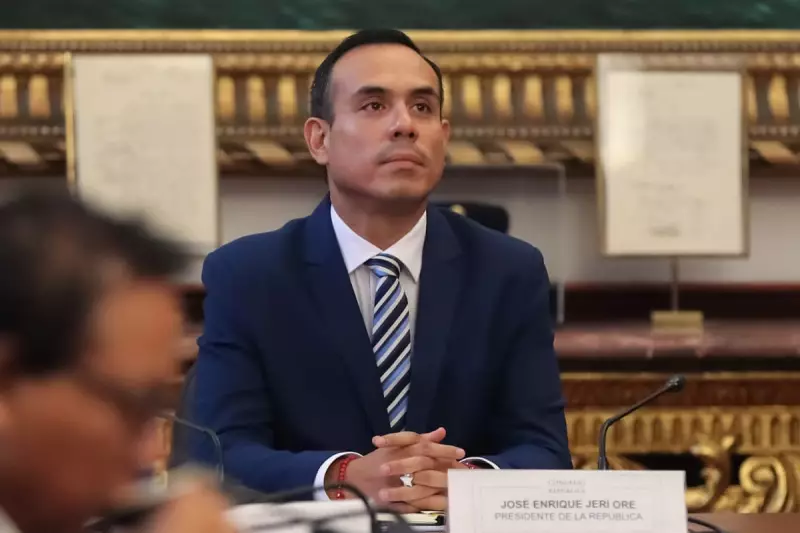
Jerí appeared before the congressional oversight and accountability committee in Lima on 21 January 2026, where he vehemently denied any wrongdoing. The 39-year-old interim president, who assumed office in October after his predecessor Dina Boluarte was forced out, claimed he was the victim of a deliberate smear campaign designed to destabilise the nation ahead of crucial elections scheduled for April.
"It could be understood to be a trap," Jerí told lawmakers, referring to the two meetings that occurred outside official office hours and were not publicly disclosed as part of his presidential agenda. He insisted that he would not resign from his position, stating firmly: "I will not resign, because that would imply that I had done something wrong, which is not the case."

The "Chifagate" Meetings
The scandal erupted following the emergence of video footage showing Jerí meeting with well-connected Chinese businessman Yang Zhihua, whom the president refers to as "Johnny." The recordings depict:
- A meeting at a Chinese restaurant (or chifa) where Jerí appeared wearing a hooded top pulled over his head
- A subsequent encounter at Yang's shuttered shop in Lima's Chinatown, where the president was seen wearing dark glasses and gesturing animatedly while making a telephone call
Yang Zhihua has resided in Peru for decades and has built a substantial business empire encompassing shops, restaurants, and a concession for a hydroelectric project. Official records indicate that he made several visits to the presidential palace in recent months, accompanied by another Chinese citizen, Ji Wu Xiaodong.
Investigations and International Implications
Public prosecutors have launched a formal investigation into the meetings, particularly focusing on Ji Wu Xiaodong, who is accused of belonging to an illegal timber-trafficking network known as Los Hostiles de la Amazonia. Ji Wu had previously been placed under house arrest for two years and had worked as an accredited Spanish translator with Lima's Chinese embassy.
In a national television interview, Jerí claimed that Ji Wu had merely served food at the restaurant meeting and that they did not converse due to language barriers. The president had previously issued a public apology after the first video emerged, explaining that the restaurant visit was intended to coordinate celebrations for Peruvian-Chinese Friendship Day. He expressed regret for "giving rise to suspicions and doubts about my behaviour" through his unconventional attire.
Broader Geopolitical Context
The scandal unfolds against a backdrop of intensifying competition between the United States and China for influence across Latin America. China has become the main trading partner for most countries in the region, including Peru, and represents a significant source of foreign direct investment.
Recent developments highlight this geopolitical tension:
- Chinese firm Cosco Shipping Ports has operated a fully automated deepwater port in Chancay since November 2024, creating an express trade route to China
- The US State Department recently approved the potential sale of $1.5 billion in equipment and services to help Peru relocate its main naval base in Callao, in what appears to be a direct challenge to China's growing regional influence
Political Instability and Public Opinion
Peru's political landscape has been characterised by chronic instability, with seven presidents occupying the office since 2018 through a revolving door of dismissals and resignations. Despite the current scandal, Jerí maintains significantly higher popularity than his predecessor, with recent polls indicating approval ratings around 44%, compared to Boluarte's single-digit figures.

The controversy raises serious questions about transparency and accountability in Peruvian politics while highlighting the complex geopolitical dynamics shaping Latin America's relationships with global superpowers. As investigations continue and impeachment motions are prepared, the stability of Peru's interim government hangs in the balance during a crucial election year.