The Rise of Political 'Slopaganda': How AI Memes Became Official White House Communication
In an unprecedented development in political communication, the White House under Donald Trump has fully embraced what academics term "slopaganda" - the strategic use of AI-generated imagery for political messaging. This represents a significant shift from traditional government communication methods to what experts describe as "institutional shitposting," where deliberately provocative content becomes official state communication.
From Fringe to Mainstream: The Evolution of Political Trolling
The phenomenon began with a fabricated Time magazine cover depicting Trump as a king, posted alongside an announcement about New York City's congestion pricing. This marked a crucial turning point where online trolling tactics, previously associated with far-right message boards like 4chan and Reddit, entered mainstream political discourse through official government channels.
According to Don Caldwell, editor of Know Your Meme, this represents "institutional shitposting" reaching the highest levels of government. "The Trump administration has not only permitted the AI industry extensive regulatory freedom but has actively adopted these technologies for internal purposes," Caldwell explains. The administration's approach demonstrates remarkable agility in capitalising on emerging online trends, often posting responses to viral memes within days of their emergence.

Ten Significant Examples of White House AI Propaganda
1. The Royal Treatment: The initial AI image set the tone for Trump's second term, featuring the president as a monarch on a fake Time cover. New York Governor Kathy Hochul famously displayed this image during a press conference, declaring: "New York hasn't laboured under a king in over 250 years. We sure as hell are not going to start now."
2. Studio Ghibli Deportation Meme: In March 2025, the White House applied OpenAI's Studio Ghibli-style generator to an image of a woman being arrested by ICE agents. The administration demonstrated remarkable speed, posting their version just days after the meme trend began circulating on social media platforms.
3. Papal Pretensions: An image depicting Trump as Pope generated global headlines and significant controversy. Catholic groups expressed outrage, with the New York State Catholic Conference stating: "There is nothing clever or funny about this image, Mr President." Trump responded by claiming the media lacked humour while asserting that Catholics appreciated the joke.
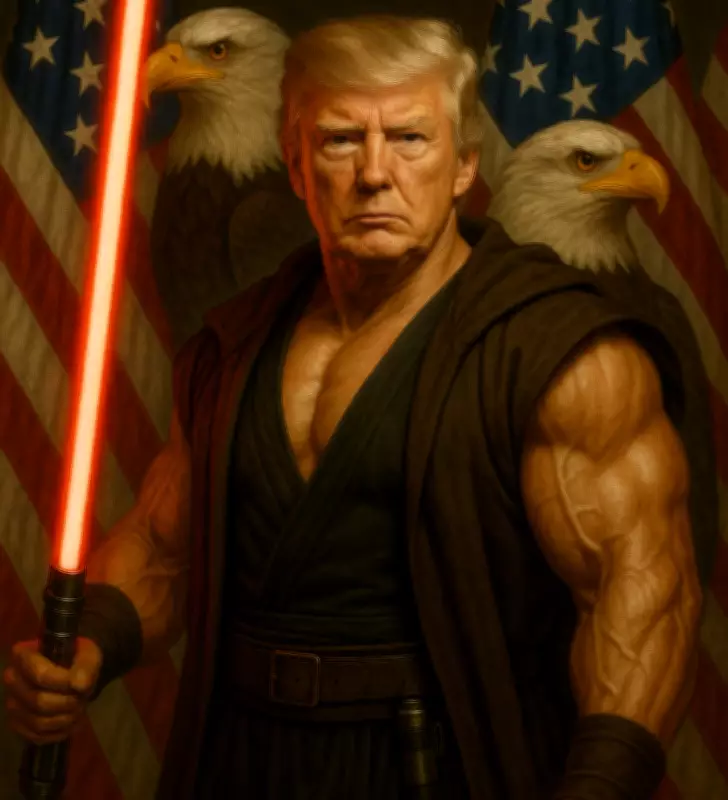
4. Jedi Fantasy: On Star Wars Day, the White House posted an image of Trump as a muscular Jedi knight, complete with lightsaber and patriotic symbols. Despite factual inaccuracies (Jedi typically wield blue lightsabers), the image represented pure political fantasy art designed to engage supporters.
5. Racial Caricatures: The administration posted images showing Democratic leaders Hakeem Jeffries and Chuck Schumer wearing sombreros and holding tacos. This followed an earlier deepfake video applying similar racial filters to Jeffries, which the congressman countered by posting a genuine photograph of Trump with Jeffrey Epstein.
6. Golden Age Propaganda: In January 2026, the White House released an AI video showing the presidential residence showered in gold coins with Bruno Mars' "24K Magic" as backing music. Research suggests such wishcasting remains effective even when audiences recognise its artificial nature, as neural representations of false information continue influencing beliefs after correction.
7. Extremist Undertones: A "Which way, Greenland man?" post referenced a 1978 neo-Nazi text, according to extremism monitoring groups. Heidi Beirich of the Global Project Against Hate and Extremism noted: "It's absolutely shocking to see such images being deployed by this administration."
8. Nostalgic Recruitment: Daniel de Zeeuw, digital media professor at the University of Amsterdam, observes that "AI is very good at constantly reiterating images from the past," allowing extremist messages to be inserted into familiar graphic styles like patriotic posters or 1950s public information campaigns.

9. Deepfake Manipulation: The White House altered an image of civil rights lawyer Nekima Levy Armstrong to show her crying during arrest, despite her actual composure. This marked a shift from obviously artificial content to more deceptive deepfakery. White House deputy communications director Kaelan Dorr responded: "Enforcement of the law will continue. The memes will continue."
10. Nihilistic Messaging: An image of Trump walking with a penguin toward a Greenland flag riffed on viral "nihilist penguin" memes. Robert Topinka of Birkbeck University explains that such posts function as "emotional hooks" rather than legitimate arguments, designed primarily to energise political bases.
The Psychological Impact and Ethical Concerns
Academic research into slopaganda reveals concerning psychological effects. According to studies by Michał Klincewicz, Mark Alfano and Amir Ebrahimi Fard, "neural representations of information that were shown to be false continue to influence people's beliefs and reasoning after being corrected." This persistence effect makes AI-generated political content particularly potent, even when audiences recognise its artificial nature.
De Zeeuw suggests the sometimes unconvincing nature of these deepfakes serves a purpose: "What is being communicated here is the falsification itself: you're showing your ability to falsify images, to falsify evidence." This demonstration of power becomes part of the message, reinforcing the administration's control over narrative construction.
A New Era in Political Communication
The Trump administration's embrace of AI-generated content represents a fundamental transformation in how governments communicate with citizens. White House staffers have reportedly stated they use AI because it's "the fastest way to get content out" - not necessarily the fastest way to convey truth, but certainly the most efficient method for propagating their political messaging.
This approach aligns with what Naomi Klein and Astra Taylor term "end times fascism," where technological capabilities merge with political messaging in ways that challenge traditional notions of truth and evidence in public discourse. As these practices become normalised within government communication, they raise significant questions about the future of political discourse, media literacy, and democratic accountability in the digital age.